



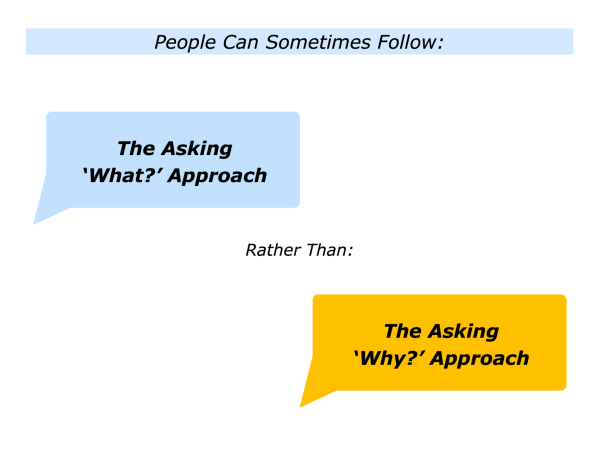
This is a slightly controversial view. The reason I have written it is because I have seen the negative effects of people asking critical ‘Why?’ questions.
Certainly it is sometimes possible ‘Why?’ questions in a caring way. When in doubt, however, it can often be more encouraging to use ‘What?’ rather than ‘Why?’
The following sections describe how this approach can be used in different situations. When done properly, this can be more likely to help people to achieve their picture of success. Let’s explore this approach.
Be careful when
asking ‘Why?’ questions
During my early career I met many fine therapists who helped people to manage challenges. One of these gave the following reasons for being careful when asking ‘Why?’ questions.
“Imagine that you are helping a person who may be behaving in a self-defeating way. There are several reasons why it is important to be careful when asking ‘Why?’ questions.
“First, some people may have bad experiences of being asked critical ‘Why?’ questions. For example, being asked: ‘Why do you do that?’ They may feel attacked and asked to justify their behaviour.
“Second, sometimes it difficult for a person to explain why they behave in a certain way. They may have had poor models in the childhood, be repeating failed patterns or not have the skills to behave in another way.
“Even if a client discovers ‘Why’ they behave in a certain way, they must then still move towards changing their behaviour. So you may want to consider another approach.
“People are more likely to open up if you create an encouraging environment and then ask certain kinds of ‘What?’ questions.”
The therapist’s views highlighted why people clammed up when asked a ‘Why?’ question. Much depends, of course, on how the question is asked. Sometimes it can come across as caring, but other times it is interpreted as critical. One person said:
“When people keep asking ‘Why?’ it is as if an electrical charge goes across my brain.”
Certainly a person may benefit from understanding the reasons for their action. But there are other methods for helping them to gain such insights and develop better ways of achieving their goals. Let’s explore some of these approaches.
Asking ‘What?’ questions to
help a person to succeed
Imagine you are a counsellor, therapist or coach. A person may ask for your support in helping them to tackle challenges and achieve their personal or professional goals.
Such a person may have both successful and self-defeating patterns. One approach is to focus on why they behave in certain way, but there are other ways to help them to achieve their picture of success.
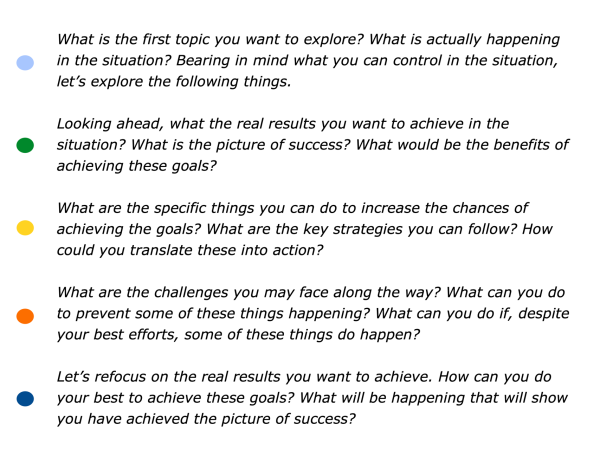
Another approach is to start by creating an encouraging environment in which a person feels able to explore. Looking at the first topic they want to explore, it is then to ask some of the following questions.
Coaches who use ‘What?’
rather than ‘Why?’
Good coaches in sport follow certain rules when helping an athlete to look back on their performance. Such coaches often take the following approach.
First, they ask the athlete to be the first to evaluate their performance.
Second, they use ‘What?’ questions rather than ‘Why?’ questions.
Several years ago I saw this illustrated when a television crew were filming a promising young woman athlete. She had an encouraging coach, but extremely critical parents.
The athlete was used to winning. In one of the races the crew filmed, however, she finished in second place. The cameras caught her parents being angry. They shouted things like:
“Why did she do that? Why didn’t she win? Why did she do X rather than Y?”
The coach moved between the parents and the athlete. Creating a sense of calm, he led the athlete to a place where she could recover and regain her composure.
The coach then asked the athlete to, when appropriate, do the following exercise. This invited her to take time reflect and also focus on the future. They would then spend some time exploring what she had written.
Looking at the race – including the way she prepared and then ran the race – he asked her to describe the following things.
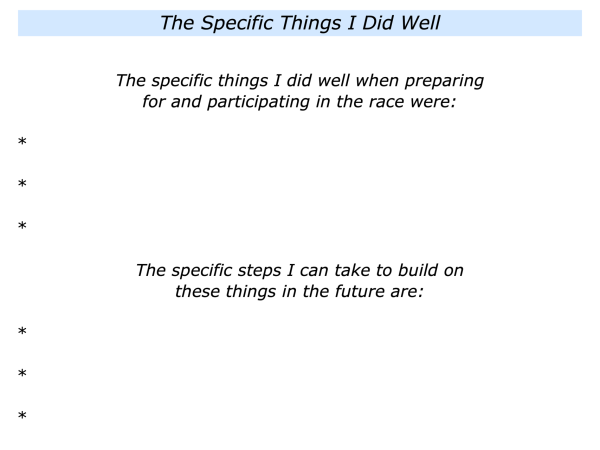
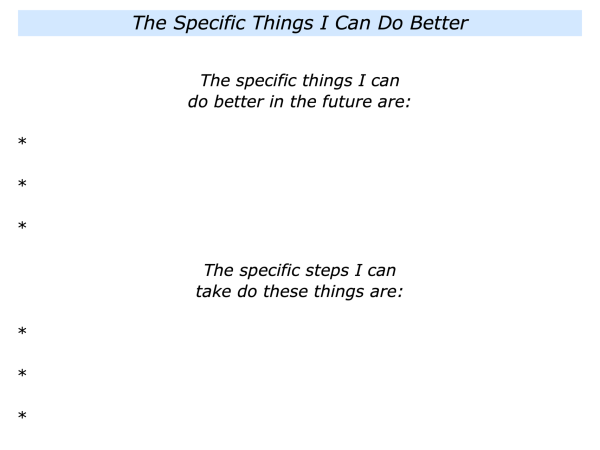
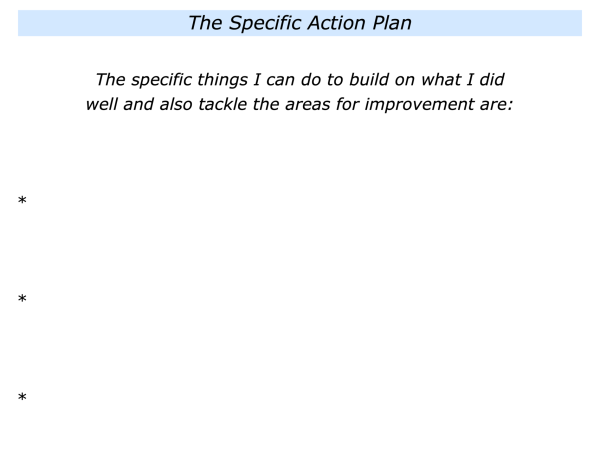
The coach helped the athlete to develop the habit of continuous improvement. He did this in an encouraging way by inviting her to explore and formulate her own answers.
During the follow-up session he also, when appropriate, shared his suggestions. The athlete built on her own ideas – plus took his advice on board – and continued to improve her performance.
Inviting a person to consider positive alternatives
about ‘What’ they can do in the future
rather than asking them: ‘Why do you do that?’
During the 1970s I spent several years working with family therapy. One pattern that emerged was that members of healthy families were often fair fighters.
Healthy parents encouraged their children. They also gave them clear messages rather than confused messages or conflicting messages.
Everybody knew the ‘family rules’ which were geared to helping people to grow. When the parents had to draw a line with their children, however, they frequently gave the youngsters a positive alternative.
Certainly they expressed their feelings, but they also explained ‘What’ they would like the children to do in the future. The children therefore knew the specific behaviour that would – and would not – be rewarded.
Troubled families often indulged in dirty fighting. The parents fell into arguments and criticised other family members, demanding: “Why do you do that?” Everybody felt blamed and there was no place to go.
Fair Fighters And Dirty Fighters
Fair fighters offer people a positive way forward. They take responsibility for their own behaviour and focus on how they can behave in a positive way in the future.
When encountering conflicts, they aim to clarify what each person wants and aim to find creative solutions. They then use ‘What? And ‘How?’ questions, such as:
“What does each person want? What are the things that people have in common? How can we build on these things? How can we, as far as possible, find a win-win solution?”
Looking to the future and
offering positive alternatives
Let’s look at a more challenging situation. Imagine that somebody wants to encourage a person to consider behaving in another way in the future. This could be in their personal or professional life.
Before saying anything to the person they may take time to prepare properly. They may do this by exploring the following themes.
What is the other person doing? Looking ahead, would I like them to behave in another way in the future? If so, how would I like them to behave? What would be the positive benefits for them or myself?
Looking ahead, do I actually want to suggest a positive alternative to the person? Bearing in mind the potential pluses and minuses involved, is it something I want to do? If so, when would be the appropriate time?
What are the key messages I want to give to the person? How could I give these messages in a positive way that the person is more likely to consider or accept?
How might the person respond – in a positive or not so positive way – if I give these messages? Depending on their response, what do I want to do? How can I continue to remain positive and keep focusing on the future?
Different people are comfortable with using different phrases when taking this approach. One person may offer a positive alternative to somebody by saying something along the following lines:
“In the future, I wonder if it would be possible for you to …”
What happens if the other person says they are not interested or replies in a negative way? Then it may be best to leave it rather than get into an argument. But at least a positive alternative has been offered.
Asking ‘What?’ to clarify your reasons
for wanting to achieve a specific goal
Many people are told that they need to clarify their ‘Why?’ before embarking on working towards achieve a specific goal. This sounds reasonable, but some people may find it hard to give an exact answer to this question.
Different people may have different answers swirling around their heads. For example,
Do they want to achieve a
specific goal because either:
They want to be financially independent? They want to help other people to succeed? They want to be famous? They want to prove other people wrong? They want to build a better world? They want to do it for another reason?
Sometimes it can be easier to answer the challenging ‘Why?’ question in another way. It can be useful to focus on the benefits of aiming to achieve a certain goal. Bearing this in mind, one approach is to ask themselves the following questions.
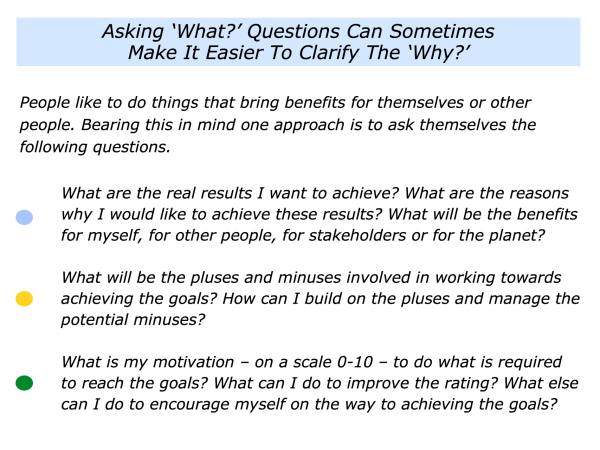
There are many ways to help people. This piece has explored how it can sometimes be useful to ask ‘What?’ questions rather than ‘’Why?’ questions.
As mentioned earlier, this may be a slightly controversial view. It is one that I have seen work in certain situations, however, to help people to achieve their picture of success.
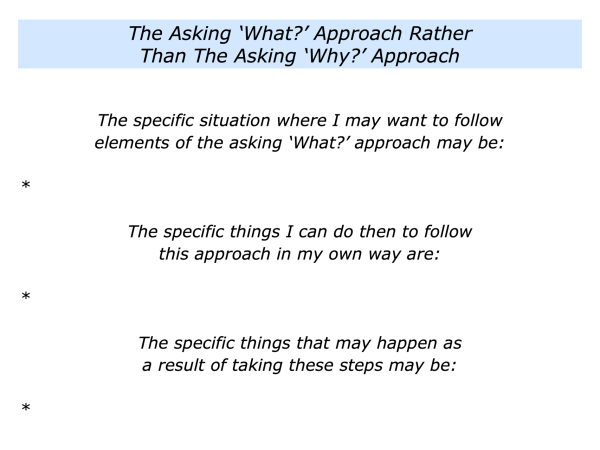
Let’s return to your own life and work. Looking ahead, can you think of a situation where you may want to follow elements of this approach? This could be in your personal or professional life.
If you wish, try tackling the exercise on this theme. This invites you to complete the following sentences.

Leave a Reply