



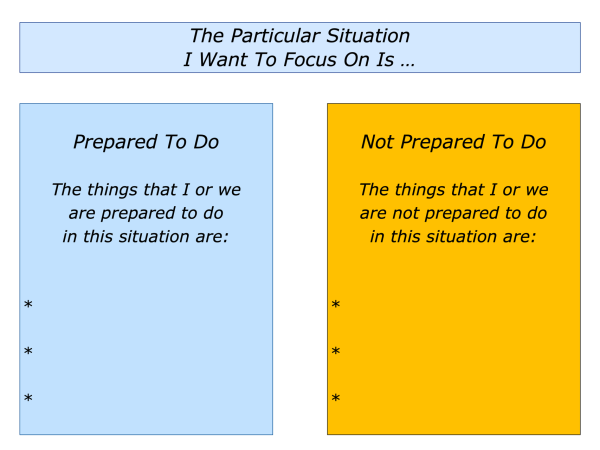
This is an approach that can be used by individuals, teams and organisations. It involves thinking through what you are prepared and are not prepared to do in a particular situation.
Taking this approach can help you to clarify the principles you want to follow in both personal and professional life. Bearing this in mind, it can be useful to look ahead to a potentially challenging situation and aim:
To clarify the possible options you can follow in the situation together with the pluses and minuses of each option;
To clarify the things that you are prepared to do and not prepared to do in the situation;
To clarify the things you want to do, translate these into an action plan and then follow this in the situation.
This approach involves focusing on your principles and making a contract with yourself before going into a situation. This makes it easier to be true to yourself and, when appropriate, make clear contracts with other people.
One key point is worth bearing in mind. Whatever route you follow may have both pluses and minuses. It is therefore important to clarify how you can build on the pluses and manage the consequences of any minuses.
Imagine that you want to follow elements of this approach. Let’s explore how this can be applied in personal and professional situations.
The Personal Situation
Some individuals choose to follow this approach in their personal lives. Let’s look at one example that arose in a mentoring session.
Person A – Helping
Their Son To Develop
One father described how they wanted to help their son who had ADHD and experienced difficulties at school. Their son loved learning but preferred to do this in their own way.
This led to them having outbursts when one teacher forced them to do things. We therefore focused on what the father did and did not want to do in the situation.
They did want:
To encourage their son … To help them to follow their interests … To help their son to set their own goals and work to achieve success … To help them to learn from people who had been through similar situations.
To, if possible, help to create a positive situation at school that could help their son … To, at the same time, help their son to learn how they could behave in a more constructive way in challenging situations.
They did not want:
To discourage their son from learning in their way … To go into the school and criticise the teacher … To get into a fight with the school authorities … To embarrass or make things more difficult for their son in the process.
The father followed this approach. Unfortunately the school found it difficult to understand or channel the strengths of children with ADHD. This led to a long and exhausting bureaucratic process.
He eventually moved his son into another school that took a more appropriate approach. Whilst this involved a longer commute, it resulted in his son channelling his energy into doing projects where he applied himself and achieved success.
Looking ahead, can you think of a personal situation where you may want to clarify what you are and are not prepared to do? Let’s consider one scenario.
You may, for example, have a relative who is involved in substance abuse. They may also sometimes contact you to complain about their circumstances or ask for financial help.
Whilst recognising their circumstances, you may only be prepared to talk with them if they are prepared: a) to take responsibility; b) to put themselves on a treatment programme; c) to not ask for financial help.
You may find any interaction with the person to be exhausting, however, and not worth the price. So you may decide not to have any conversations with them until they have shown that they are behaving in a responsible way.
Looking at the bigger picture, what is your philosophy about what you can and can’t do to help such a person? For example, you can provide an encouraging environment but you can’t motivate an unmotivated person. In some cases, you may even enable their irresponsible behaviour.
Imagine that you have such a challenging relative. What are the things you do and don’t want to do in this situation? How can you protect yourself and, for example, your family?
Looking ahead, there may come a time when the person chooses to take responsibility. You can then decide what you are and are not prepared to do in that situation. But what do you want to do right now?
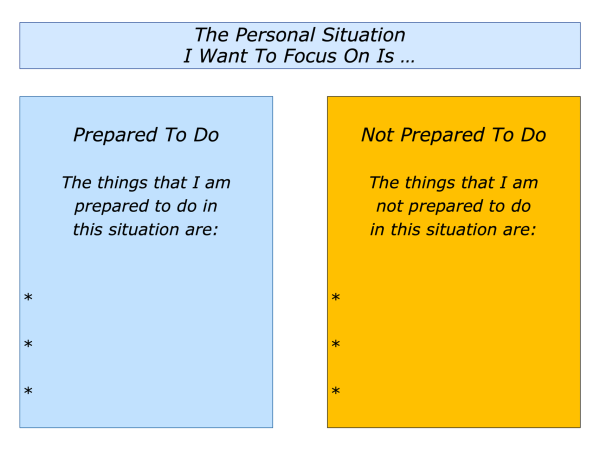
Let’s return to your own life. Can you think of a personal situation where you may want to follow elements of this approach? What may be the things you are prepared and not prepared to do in the situation?
What will be the pluses and minuses involved in following this approach? How can you build on the pluses and manage the consequences of any minuses? If you wish, try tackling the exercise on this theme. This invites you to complete the following sentences.
The Professional Situation
Some individuals and organisations need to make decisions in potentially challenging issues. The following example describes one such example where it was important to deal with a difficult situation.
A senior manager in a company explained the circumstances in the following way. This led us to exploring what the company was prepared to do and not to do in the situation. Here is a summary of what they said.
The Challenging Situation
One of the people who reports to me is returning to their role after a period of compassionate leave. This is challenging because of the following circumstances.
First
The person did not previously perform in the role and this led to them going through a performance improvement process. During those discussions the person said they had not been given the necessary support.
The company could maybe have done some things better. But the person refused to accept that they could also have taken more responsibility for improving the situation.
Second
The process was difficult and painful for everybody involved. It eventually resulted in the person being given another opportunity to deliver the outcomes required in the role.
Soon after that decision the person was granted a period of compassionate leave to take care of their partner who was undergoing treatment for cancer. Their partner was now on the road to recovery.
The person now wanted to return to their previous role but said they wanted to reduce the numbers of hours they do in a week. In the meantime, somebody has stepped up to do the role successfully.
Third
I am not sure what to do in the situation. If the person is not allowed to return to their previous role – and pay grade – they will probably complain and threaten to take legal action.
There is another issue. Some of the person’s peers and team members feel the person has been given preferential treatment and this has created problems.
I may also caught in the middle because the person previously complained I did not help them to reach their targets. This could be challenging both personally and professionally.
Finally, I want us to do what is best for the company and the colleagues, not just for the person who is returning. Whatever route it is taken, however, there will be some consequences.
The senior manager and I discussed the options. Bearing in mind the potential pluses and minuses, we focused on the following themes.
Step One – Clarifying what the company was
and was not prepared to do in this situation.
Rather than the senior manager tackling the situation on their own, the first step was to clarify the company’s position. They therefore met with their manager – a member of the C-Suite – and the HR Department.
They began by understanding the legal position. Bearing this in mind, they clarified what the company did and did not want to do in the situation.
The Company did want:
To be a company that employed motivated people who wanted to make a positive contribution towards achieving the goals … To be seen as a place where people were rewarded for taking this approach.
To clarify the possible options in this situation and the consequences of each option … To maybe offer the person another role in which, providing they behaved in a professional way, they could contribute to the company.
To try to find, as far as possible, a practical solution but also to maintain the company’s principles … To provide support for the person – within certain parameters – if the result was that they moved on from the company.
The Company did not want:
To offer the person their previous role in a way that would result in them not achieving their targets … To reward behaviour that was against the company’s principles.
To make a decision that would have negative consequences for the people who had stepped up whilst the person was away … To completely cut off the person without giving them the opportunity of practical support.
Bearing these things in mind, they then moved on to the next stage of the process.
Step Two – Clarifying the
possible options going forwards.
The C-suite member, senior manager and HR person decided to see the situation as an opportunity. They translated it into a chance to reorganise some of the roles in the team.
They focused on how to coordinate people’s strengths to achieve the team’s specific goals. This would produce positive opportunities for most people in the team.
Bearing this in mind, they considered the possible options regarding the person who was returning. These included the following.
Option A – The person could be offered something similar to their previous role. This would be for five days a week and also involve the person meeting certain professional standards.
Option B – The person could be offered a role that could be done in four days a week. This would also involve them committing to following certain professional standards.
Option C – The person could be offered a four days a week project-based role. The project must, however, benefit the company. This would also to some extent sideline the person so that their behaviour did not adversely affect other people.
Option D – The person could be offered a generous redundancy package and also, if they wished, various kinds of support.
Option E – The final resort for the company would be to go down the legal or mediation route. This could be necessary if the person did not take up any of the options and behaved in a way that created too many problems or distractions.
Looking at these options, there were pluses and minuses to each route. Bearing these in mind, it was time to move on to the next stage.
Step Three – Clarifying the chosen route
forwards and translating it into action.
The C-suite member, senior manager and HR person decided on their chosen way forwards. This would be to meet with the returning person and offer them Options A, B and C.
They would position these options, however, within the context of the company changing some roles in order to achieve the team’s goals. They then clarified the messages they would give to the person. These included the following:
Looking to the future, the company is changing some of the roles in the team in order to achieve the team’s goals.
The company is therefore able to offer you the following options. Option A is … Option B … Option C …
We would like you to take time to reflect and decide if you would like to take any of these roles. If so, we can then move on to the next steps.
The person might argue, talk about the past or threaten legal action. If so, the C-Suite member, senior manager and HR person would not get into arguments. They would simply repeat the following key messages.
Looking to the future, the company is changing some of the roles in order to help the team to achieve its goals …
The possible options we can offer you are these … Please take time to reflect and get back to us.
If for any reason you prefer not to pursue any of these options, then we could maybe look at the possibility of a good redundancy package. But take time and then get back to us.
The C-suite member, senior manager and HR person met with the returning person. They explained the company’s decision to change the roles in the team and offered the person Options A, B and C.
As partly expected, the person reacted negatively and talked about how they had been let down by the company. Their reaction was met by repeating the key messages about the possible roles.
Two weeks later the person responded by saying that: a) they had taken legal advice; b) they were prepared, however, to discuss the project-based role.
During the next few weeks there was much toing and froing. This proved tiring for the senior manager, who was the main point of contact, but they kept repeating the key messages.
The person continued to argue about the past but then began to explore more about the project-based role. They did balk, however, when they were asked to commit to following certain professional standards.
The person then began to express an interest in the possible redundancy package, which was something they eventually accepted. But they insisted on putting on record their complaints about the company.
The company aimed to behave reasonably throughout the process. They were clear, however, on what it was and was not prepared to do. This provided a guiding compass in the situation.
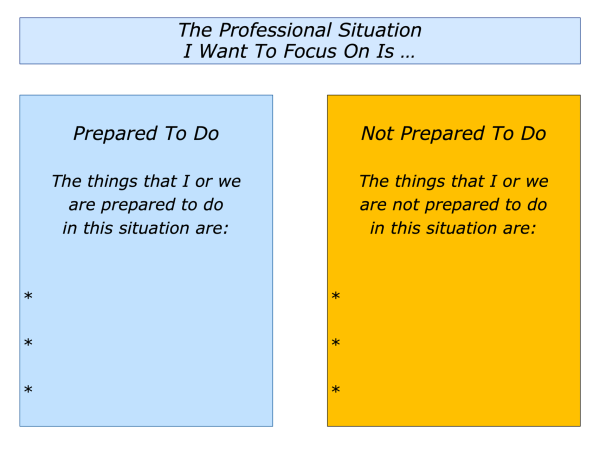
Let’s return to your own work. Can you think of a professional situation where you or your colleagues may want to follow elements of this approach? This could involve clarifying the principles you want to follow in a specific situation.
For example, when dealing with customers, working with colleagues or tackling another challenge. You can then aim to be true to yourself and do your best in the professional situation.
Here is the exercise on this theme. This invites you to complete the following sentences.
What happened next

Leave a Reply