



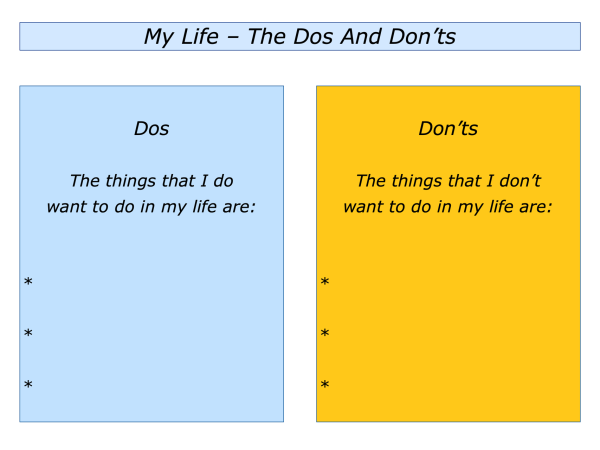
There are many ways to live life. One approach is to focus on the Dos and Don’ts you want to follow in your life and in particular situations. It is then to translate these into action.
Imagine that you want to follow elements of this approach in your own way. The following sections explore how it is possible to do this in your life and work.
My Life – The Dos And Don’ts
There are many ways for people to define their philosophy of life. Some people aim to follow a certain spiritual faith, a moral code or sense of vocation.
Some focus on what they believe is important in life. They then translate these into aiming to achieve certain life goals. Some focus on the positive things they want to give people during their time on the planet.
Some people combine elements of these approaches into clarifying the principles they want to follow. They then translate these into the things they do and don’t want to do in their life.
Different people describe different things when exploring this them. Here are some of the things that people may mention.
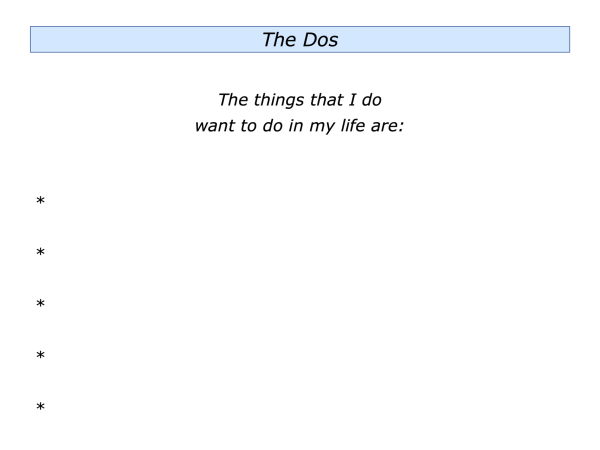
Dos – The things I do
want to do in my life are:
To follow my principles … To be positive … To focus on what I can control rather than what I can’t control … To encourage people … To be kind … To build a happy family.
To spend time with positive people … To make use of my talents … To create an inspiring school … To do my best … To pass on a positive legacy.
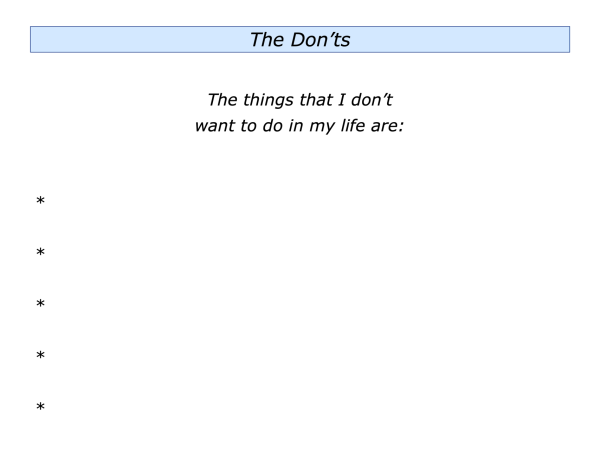
Don’ts – The things I don’t
want to do in my life are:
To fail to follow my principles … To be negative … To hurt people … To spend time with negative people … To fail to use of my talents … To have regrets.
Let’s return to your own situation. Imagine that you want to clarify some of the Dos and Don’ts you want to follow in your life. The next step would be to try to translate these into action each day.
If you wish, try tackling the exercise on this theme. This invites you to complete the following sentences.
The Particular Situation
– The Dos And Don’ts
Imagine that you face a challenging situation where you want to follow elements of the Dos and Don’t approach. This could be in your personal or professional life. Let’s look at some potential situations.
You may aim to clarify what you
want to do in the following situations
To, as a team leader, deal with a situation where one person is behaving in an unprofessional way;
To, as a parent, encourage your child who is dyslexic to build on their strengths rather than try to fit into a rigid school system;
To manage a situation where an alcoholic relative may behave in a way that affects your family;
To, with their agreement, do your best to support a person who is going through treatment for cancer;
To do positive things in your life rather than be addicted to doom scrolling about negative things happening in the world.
Let’s explore one of these examples. Imagine that you lead a team were most of the people are positive and professional. There is one person, however, who behaves in an unprofessional way.
Whilst being talented, they focus only on their own agenda. They are late for internal meetings, criticise people and appear to be addicted to conflicts. They aim to make sure that they win and other people lose.
Imagine the situation has got to a point where you need to act. Bearing in mind your goals for the team, here are some of the things that you may want do and not do in the situation.
The Dos – The things I do want
to do in the situation are:
To build a positive and successful team that makes its best contribution to achieving the organisation’s goals;
To continue to support the people who are positive and behave in a professional way;
To keep showing what good looks like by producing success stories that highlight when people have followed the professional standards;
To invite the person to decide if they want to follow the required professional standards in the future;
To replace them with somebody else if they choose not to follow these professional standards.
The Don’ts – The things I don’t
want to do in the situation are:
To fail to protect the professional standards that we require the team members to follow;
To fail to protect the people the team who behave in a positive and professional way;
To prevaricate because it is important to act now and not allow the situation to continue;
To get into an argument with the person because it is up to them to choose whether they want to follow the required professional standards;
To simply take their word for it if they say they do want to follow the standards because they actually need to translate these into action.
There are many ways to live life. One approach is to clarify what you do and do not want to do in a particular situation. This involves making a contract with yourself about the principles you want to follow. It is then to translate these into action.
Let’s return to your own life. Can you think of a situation where you may want to follow elements of the Dos and Don’ts approach? This could be in your personal or professional life.
Looking ahead, what may be the specific situation? What may be the specific things that you do want to do in the situation? What may be the specific things you don’t want to do? How can you translate these into action?
If you wish, try tackling the exercise on this theme. This involves completing the following sentences.

Leave a Reply