


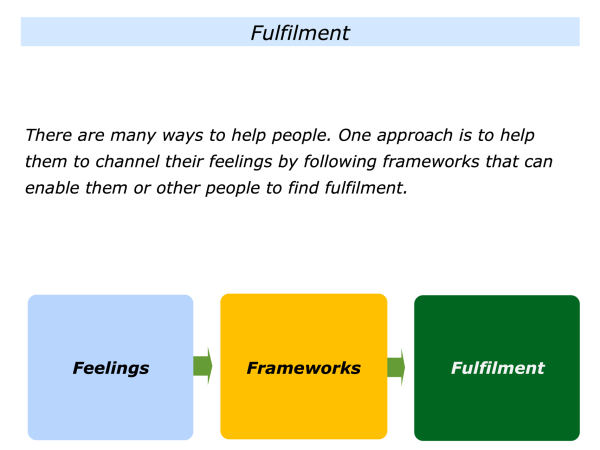
There are many ways to help people. One approach is help people to channel their feelings by following frameworks that can enable them or other people to find fulfilment.
Imagine that you work as a professional therapist, coach or mentor and somebody has asked for your help. If appropriate, one approach is to focus on the following themes.
Feelings
The first step will be to make the person feel welcome and the centre of your world. It will then be to clarify the topics they want to explore together with their goals.
Imagine that a person wants to focus on their feelings and how they can channel these in a positive way in the future. It can then sometimes be useful to go through the following steps. You can aim:
To create an environment where the person feels at ease and able to explore;
To, if appropriate, clarify what they feel at the moment and what they want to feel in the future;
To focus on how to enable them to increase the chances of them having the desired feeling and also achieving any specific goals.
Different professionals will cover these themes in different ways. One approach is for them to explore the following questions with the person.
“What are the main kinds of feelings you have in your life or work? What do you think may be the reasons why you may have some of these feelings?
“What are the kinds of feelings you want to have in the future? Bearing these in mind, are there also any particular goals you would like to achieve?”
Imagine that a person has described: a) how they feel quite a bit of the time; b) how they would like to feel in the future and maybe some of their goals. Different individuals will, of course, say different things. Here are some examples.
“I sometimes feel things get on top of me. I want to feel more in control in the future.”
“I sometimes feel quite down. Looking ahead, I would like to feel happier in the future.”
“I feel unsatisfied in my work. I would like to do more satisfying work in the future.”
There may be multiple reasons why, for example, a person feels down. It could be because of: a) the things they are doing; b) the things other people are doing; c) a combination of both.
There may be critical situations, of course, where it can be vital to immediately help the person to take more control. Imagine that you have been able to help them to take this step.
When appropriate, you may then be able to help the person to look ahead and focus on shaping their future. This can involve exploring the next theme.
Frameworks
People like to feel in control and make sense of situations. One approach is to provide them frameworks they can use to channel their feeling in a positive way.
There are several definitions for the word frameworks. Here is the one that we are using.
A Framework Is:
A set of guidelines that people can use to understand situations and follow to achieve their goals
This could be a set of ideas, rules or beliefs that people can use to make sense of experience. They can then follow this structure to find solutions to challenges or to achieve success.
Imagine that you are aware of frameworks that can work for people in various situations. When appropriate, it can then be important:
To clarify the person’s present situation together with the challenges they may face and their potential goals;
To clarify a framework the person may be able to use to work towards achieving their goals;
To clarify how to pass on this framework in a way the person can use to achieve their goals.
The kind of framework that you pass on will obviously depend on the person’s situation and their goals. When doing so, it is vital the practical ideas you share should be ones:
That have been shown to work for people;
That are relevant to the person’s situation;
That the person will able to use in their own way.
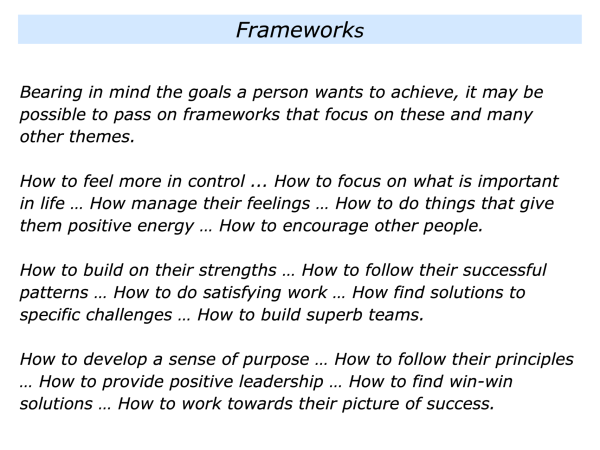
Bearing in mind what the person wants to achieve, it may be possible to pass on frameworks that focus on the following themes.
Fulfilment
Imagine that a person wants to focus how they can channel their feelings in a positive way. This may involve them working towards achieving a specific goal and, in the process, sometimes gaining a sense of fulfilment.
Much will depend on the kind of goal a person wants to achieve. They may want to feel more in control, adopt a healthy lifestyle or reach another personal goal. They may want to do satisfying work, lead a successful team or reach another professional goal.
Whatever a person’s aim, however, the first step is for them to focus on what they can control in the situation. They can then aim:
To set a specific goal;
To follow the strategies most likely to work;
To do their best to achieve the picture of success.
Imagine that you are helping a person to follow elements of this approach. You can help them to, as far as possible, set things up to succeed. If appropriate, you can then help them:
To rehearse following their chosen strategies;
To rehearse managing any challenges along the way;
To again rehearse following their chosen strategies.
Let’s assume that the person has prepared properly. They can then move into action, get an early win and follow their chosen strategies. It will also be important for them to keep reading reality.
The person can aim: a) to build on what is working; b) to tackle areas for improvement. They can then do their best to achieve the picture of success. Sometimes this can lead to a sense of fulfilment.
There are many ways to help a person. One approach is to help them to channel their feelings by following frameworks that can enable them to find fulfilment.
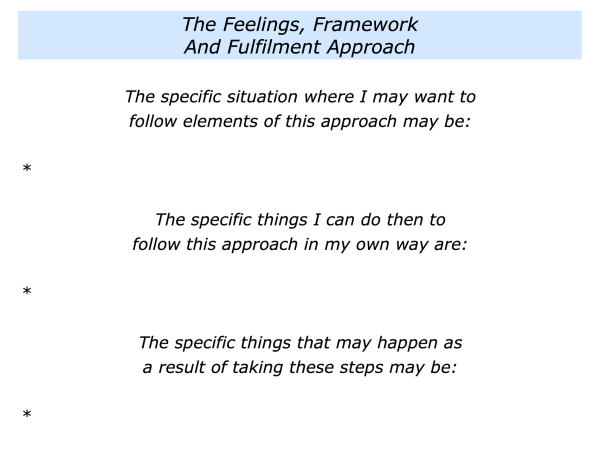
Let’s return to your own life and work. Looking ahead, can you think of a situation where you may want to follow elements of this approach? How can you do this in your own way?
If you wish, try tackling the exercise on this theme. This invites you to complete the following sentences.

Leave a Reply