



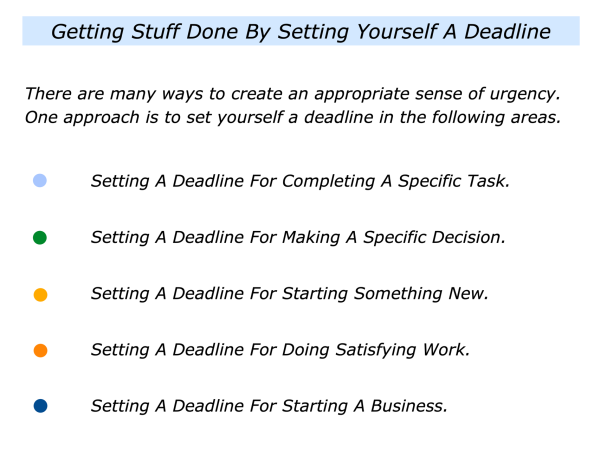
There are many ways to create an appropriate sense of urgency. One approach is for a person to get stuff done by setting themselves a deadline. They can take this approach in their personal or professional lives.
This approach sounds obvious, but it calls for a person being proactive and focusing on their priorities. Sometimes they may even choose to set themselves a pressing but reachable deadline for completing something by a certain date.
People who take this approach often start from their destination and work backwards. Starting from the end date, the describe the specific things that they want to have done by certain times.
Feeling a sense of urgency, they may then do something to start the journey and get an early success. They may then aim to maintain their momentum on the way to reaching their chosen destination.
Some people take another approach. They put off things, procrastinate and do not focus on their priorities. They fail to be decisive and sometimes drift.
Imagine that you want to follow elements of the setting deadlines approach. If you wish, you can then choose to act with appropriate urgency. Let’s explore some areas where it is possible to follow this approach.
Setting A Deadline For
Completing A Specific Task
Different people do this in different situations. Looking at my own life, for example, I used to do it when setting a deadline for completing the manuscript for a book.
Looking ahead, I sent an email to the publisher to let them know that the manuscript would be finished by a certain date. I deliberately set the date a month or so before they were expecting it. The email went along the following lines.
Dear …
Thank you for the opportunity to publish the book.
For information, I will send the completed manuscript to you by …
This will provide lots of time to add any suggestions or other ideas you want to make.
So I look forward to sending it to you by that date.
Different people can use the deadline setting technique in different ways when tackling different kinds of tasks. Taking this approach can encourage them to be proactive, get to work and feel ahead of the game.
Setting A Deadline For
Making A Specific Decision
Some decisions in life need to be taken straight away, but some can be taken in a more considered way. Sometimes it can be useful to take the following approach.
“There is a decision I need to make. But I need: a) to gather more information; b) to consider the possible options going forward; c) to take time to reflect.
“Bearing this in mind, I will set a date by which I want to make the decision. This will give me time to consider all the options and then act on the way forwards.”
Different people take this approach in different situations. Some do it in professional situations, some do it in personal situations. Taking the time to reflect – but also setting a deadline – can help them to make a more considered decision.
Setting A Deadline For
Starting Something New
This is an approach that is often used by people who want to do something new in their personal or professional lives. They may be aiming to adopt a healthier lifestyle, learn a new skill or develop in another way.
A person who takes this approach can set a deadline for doing something new but, at the same time, can build on their successful pattern for working to achieve certain goals. They may therefore take the following steps.
They can start by making a decision to commit themselves to working towards achieving a specific goal because they can see the benefits.
They can learn from their positive history and follow their successful pattern for working towards achieving a goal.
They can follow a structured plan, get early successes and follow their chosen habits one day at a time on the way towards achieving their goal.
One key part is underlining – the positive history part can be crucial. The person may be aiming to do something new, but they can learn from when they have succeeded in the past. This approach involves taking the following steps.
They can clarify when they have tackled a similar challenge or reached a similar goal successfully.
They can clarify what they did right then – the principles they followed and how they translated these into action – to do this successfully.
They can clarify how they can follow similar principles – plus maybe add other skills – to tackle the present situation successfully.
People are more likely to achieve certain goals when they can follow their successful style. They can then follow these successful principles approach – plus maybe add other skills – when aiming to do something new in their lives or work.
Setting A Deadline For
Doing Satisfying Work
This is an approach that can be used to help a person who wants to develop a more satisfying career. The key is to set a date by which they want to have one or more options for moving on from their present role.
Some people want to move from the present roles straight away. There may be times when this is necessary or possible. There may be other times, however, when it can be useful to explore another approach.
This involves picking a date in the future – such as in six months or another date – and doing the following exercise.
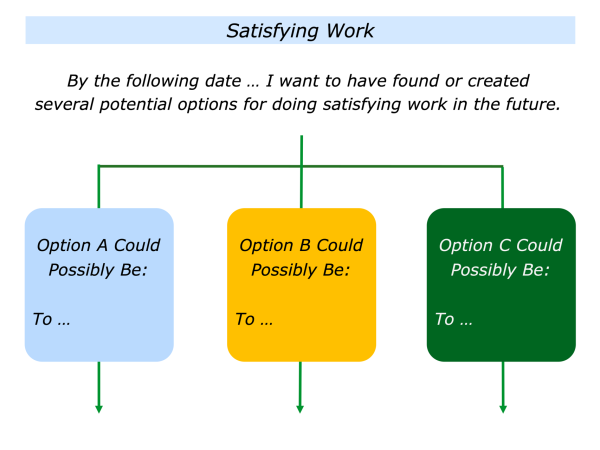
There are many ways to help a person to explore potential options. Bearing in mind the kinds of work they find satisfying, it is possible to help them to pursue the following routes.
Some people take the following approach. This involves them aiming: a) to, if appropriate, focus on their present work; b) to focus on developing several other possible options.
Imagine you are helping a person to follow this approach in their own way. Let’s explore how you can help them to translate this into action.
They Can, If Appropriate,
Focus On The Present Work
The first step can be to focus on their present work. On a scale 0-10, how satisfied are they in it at the moment? Could they try to make sure it is at least 7+/10. How can they maintain or improve the rating?
Imagine that the person is reasonably satisfied in their work. If appropriate, they then have a number of options. These can include the following.
They can continue to be super professional in their present role and, if appropriate, add more skills and qualifications to their repertoire.
They can expand the satisfying parts of the present role whilst also finding ways to make sure the other tasks get done.
They can explore how to combine these satisfying parts into creating a new role that contributes towards achieving the organisation’s goals.
Bue what if the satisfaction rating is less than 7/10? This can be a warning sign. There may be things the person can do to improve their satisfaction but it may also be important to focus on the next theme.
They Can Focus On Developing
Several Other Possible Options
Security is to have an alternative, we are told, and this is especially true in today’s world. The advent of new technologies can make some jobs obsolete whilst global events can lead to recessions. Takeovers can also come out of the blue and lead to redundancies.
Bearing this in mind, it can be important for a person to have several backup plans. There are various routes they can follow to explore this approach. Let’s start with the obvious ones.
Imagine that the person wants to explore the possibilities of finding a satisfying role with another employer. There are several potential ways forwards.
The person can look for suitable
roles and apply for them directly
This approach can sometimes work but many experienced people find it can be time-consuming and challenging. It can also sap their confidence. Bearing this in mind, let’s explore another option.
The person can aim to find a role by
focusing on their professional network
Many people get jobs through their network. This is because decision makers are more likely to hire people they know who can deliver certain results.
There are several ways that a person may be able to find a role through their network. These can involve either:
Them being hired by somebody they have worked with in the past;
Them being recommended by such a person to somebody in that person’s network.
There are several things to bear in mind when taking this route. Some of these sound counter intuitive but they can lay the ground for achieving success. The first one is this:
Real networking is about encouraging other people and helping them to succeed. It is not about self-promotion.
People who get work through their network have often spent a lot of time encouraging others. They do not suddenly send people an email asking for a job.
Bearing this in mind, the best time for a person to give to their network is when they have a job. They can then aim toencourage people by showing an interest in them and their aspirations.
One approach is for them to meet people face-to-face or keep in touch via Zoom. It can then be useful to do some research before the session. This involves them aiming:
To clarify what is happening in the other person’s world;
To clarify any challenges they face or goals they want to achieve;
To clarify how they can pass on knowledge or practical tools to help the other person to achieve success.
Different people follow this approach in different ways. Some meet face-to-face. Some send articles, materials or ideas that people may find interesting.
People who take this approach often find it rewarding to encourage others. Sometimes it can lead to conversations that produce future job possibilities. This can also overlap with the next step towards developing potential options.
The person can communicate what they
can deliver to help people, teams
or organisations to achieve success
Imagine that the person has got to a point where they aim to be more active in finding another role. It can be important for them to clarify what they can deliver to help others achieve success. They can aim:
To clarify their strengths;
To clarify the specific things they can deliver to help people, teams or organisations to achieve success;
To clarify how they can position what they offer in a way that could be attractive to potential employers.
The latter point is crucial. It is vital to focus on the potential employer’s agenda. Some individuals make their application about them. They often list their skills and experience. Whilst this may be relevant, the key is to describe what they can deliver to help the employer to achieve success.
Let’s explore how a person can follow this approach when communicating with people in their network. There are at least two kinds of emails that they can send to people
The Passing On What Works Email
The first type of email is where they do some research and focus on the person’s or organisation’s goals. If appropriate, they can then share positive models and practical tools they have seen work in these areas.
When doing this, it is important that: a) they have seen specific examples that work; b) they just want to share the ideas without asking for anything in return.
People buy success rather than the theory of success. So it can be useful to share what they have seen work. They may want, in their way, to write something along the following line.
Positive Results
Dear …
Hope that things are going well with your various ventures.
Looking at some of the things your organisation is focusing on, it seems that you are aiming to do superb work in the following areas:
*
*
*
I am sure that things are progressing well. If you are ever interested, however, I would be happy to share some of the positive models and practical tools that I have seen work in these areas.
You will, of course, have your own approach. But if you – or any of your colleagues are interested – I can pass on these ideas.
This would be done on an informal basis. People can then use these practical tools in their own ways to tackle challenges or reach the goals.
Let me know if you may ever be interested and then we can go from there.
The Professional Update Email
The second type of email is one where the person says that, whilst they may be happy in their present role, they are aiming to deliver certain things to an employer in the future
Below is an example of the kind of email that some people may send when exploring new possibilities. This is quite business-like in terms of describing what it is possible to deliver to a potential employer.
This gives one example of what a specific person would be able to deliver – such as leading superb teams. Each person will be able to deliver different things, however, to help an employer to achieve success. It is therefore important for a person to tailor this approach in their own way.
A Professional Update
Dear …
As you know, I have been working at … some time. This has been enjoyable and also rewarding to work with excellent people.
Looking ahead, however, there will come a point when I begin exploring possibilities for moving on. The aim will be to work with an organisation that wants to continue to deliver excellence in its chosen field.
Much depends on the organisation’s goals, of course, but here are some things that I could deliver for such an organisation. These include the following:
To build superb teams that coordinate their strengths and align their efforts to achieve the organisation’s goals;
To enable people to perform excellent work, focus on continuous improvement and help the organisation to build a great reputation;
To maintain a positive culture in which people take responsibility, have high morale and help the organisation to achieve ongoing success.
There are lots of practical examples I can give about how to achieve these results. But the key would be to focus on helping the organisation to achieve its specific goals.
Looking ahead, let me know if you think there may be any people in your network who may be interested in having these things delivered for their organisation.
I would then be happy to have an informal conversation with them about how it would be possible to deliver these results.
As mentioned earlier, many jobs come via a person’s network. When taking this approach, however, it is important to do so in a way that does not put pressure on people.
Let’s return to helping a person to developing backup plans. Imagine that: a) the person has actually got an interview for a specific role. This can involve focusing on the next step.
They can prepare properly for an
interview with a potential employer
There are many ways to prepare properly for an interview. Before doing so it is vital to do lots of research. This includes a person focusing on the specific role and exploring the following themes.
What are the organisation’s goals? Looking at the role, what will be the results I will be required to deliver towards achieving these goals? Bearing in mind my strengths, to what extent will I find the role satisfying?
What is the organisation’s culture? What may be the potential pluses and minuses of working in the culture? Who will be the stakeholders I need to satisfy? What is their style of leading, managing or working?
Looking at these things, do I want to go for the role? If so, what can I do to prepare properly for the interviews? How can I show that I want to make a positive contribution towards achieving the organisation’s goals?
Imagine that they want to go for the role. As mentioned earlier, there are many ways to prepare for an interview. The following section describes one approach.
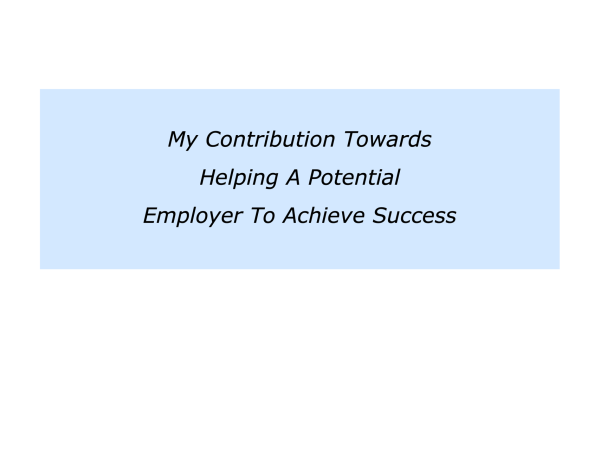
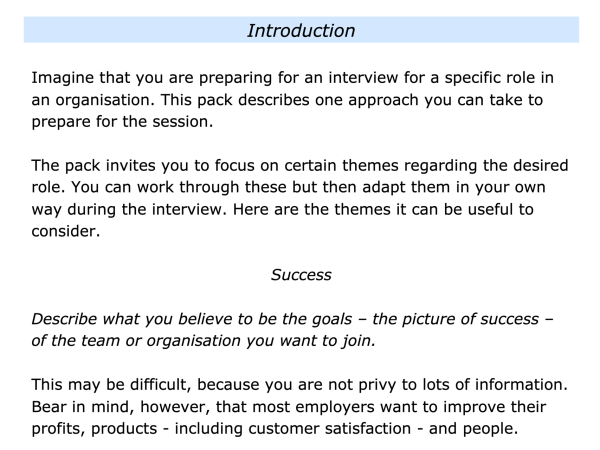
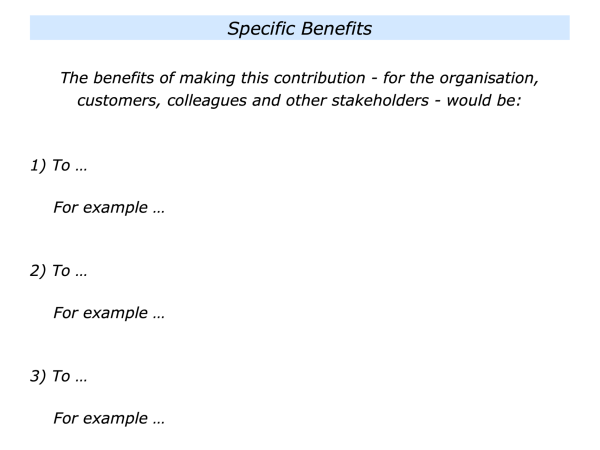
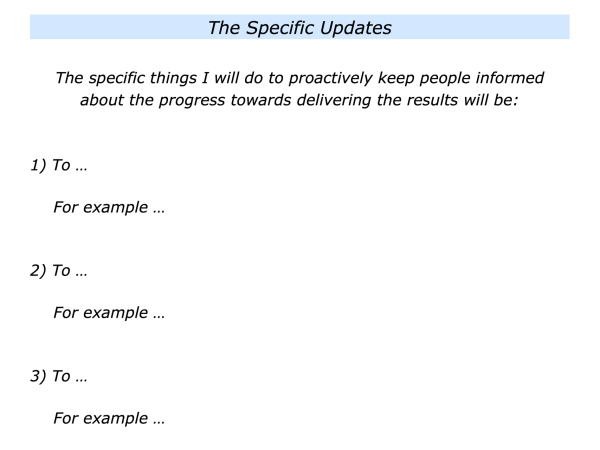
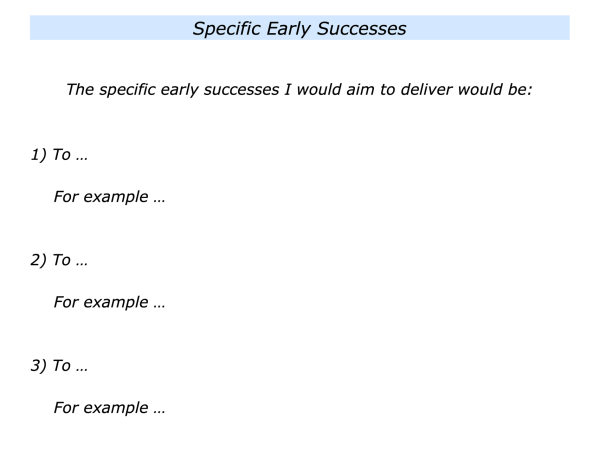
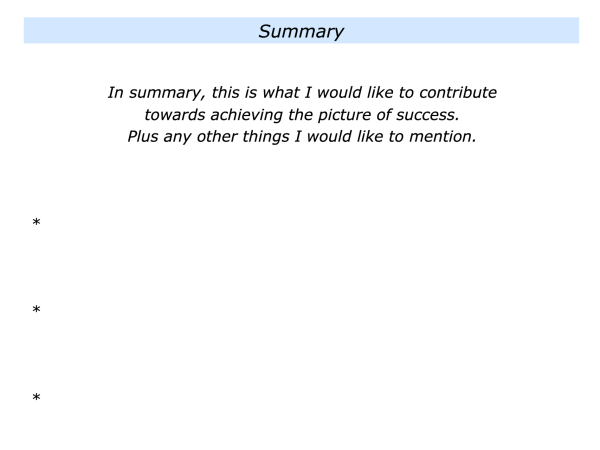
This involves working through a pack that invites them to clarify their contribution towards helping a potential employer to achieve success. The pack was created many years ago to help people who had been laid off when their company went into administration.
The key was to focus on how they wanted to help the potential employer to achieve success rather than to try to sell themselves. Many people found it useful and reported it gave them a head start when going for interviews. Each person will, however, adapt the pack in their own way.
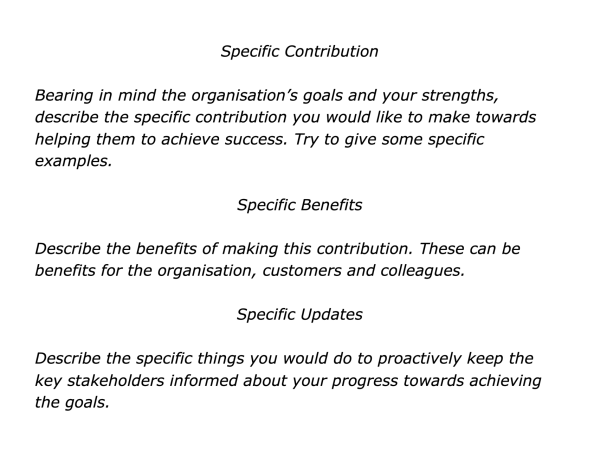
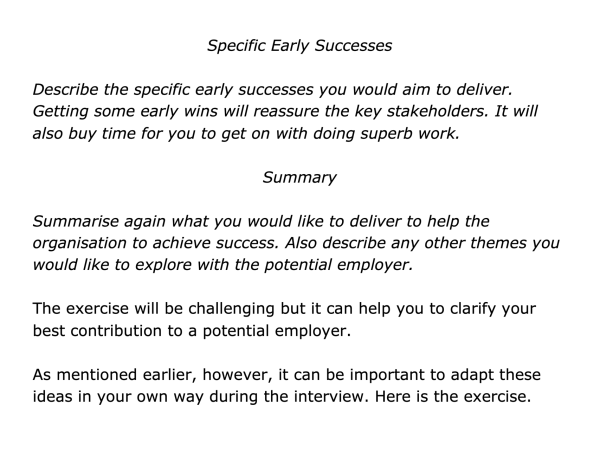
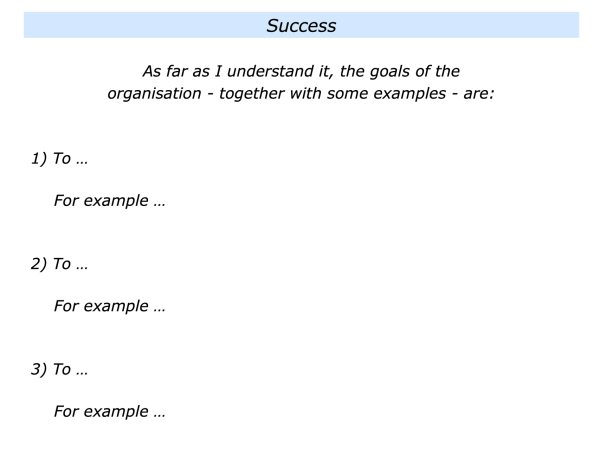
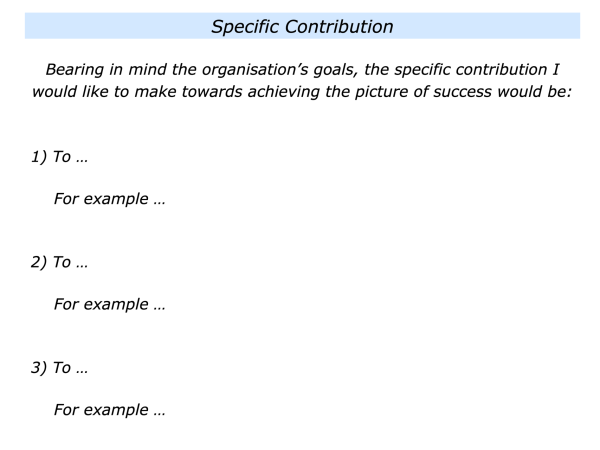
There are many ways for a person to move towards doing satisfying work. One approach is for them to set a deadline by which they want to have found or created several options.
Taking this approach can help them to be proactive and develop an appropriate sense of urgency. Let’s explore another options that some people may follow.
Setting A Deadline For
Starting A Business
There are many ways to start a business. The following section looks at three different approaches. Some of these include setting a deadline. If appropriate, you could help a person to explore and follow their chosen route.
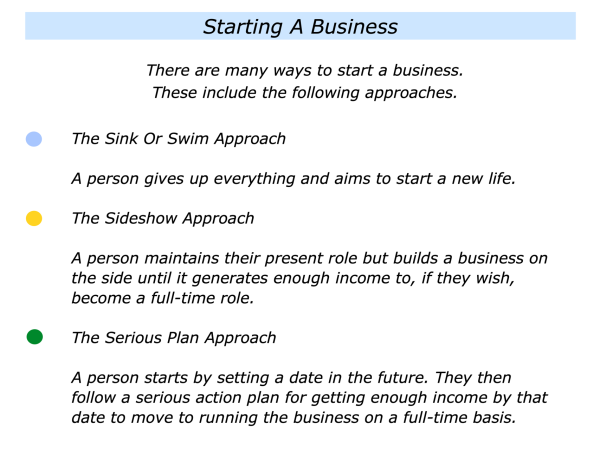
The Sink Or Swim Approach
A person may reach a point where they feel unhappy in their work and want to change everything immediately. They may say something like the following.
“I am totally fed-up with my present job. So I will hand-in my notice on Friday, give-up everything and start my own business. I will make it or bust.”
This sounds brave and it sometimes works. There may also be certain kinds of people who may pursue this route successfully. These include the following.
First, emigrants who leave their country and start again with few assets. They work hard from day one and are streetwise. Spurred on by needing to put food on the table, they find or invent creative ways to achieve success.
Second, entrepreneurs who start their business fired by anger. They may have got sacked or become frustrated when trying to get an idea through the bureaucracy of an organisation. They may say something like the following.
“I will show them. I will never be beholden to anybody again.”
There are some people for whom this approach is less likely to work. Those who are semi-institutionalised or think that if they have a good idea the money will roll-in.
The pluses of the sink or swim approach are that a person can start straight away. They are forced to use their creativity and feel great if they succeed. The minuses are that they may have little security, few customers and may use all their energy just to survive.
The Sideshow Approach
People who follow the sideshow approach often take a longer-term view and minimise the risk when starting a business. Looking ahead, they may say something along the following lines.
“I will keep my full-time job, but develop my own business on the side. I want to make sure that the business works before making the transition.
“If the business does take off, then I will quit my present job. I will invest the time and money needed to make the business into a profitable enterprise.”
The person who takes this approach may need: a) to continue to be super professional in their present role; b) to make sure the new business does not clash with their present employer’s goals.
The pluses of this approach are that a person retains a sense of security. They can also test many ideas to see what works. They can then transition to the side business without risking everything.
The minuses are that the person may feel split and exhausted. They may never be able to sufficiently build the business to generate enough income. They may also still need to take a calculated risk before going full-time.
The Serious Plan Approach
A person who takes this approach starts by setting a date in the future. They then follow a serious action plan for getting enough income by that date to move to running the business on a full-time basis. Such a person may say something along the following lines.
“I will stay in my present job for the moment, but aim to transition to my new business in six months. By that date I aim to have enough customer orders to bring in a profit for the first quarter.
“Starting from the end goal and working backwards, I will make a specific plan that shows the concrete things I must do each month to translate the dream into a reality.
“I will then aim to get some quick wins and then do something every day towards getting future customers. This will increase the chances of achieving the goal by my chosen date.”
The serious plan approach can succeed, but it needs a person to act with an appropriate sense of urgency. This final point is crucial because they need to be decisive rather than just to drift. One approach is to invite them to consider the following scenario.
“Imagine that your present job is going to disappear in six months and by that time you want to be running your own business. Who would be the first three potential customers you would contact?
“Bearing in mind your strengths, what would you offer to these people? What could you deliver that would help them to be successful? Bearing this in mind, do you think you would be able to survive?”
People invariably say they would survive, perhaps even thrive. They may only leap into action, however, when the knife is on their throat or they aim to get the business up and running by a certain date.
The pluses of this approach are that a person can build a customer base and minimise the risks. They can also reach specific milestones along the road and create the basis for building a successful business.
The minuses are that they must continue to be disciplined and encourage themselves on the journey. Like many driven business people, however, they may never feel 100% certain of financial security.
There are many ways to start business. These include the sink or swim, sideshow or serious plan approaches. As mentioned earlier, each of these has both pluses and minuses.
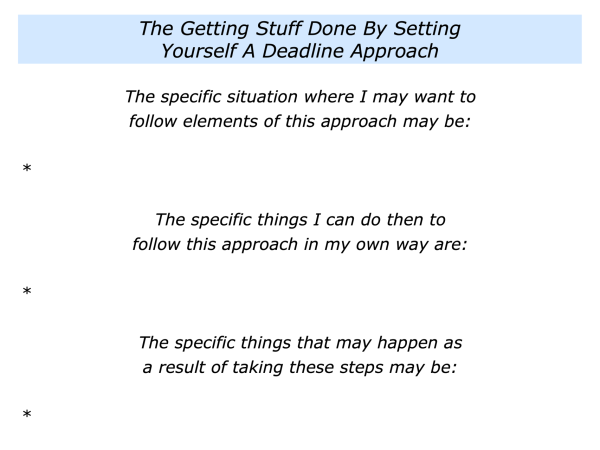
Let’s return to the theme of getting stuff done by setting deadlines. Can you think of a specific situation where you may want to follow elements of this approach? This could be in your personal or professional life.
If you wish, try tackling the exercise on this theme. This invites you to complete the following sentences.

Leave a Reply