



Some people are gut driven. They make decisions in their gut about a person, a situation or a possible way forward. They then back-up this decision with selected logic.
Some people are good at making such decisions. Some are not so good. Much depends on whether the person has a track record of making good decisions based on their gut feelings.
Great workers are also sometimes gut driven. They aim to do work that feels right and gives them positive energy. They may then aim to follow certain guidelines and do great work.
Imagine that you want to follow elements of this approach. This can sometimes mean focusing on the following themes.
Gut
Imagine that your gut is giving you messages about what to do in a certain situation. It can be useful to get examples that provide reasons for your feelings. One person expressed this in the following way.
“I often get a strong feeling about something. But I need evidence to prove the feeling is right. This helps me to decide how I want to move forwards.”
Great workers sometimes follow their gut when aiming to work towards a specific goal. Before moving into action, however, they may ask themselves the following questions.
“What is the piece of work I want to do? What are the reasons why I want to do it? What will be the benefits – for myself or for other people – of doing this work?
“What will be the pluses and minuses involved in doing the work? How can I build on the pluses and manage any minuses? Bearing these things in mind, on a scale 0-10 how motivated do I feel to do the piece of work?”
Imagine that you have explored these themes and aim to work towards a specific goal. If you wish, try tackling the following exercise. This invites you to complete the following sentences.
The Picture Of Success – The Specific Goal
The specific goal I
want to achieve is:
*
The specific benefits of
achieving this goal will be:
*
*
*
The specific things I can do to build on
the pluses and manage any minuses on
the way towards achieving the goal are:
*
*
*
Guidelines
Great workers often follow certain guidelines – certain strategies – when working towards achieving a goal. Different people do this in different ways. Some people go through the following steps.
They recall what they did to reach a similar goal successfully in the past and how they can follow these strategies in the present situation.
They explore many other options – and the consequences of each option – before settling on their chosen strategy for achieving the goals.
They mentally rehearse pursuing their chosen strategy and also managing any challenges on the way towards achieving the goals.
Gary Klein described a similar process in his books Sources of Power: How People Make Decisions and The Power of Intuition. He described how firefighters play different scenarios in their heads – almost like running films – in pressure situations.
The firefighters recall what worked when tackling similar fires in the past. They visualise follow similar principles to tackle the present fire – plus explore other ideas – and imagine what may or may not work. They then settle on their chosen strategy.
You will have your own approach to clarifying the guidelines you want to follow to do good work and reach your goal. Sometimes this may involve going through the following steps. You may aim:
To again clarify the specific goal you want to achieve and focus on this picture of success;
To clarify the specific guidelines – the strategies – you can follow to increase the chances of achieving the picture of success;
To clarify the specific things you can do to perform good work and maybe even great work on the way towards achieving the picture of success.
Imagine that you have worked through these steps. You may then move into action and focus on the next step.
Great Work
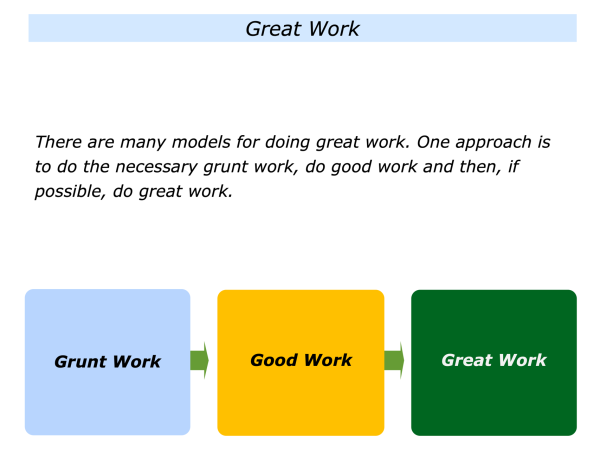
There are many models for doing such work. One approach is to do the necessary grunt work, do good work and then, if possible, do great work. Let’s explore how you may follow this path in your own way.
Grunt Work
This step involves doing the necessary grunt work for providing the platform for doing great work. Different people will do this in different ways depending on their chosen work.
The gardener continues to create fertile ground in which things can grow. The aspiring actor works in repertory theatres to develop their skills. The sports team attends boot camp to master the basics that will later enable them to deliver brilliance.
People are often happy to do the grunt work providing they can see how it will contribute to doing the great work. Some actually love this part of journey towards achieving their picture of success.
Good Work
This step involves developing the habit of doing consistently good work. This is an approach that many workers continue to follow throughout their lives.
Great workers often have a pattern of starting to produce good work in their early careers. They may do this when working as a writer, chef, teacher, carpenter or in another role. They then begin to develop consistency.
Some young footballers, for example, sometimes produce good performances but then fall away. Some commit themselves to their careers and focus on continuous improvement. This can result in them beginning to deliver consistently good performances.
Great Work
Great workers sometimes go into another dimension. They build on their strengths and follow strategies. They may then do something special to reach their goals. Let’s look at some examples.
Michael Murphy and Rhea White describe how great performers take this step in their book In The Zone. This explores transcendent experiences in sports, the arts and other fields.
One section describes how Mikhail Baryshnikov aimed to take ballet into another dimension. The authors do this by using the following quote from Herbert Saal, the ballet reporter.
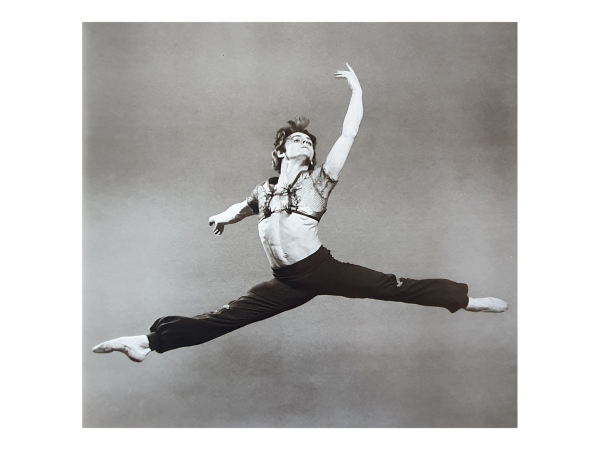
The most exquisitely chilling weapon in the arsenal of this complete dancer was his ballon, his ability to ascend in the air and stay there, defying gravity, especially in the double tour en l’air, in which the male dancer revolves two full times before landing.
The Stuttgart Ballet’s Richard Cragun can turn three times in a blur of motion. But Baryshnikov did it in slow motion. And it was unbelievable.
He blasted off with the hesitation and majesty of a spaceship. He turned – once, twice – and every thread on his costume was plainly visible as he soared high above the audience like an astronaut looking back at earth.
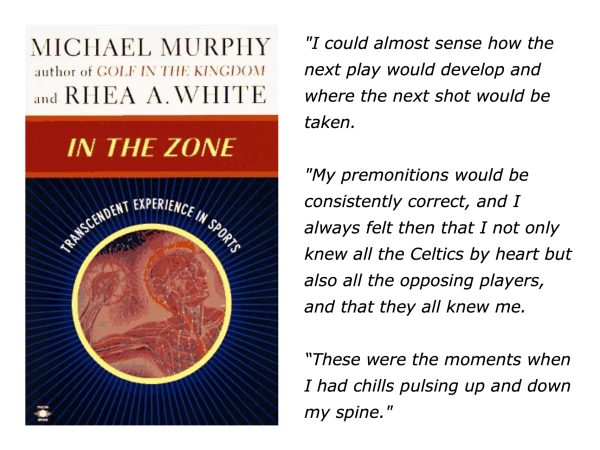
The authors describe a similar phenomenon happening in team sports. They quote Bill Russell, who played for the Boston Celtics, describing how the basketball team produced magic in games.
Bill explains how the process would start with three or four of the team’s top players acting as a catalyst. He explained this in the following way.
“The feeling would spread to the other guys and we’d all levitate. At that special level all sorts of odd things happened. It was almost as if we were playing in slow motion.”
Bill goes on to describe what happened next.
There are many ways to do fine work. One approach is to be gut driven. It is then follow certain guidelines and, if possible, aim to do great work.
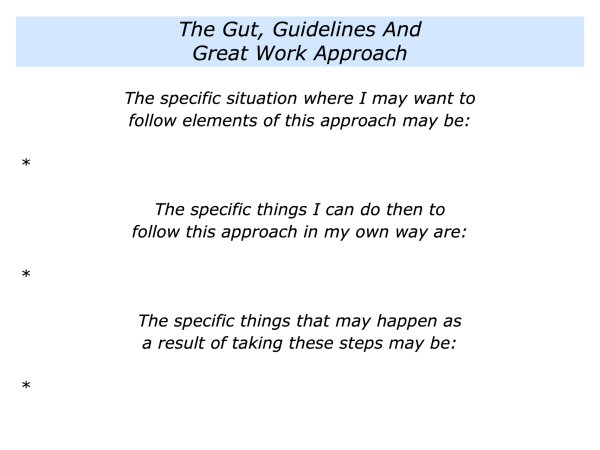
Let’s return to your own work. Can you think of a situation where you may want to follow elements of this approach? How can you do this in your own way?
If you wish, try tackling the exercise on this theme. This invites you to complete the following sentences.

Leave a Reply