



There are many ways to make transitions in life. One approach involves moving towards something rather than just moving away from something.
This approach involves focusing on a positive vision rather than just escaping a problem. It involves moving on to something better rather than just escaping a difficult situation. As one person put it:
“I am running towards something not just away from something.”
People who take this approach follow the maxim: ‘what you focus on you become’. They focus on what they want to start doingrather than what they want to stop doing. The following section explores how they may translate this into action.
The Positive Goals Approach Rather
Than Negative Goals Approach
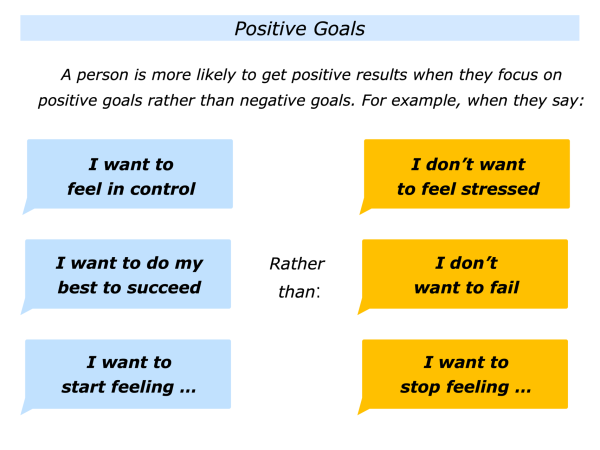
This is an approach that can be used to help a person to take more control of shaping their future. It is based on the principle that:
A person is more likely to achieve positive results when they focus on positive goals rather than negative goals.
Some people spend much of their lives worrying about what they want to stop doing. Sometimes it can be useful to help them to focus on what they want to start doing instead. For example,, they may want:
To take control rather than be stressed … To build on their assets rather than worry about their angst … To aim to become the best they can be rather than worry about being the best.
There are many ways to help a person to take this approach. The following section describe some of these steps.
You Can Help The Person
To Clarify A Positive Goal
A person may start by saying that they want to stop having a particular feeling or doing certain things. They may say something along the following lines.
“I want to stop feeling stressed, angry and behaving in a particular way.”
The person may find it easier to reach a positive goal, however, rather than a negative goal. Bearing this in mind, it can be useful to ask them something along the following lines.
“What do you want to start feeling or start doing instead? What would be the benefits of taking those steps?”
This process can take time. The person may want to talk about why they feel a certain way or the difficulties they face. At a certain point, however, it is important to encourage them to focus on what they can control in the situation. You can help them:
To clarify what they do want to feel or what they do want to do;
To clarify a positive goal;
To clarify the benefits of achieving the goal.
You Can Clarify How The Person Can Use
Their Strengths To Achieve The Positive Goal
There are many ways to help a person to work towards their goal. One approach involves helping them to learn from their positive history. Much depends on the goal they want to achieve, of course, but it can mean saying something along the following lines.
“Let’s start by looking back at when you have managed a similar situation successfully? What did you do right then? What were the principles you followed? How did you translate these into action?
“You already have a successful pattern. Let’s explore how you may be able to follow some of these principles – plus maybe add other skills – to manage the future situations successfully.”
This approach helps to affirm the person. They already have strengths and successful patterns they can follow to achieve their future goal.
If appropriate, however, you can share practical tools they can add to their repertoire. Bearing in mind what the person wants to achieve, you may say something along the following lines.
“If you are interested, I can offer some ideas and strategies that people use to get the kinds of results you want to achieve. Would you like me to share some of these?”
You can then pass on strategies that work and practical tools the person can use to achieve their goal. It is important to share these in a way the person can accept and use in their life or work.
You Can Help The Person To Clarify Their
Action Plan For Achieving The Positive Goal
People need to believe in their chosen way forward, which is why it useful to build on their strengths and successful patterns. The next steps are to help the person:
To clarify their action plan for working towards the positive goal;
To rehearse follow these strategies and how they will deal with any challenges along the way;
To get a quick success, maintain the momentum and do their best to achieve the positive goal.
The key point is worth underlining again. It is to encourage a person to focus on a positive goal rather than a negative goal. They are then more likely to achieve success.
The Positive Addictions Approach Rather
Than The Negative Addictions Approach
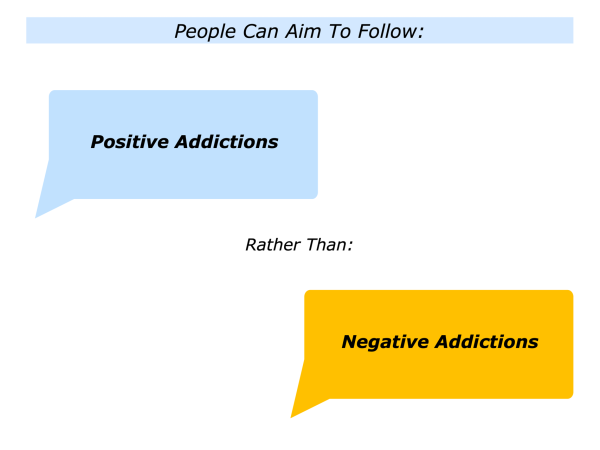
Some people have extremely addictive personalities but actually many people have some form of addictions. These addictions may fall into two extreme categories.
Positive addictions – these can have positive consequences for themselves and others.
Negative addictions – these can have negative consequences for themselves and others.
Some people learn to recognise such addictions. They may then aim to channel these in ways that help rather than hurt themselves and other people. Let’s explore these themes.
Positive Addictions
Some people may be addicted to focusing on positive things in life or finding solutions. Some may be addicted to exercise, staying healthy or doing creative work. Some may be addicted to helping other people.
Negative Addictions
Some people may be addicted to alcohol, drugs or other substances. Some may be addicted to angst or continually finding problems. Some may be addicted to anger or getting their highs by hurting other people.
Some therapy programmes encourage people to follow positive rather than negative addictions. William Glasser described this approach in his 1976 book Positive Addiction. He showed how people could channel their energies into running, meditation or other beneficial activities.
This is an approach I sometimes used with people who wanted to channel their addictive personalities in positive ways. This called for helping them:
To clarify their personal or professional goals – their picture of success;
To clarify the positive patterns they could follow to increase their chances of achieving success;
To clarify and follow their specific action plan for achieving success.
Some people may object to this approach. They may say:
“Isn’t that just replacing one addiction with another? Shouldn’t the person be trying to find their true self?”
Perhaps, but some people found it proved more helpful for themselves and others. Some developed a positive addiction for exercise or helping other people who were in difficulties. This called for them choosing:
To follow a set routine and get some quick successes … To keep repeating this pattern and get positive results … To rehearse how to manage situations that could trigger negative habits.
This approach calls for a person really wanting to turnaround their life. It can involve finding other ways to get their highs.
Some people with psychopathic tendencies, for example, may get a physical chemical reaction when they hurt others. They become addicted to this approach and look for the next situation where they can get this kick. This can create lots of collateral damage.
Such people are addicted to anger. They try to make themselves feel big by making others feel small. They not only want to win, they want others to feel they have lost.
Some people take another route. They get their highs by helping other people. They love to encourage other people when acting as parents, educators, coaches, leaders, trusted advisors or playing other roles. They love to nurture people.
They care for others and, when faced by difficult situations, try to get win-win solutions. Such people want to plant seeds of hope that encourage both present and future generations.
Such people feel good after helping others. They can experience a rush followed by a sense of calm. It is as if they have served something greater than themselves.
The moving towards something approach often involves putting something positive in place rather than simply trying to remove the problem. One way to do this is to follow elements of the positive addictions approach.
The Positive Transitions Approach
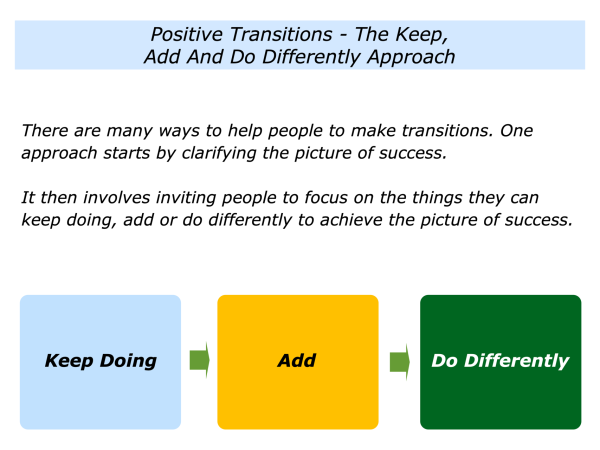
This is an approach that can help individuals, teams and organisations to develop rather than telling them they have to change. It also gives them some ownership in working towards the aims.
The following section focuses on how you can use the approach when working with teams. But it can also be adapted to other situations.
The approach starts by communicating the big picture and giving people the context. It then involves describing the team’s strategy for moving forwards and the benefits of achieving the future picture of success.
It is important to share this information in a way that enables people to see the reasons for pursuing the future strategy.
The next step is to invite people to suggest ideas that will help them and the organisation to achieve these aims. Invite each person to write their suggestions on Post-it Notes under the following headings.
Keep Doing
They are to write what they believe their team or the organisation needs to keep doing in order to achieve future goals.
Add
They are to write what they believe their team or the organisation may need to add in order to achieve the future goals.
Do Differently
They are to write what they believe their team or the organisation may need to consider doing differently in order to achieve the future goals.
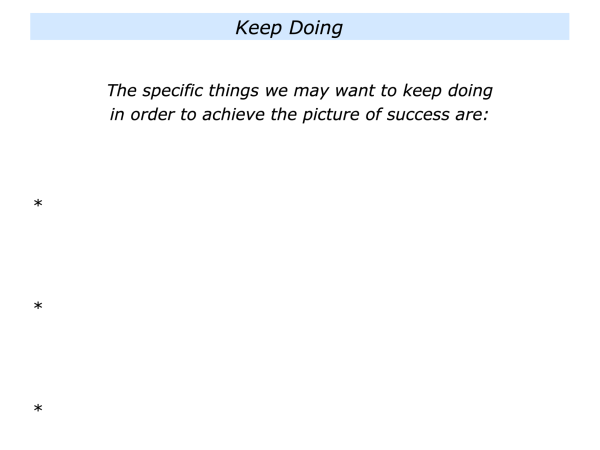
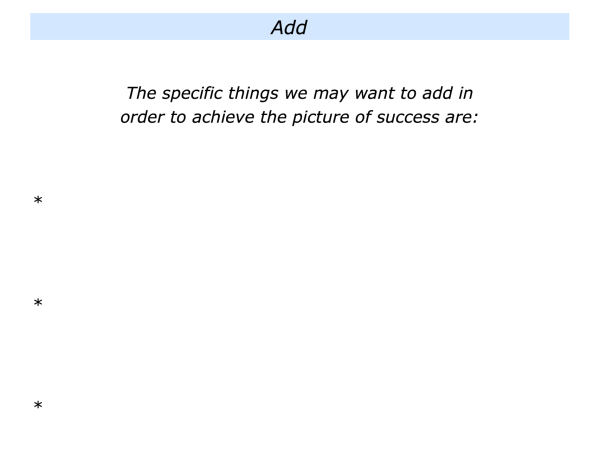
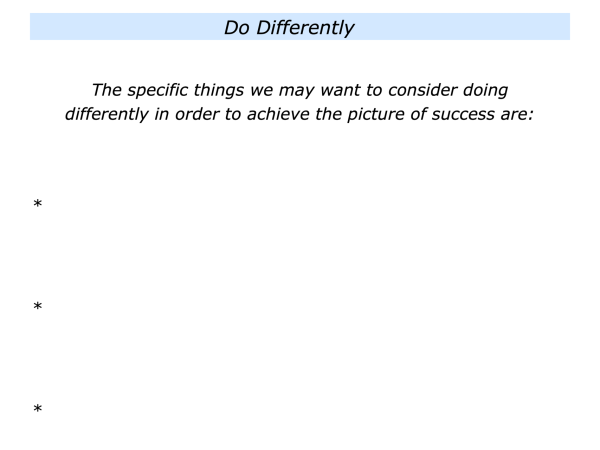
People can write as many ideas as they wish under each category. It is good if they can write one idea per Post-it, because this makes the ideas easer to collate afterwards.
Give people at least fifteen minutes to write their Post-its. They can then be invited to go up in turn and put their ideas under the relevant headings. They can also explain their reasons for each idea.
After all the ideas have been added, you may want to discuss some of the themes that have emerged. The ideas can then be collated and shared back with people.
It will be important to describe how some of the ideas are going to be implemented. Plus, if appropriate, the support that people will be given to enable them to achieve the aims.
There are many ways to help people to make transitions. This section has described one approach. It is to encourage them to focus on what they can keep doing, add or do differently to achieve a picture of success.
The Moving Towards
Something Approach
There are many ways to keep developing. One approach involves the idea of moving towards something rather than just moving away from something.
This involves focusing on a positive vision rather than just escaping a problem. It involves moving on to something better rather than just escaping a difficult situation.
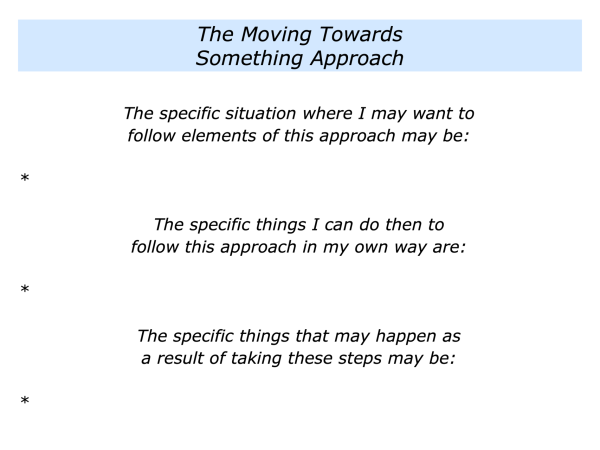
Let’s return to your own life and work. Looking ahead, can you think of a situation where you may want to follow elements of this approach? How can you do this in your own way?
If you wish, try tackling the exercise on this theme. This invites you to complete the following sentences.

Leave a Reply