



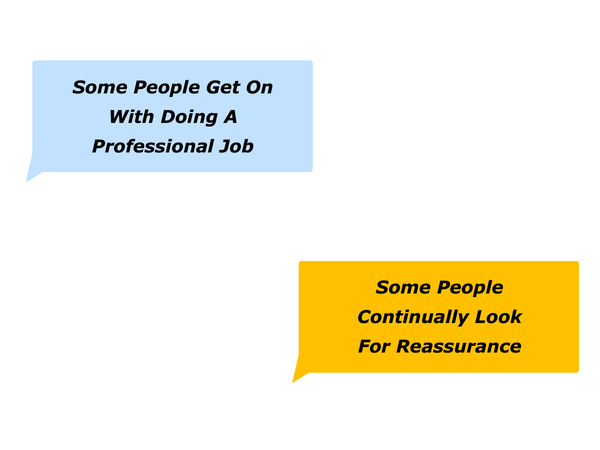
Some people can be a joy to work with because they get on with doing a professional job. They clarify the results to achieve, maintain high standards and deliver positive results.
Some people continually look for personal reassurance. Whilst they may do good work, they want others to reassure them they are okay. This can be tiring for people who may be asked to play the role of therapist.
The approach that people take can have consequences for themselves and other people. Let’s explore these themes.
Some People Get On With
Doing A Professional Job
People who take this approach are often self-managing and aim to do a professional job. Such people often take the following steps to make sure they are clear on the brief to be delivered.
They clarify the goals to achieve by meeting with their key stakeholders and agreeing on the desired positive results.
They clarify the overall guidelines to follow – such as any Dos and Don’ts – on the way towards delivering the desired positive results.
They clarify how they will keep their stakeholders informed about their progress on the way towards delivering the desired positive results.
Such people are good at priority management. They focus on the key outcomes to achieve, get some early wins and do superb work. They also encourage other people and help them to achieve success.
They are good at reading reality. They see what is happening, build on what is working and tackle areas for improvement. They are also good at finding solutions to challenges.
They are often future focused. Looking to the future, they clarify how they can build on their strengths. They also add to their repertoire of strategies and skills for achieving future success.
Good organisations have many people who get on with doing a professional job. Such organisations take the following approach.
They encourage these people to build on their strengths, keep doing superb work and make their best contributions.
They encourage them to focus on their development and provide them with opportunities to add to their professional repertoires and development.
They encourage them to lead or contribute to projects that enable them to develop and sometimes move one to other roles where they can make positive contributions.
Good organisations build on such individuals. At the same time, they are also prepared to offer them practical support. This can result in wins for the individuals and wins for the organisation
Some People Continually
Look For Personal Reassurance
Some people may do good work but can sometimes appear to be needy. They continually look for personal reassurance and being told they are doing okay.
Such a person may do a piece of work but keep putting themselves down. They may see this as being honest, but it can also be tiring for other people.
This pattern does not help anybody. It can also be construed as looking for compliments or asking somebody to be their counsellor. Let’s look at one example.
A relatively senior person was hired to help a project director to deliver certain results. The first couple of months went well and the project looked to be on track.
The person then kept expressing doubts about their ability to deal with both professional and personal challenges. The project director tried to help, but found the sessions to be exhausting.
One of their colleagues brought the situation to a head by talking with the project director and making the following observation.
“Who is supposed to be the helper here? The person was hired on a good salary to help you to deliver the project. It is important to be empathetic, but it seems that you are spending lots of energy just helping them.”
The project director decided to have a conversation with the person who was looking for constant reassurance. Looking ahead, they explained the following things.
The Dos: The specific things they did want the person to do – such as play to their strengths and deliver certain positive results.
The Don’ts: The specific things they did not want the person to do – such as quickly move into talking about their self-doubts.
The project director explained the person’s role was safe providing they behaved in a professional way. It was also okay to ask for help but in a way that explored how it was possible to improve in the future.
The person’s job may be at risk, however, if they continued to ask for reassurance. The company employed an external therapist, for example, who may be able to help them with such issues.
The person chose to behave in a professional way. They got on with the job and delivered the goods. They also made use of the external support to manage some of their other issues.
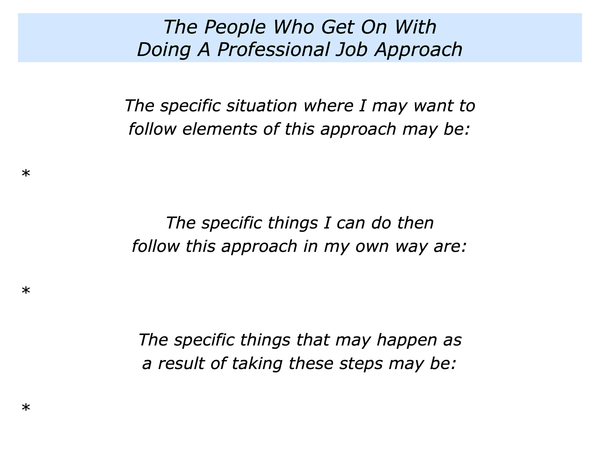
Let’s return to your own work. Can you think of a situation where you may want to follow elements of the people who do a professional job approach? If you wish, try tackling the exercise on this theme.

Leave a Reply