



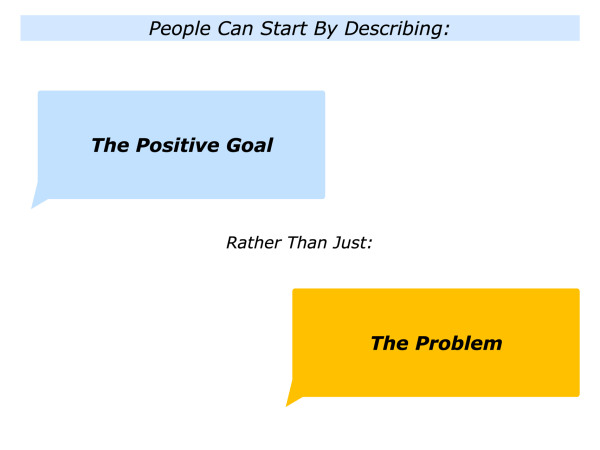
Different people communicate in different ways. Good communicators recognise, however, that the way they start the communication can have a positive or negative effect on other people.
Some people start by describing the positive goal. They may do this when communicating with an individual, an organisation or people in the wider society. Taking this approach can help to lift people.
Such people aim to be positive but realistic. They may describe the possible solutions to challenges and the benefits of achieving the desired picture of success.
Some people start by spending lots of time describing the problem. They may do this when communicating with an individual, an organisation or people in the wider society.
Taking this approach may sound reasonable, but it can suck energy and lead to a feeling of depression or paralysis. It can then be harder to lift people and encourage them to explore possible solutions.
Different people follow these approaches in different situations. Let’s explore how they may translate these into action.
The Positive Goal Approach
Some people start the communication by aiming to encourage others and set a positive tone. Such people are not starry-eyed optimists, but they recognise that it is important:
To create, as far as possible, a positive atmosphere;
To show people there are possible ways forward to achieve a positive goal;
To show people the benefits of achieving the positive goal.
Different people may take this approach in different situations. The following section explore some examples.
A leader may take this approach when communicating with their team. They may explain: a) the purpose of the team; b) the principles it can follow to express this purpose; c) the positive results to achieve and the benefits of achieving this picture of success.
Such a leader may then invite people to decide if they want to help to achieve these goals. If so, they will make clear contracts with them about their positive contributions towards achieving the picture of success.
A sports coach may follow elements of this approach when meeting a gifted athlete who needs to show a positive attitude in order to continue to be selected for the team. They may say something along the following lines.
“Looking ahead, I would like to select you for the team. If you want to contribute to it, however, we would like you to do your best to demonstrate a positive attitude. If you do that, then I am sure we can achieve success together.
“I have seen you demonstrate such an attitude in certain situations. For example, when you encouraged one of the players who was recovering from a tough injury.
“Looking ahead, I would like you to show a similar attitude during matches. For example, encouraging your colleagues even if they make a bad pass and even if you are substituted during a game.
“This will be your choice, of course. I would like you to take time to reflect and decide if you want to demonstrate such an attitude. If so then, when combined with your ability, this will help both you and the team to achieve future success.”
Many environmentalists want to encourage people to care for the planet. They may need to describe a positive goal, however, when communicating to a wide audience. This can be more effective than haranguing people.
People are more likely to do something if they can see the benefits for themselves or other people. Sometimes this may involve a person communicating a positive paradigm. Let’s look at this approach.
The Positive Paradigm Approach
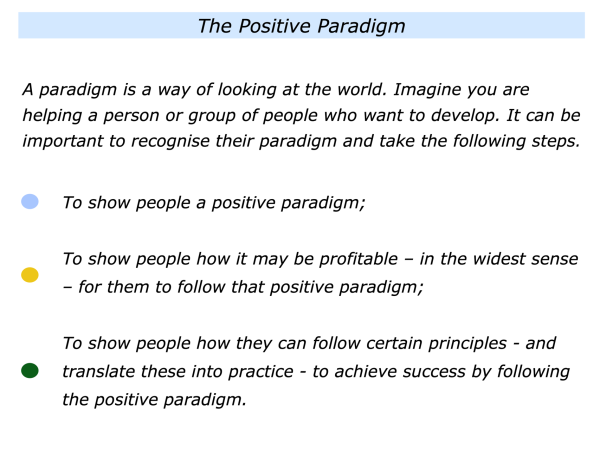
A paradigm is a way of looking at the world. The paradigm that we have often influences our daily actions. It can also have consequences for both ourselves and other people.
Imagine that you are working with a person, team or organisation that wants to develop. It can be important to recognise their present paradigm and then to take the following steps.
To show them a positive paradigm;
To show how it may be profitable – in the widest sense – for them to follow that positive paradigm;
To show how they can follow certain principles – and translate these into practice – to achieve success by following the positive paradigm.
If appropriate, you can then enable people to follow this approach successfully.
Different people communicate the positive goal in different situations. Some aim to encourage people, show the possible ways forward and describe the benefits of achieving the positive goal.
The Problem Approach
Some people start by describing the problem. They may do this when communicating with an individual, an organisation or people in the wider society. Different people take this approach this for different reasons.
Some take it because, in their view, it is important to outline what they see as the truth. What they see as the truth, however, may be based on their own agenda, their opinion or selected events they want to highlight.
Some people start by describing the problem because that is the approach they learned in academia, politics or other fields. They believe it is important to describe what is going wrong before moving on to possible solutions. This sounds reasonable, but it can produce challenges.
Such an approach does not necessarily inspire people or fire their imagination to solve the problem. Starting by highlighting the problem can create a feeling of blame, negativity or hopelessness.
Let’s return to your own life and work. Looking ahead, can you think of a specific situation where you may want to start by following elements of the positive goal approach?
This could be a personal or professional situation. It could be when communicating with an individual, a team, an organisation or a wider audience of people.
Looking ahead, how could you set a positive but realistic tone? What may be the key messages that you want to give to the person or to the group of people? What may be the positive goal you want to describe?
How could you bring these messages to life by giving examples that resonate with people? How could you describe the potential benefits of achieving the positive goal?
If you wish, try tackling the exercise on this theme. This invites you to complete the following sentences.

Leave a Reply