



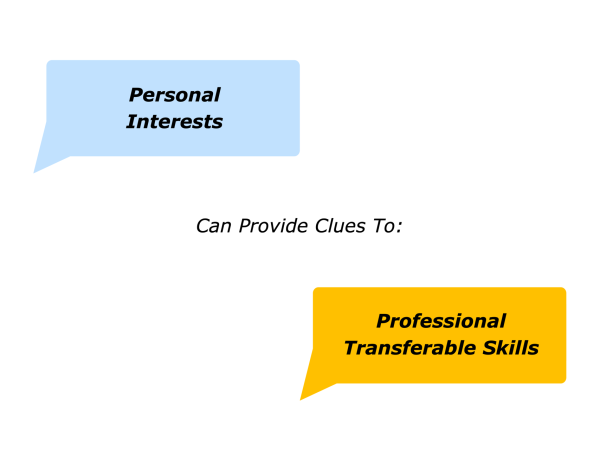
There are many ways to find people’s strengths and successful patterns. One approach is to focus on their personal interests. These can provide clues to professional transferable skills they can apply to achieve success.
This is an approach that focuses on the real, whole person rather than simply their present role. It is one that can lead to them enhancing their present work or maybe even shaping a new professional role.
The following section describes some of the people I have worked with in the past who took this approach.
Person A – The Interior Designer
Person A was working in a marketing role but wanted something more fulfilling. During a career development session I asked about their interests.
They explained that they loved interior design and had done some weekend work on this for friends. They would like to do this as a full-time role but did not feel they had the qualifications. Their vocation was:
They wanted to create enriching environments in which people felt at ease.
We focused on how they could do more weekend work and build their portfolio. They pursued this route and, within six months, had enough orders that meant they could do it full-time.
Person A went on to build a successful business. Fifteen years later they were invited to become a board member on one of the pre-eminent design societies in the UK.
Person B – The Coordinator Of Events
Person B was leading a small team but wanted to do something on a bigger scale. I asked about the kind of projects – in the broadest sense of the word – that they enjoyed doing. They answered in the following way.
“I am not sure if these fit the bill, but there are several things. First, I love holding Sunday lunches for the wider family. It is great to create a positive atmosphere and provide nourishing food for people.
“Second, at university I took the role of social secretary for one of the societies. I still organise the annual group ski trips that some of us take together. I also helped to organise my friend’s wedding.
“Third, one year ago my boss said we had been let down by an events company that had gone bust. I stepped into the breach and organised an event that was well-received by people who flew in from around the globe.”
Person B is a great coordinator. Bearing this in mind, they eventually moved into a role where they coordinated conferences and other events. They loved the opportunity to provide people with good experiences and take away positive memories for life.
Person C – The Storyteller
Person C was working as a technical specialist in a software company. During one session they described how they loved writing and wanted to show people how technology could simplify their lives.
Bearing this in mind, they had started a blog. They was good writer and highlighted how the company’s products could help people in their lives and work.
The blog became popular and they were asked to go to the company’s headquarters in the USA. Wondering if they were going to get fired, they approached the meeting with some trepidation. The company had an offer, however, this was:
“Would you like to become the company’s chief storyteller?”
Person C took this role. Their personal passion for showing the benefits of technology meant led to them becoming a full-time journalist and storyteller for the company.
There are many examples of people who have translated their personal interests into professional transferable skills. Different people do this in different ways. One approach is to invite them to explore the following questions.
What are your personal interests? What are your passions? What are the kinds of things you do where you feel fully alive? What are the things you cannot help but do?
What have been some of the satisfying projects – in the broadest sense of the word – you have done in your life? What made these satisfying? What were the principles you followed to achieve success?
What are some of your strengths? What are some of your successful patterns? How could you follow some of these principles in the future and do satisfying work?
There are many ways to help people to build on their strengths. One approach is to focus on their personal interests. These can provide clues to professional transferable skills they can apply to achieve success.
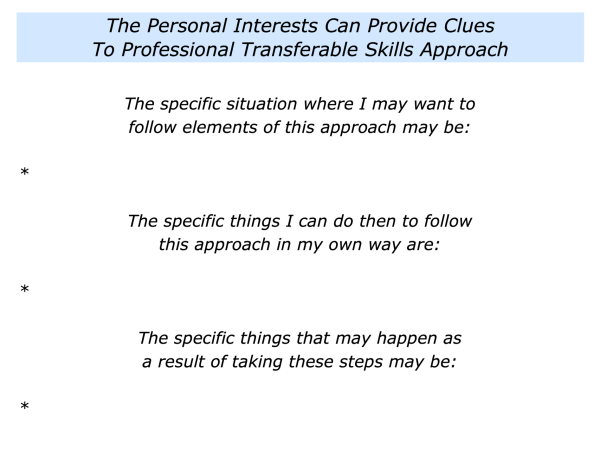
Let’s return to your own life and work. Looking ahead, can you think of a situation where you may want to follow elements of this approach? How can you do this in your own way?
If you wish, try tackling the exercise on this theme. This invites you to complete the following sentences.

Leave a Reply