



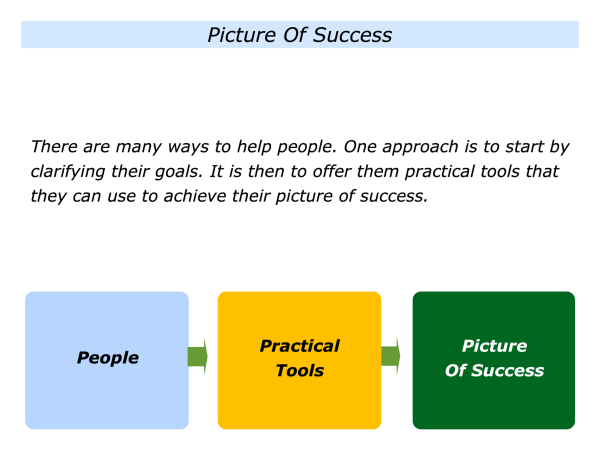
There are many ways to help people. One approach is to start by clarifying their goals. It is then to offer them practical tools that they can use to achieve their picture of success.
Different people follow this approach in different ways. They may do this as educators, medics, counsellors, specialists or in other roles. They may also pass on knowledge that helps people to shape a positive future.
People who take this approach often get pleasure from helping others. They may also sometimes experience the helper’s high, but that is a by-product. Their main aim is to help other people to reach their goals.
Imagine that you want to follow this approach in your own way. This often involves focusing on the following themes.
People
Imagine that a person has asked for your help in working toward their goals. It will be important to prepare properly before the session. One approach is to use your imagination to explore the following questions.
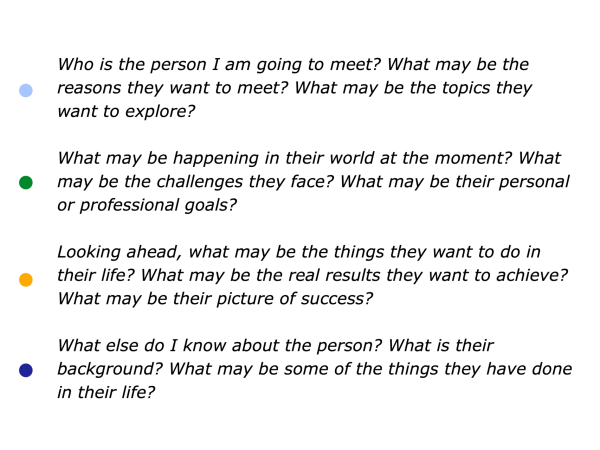
Who is the person I am going to meet? What do I know about the person? What may be the reason they want to meet? What may be the topics they want to explore?
What may be happening in their world at the moment? What may be the challenges they face? What may be their personal or professional goals? What may be their picture of success?
How can I make the person feel welcome? How can I clarify the topics they want to explore? How can I pass on knowledge and practical tools they can use? What for them will make it a successful session?
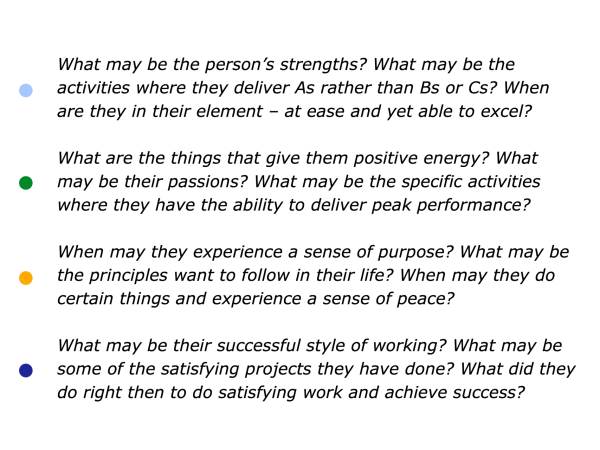
There are many ways take this step. Here is a more detailed version of these questions.
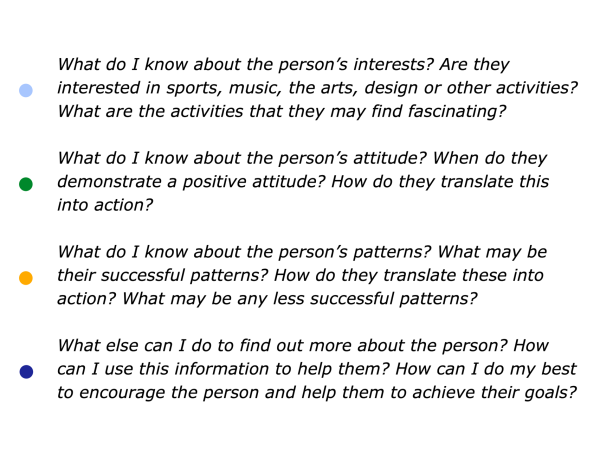
Imagine that you have explored some of these themes. If appropriate, you may also want to contact the person ahead of the first meeting.
This can help to set the scene for the person. It can also give them the chance to reflect and think about what they want to explore in the session.
Looking at my own work, here is an example of the kind of email I may send to a person before the first meeting. You will, of course, have your own approach.
The Mentoring Session
Hello …
Looking forward to seeing you for our first session on …
As you know, the sessions are confidential and we can explore any topics you wish. For example:
How to build on your strengths … How to shape your future … How to do satisfying work … How to build superb teams … How to manage key stakeholders.
How do build on your successful patterns … How to manager certain situations … How to find solutions to specific challenges … How to work towards your personal or professional goals.
Or any other topics that it may be useful to consider.
We will start the session by clarifying the themes you want to explore.
Looking at the first topic, we will clarify the real results you want to achieve. Bearing this in mind, we will consider the possible ways forward for achieving the picture of success.
If appropriate, and if you wish, I can then share some practical tools that seem to work in this kind of situation. You can take the ideas you like and use these in your own way.
Finally, if you get chance before the session, let me know if there any particular topics you would like to explore in the meeting. Otherwise we can clarify these at the start of the session.
Look forward to seeing you then.
Imagine that you have taken all these steps. If appropriate, you may want to take the following step before meeting the person.
Rehearsing The Session
Great workers often rehearse properly before moving into action. If appropriate, you may want to rehearse the following things.
How to start the session … How to make the person feel welcome … How to clarify the topics the person wants to explore … How to show the person that you understand these topics.
How to focus on the first topic they want to explore … How to clarify the specific examples of what may be happening or what they want to happen in this situation.
How to clarify the results they want to achieve … How to clarify the things they can control in the situation … How to clarify the possible options for going forwards together with the pluses and minuses of each option.
How to clarify the strategies that seem to work in this kind of situation … How to clarify the knowledge – the positive models and practical tools -that you can share to help them to achieve their goals.
How to pass on this knowledge in a way the person can receive … How to bring it to life with specific examples that resonate with the person … How to help them to use the ideas in their own way to achieve their goals.
Imagine that you have rehearsed properly. It may then be time to move on to the actual session with the person. Let’s explore this stage.
Starting The Session
You will aim to make the person feel welcome. One approach is to create an encouraging environment in which they feel at ease. You will, of course, do this in your own ways.
The next step will be to invite them to describe the topics they would like to explore. Different people will mention different things. Here are some of the themes that people have described during mentoring sessions.
How to feel more in control in my life … How to shape my future career … How to regain my zest for work … How to manage a difficult boss … How to shift the culture in my organisation … How to build a successful team.
How to build my business … How to encourage my son who is having difficulties … How to manage the situation with an alcoholic relative … How to retain my sanity … How to work towards my life goals.
You can then invite the person to focus on the first topic they would like to explore. It can be time to move on to the next stage.
Practical Tools
The aim of the session is to provide the person with practical tools they can use to achieve their picture of success. There are many ways to make this happen. If appropriate, you can go through the following steps.
You can get more information about the
situation and clarify the picture of success
Imagine that you are focusing on the first topic the person wants to explore. It can be useful to get more information about the situation and also the results to achieve.
One approach is to say something along the following lines. You will, of course, do this in your own
Let’s focus on the first topic you want to explore. Can you tell me a bit more about this situation? What is actually happening? Can you give me an example?
Looking at the situation, what are any other people actually doing? What are you doing? What else may be happening? What may be the consequences of what is happening?
What are the things you can control in the situation? What are the things you can’t control? Bearing these in mind, what are the things you can do to build on what you can control?
Looking ahead, what would you like to happen? What are the real results you would like to achieve? What may be the short, medium or long-term goals? What would be your picture of success?
Imagine that you have explored these themes with the person. At some point you may want play back your understanding of their goals. Bearing this in mind, you may want to say something along the following lines.
The Picture Of Success
Looking at this topic, as far as I understand it the real results you want to achieve are:
To
To
To
Is that right? Are there any other things you want to add?
Imagine that you have clear picture of the results the person wants to achieve. If appropriate, you can then go onto the next stage.
You can clarify the possible ways forward
towards achieving the picture of success
There are many ways to clarify the possible ways forward towards achieving their desired results. One approach is to start by asking the person the following question:
What have been the things you have done in the past to try to reach the goals? What happened as a result of taking these steps?
Imagine that the person has given you an overview of the strategies they have tried in the past. Some may have worked, some may not have worked.
Bearing these in mind, you may then want to help the person to explore the possible ways forwards. It can also be useful to look at the pluses and minuses of each option.
Much depends on the specific situation, of course, but it may be possible to summarise the options as you go along. If appropriate, you may want to say something along the following lines.
Looking ahead, let’s explore all the possible ways forward. You may not want to pursue some of these, of course, but it can be useful to list all the possible options. There are, of course, pluses and minuses to each option.
Let’s start with these possible ways forward. Later we can explore other potential creative solutions. We can then also look at some of the strategies that have worked in similar situations.
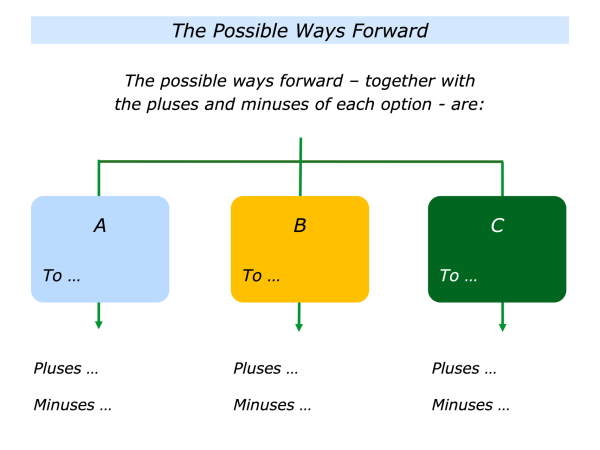
Option A Is: To …
The pluses are …
The minuses are …
Option B Is: To …
The pluses are …
The minuses are …
Option C Is: To …
The pluses are …
The minuses are …
Imagine that you have explored some of the obvious options with the person. If appropriate, you may then say something along the following lines.
We will soon move on to exploring other possible routes, but before then let me check something.
Looking at these ways forward, what for you is the most attractive option? How attractive is this on a scale 0-10?
Looking ahead, are there any other potential creative solutions? For example, it is possible to combine elements of some the ways forward to create a new option?
Imagine that you have worked through these themes with the person. If appropriate, you may then move on to the next step.
You can pass on practical tools that
the person can use to work towards
achieving the picture of success
This step involves passing on knowledge and practical tools that the person can use to achieve their goals. Whenever possible, these should be based on what seems to work in such situations.
There are several ways to focus on what may work in a situation. When appropriate, it can be useful to help the person to learn from their own and other people’s experiences. One approach is to say something along the following lines to the person.
Let’s start by learning from your positive history. Looking back, can you think of a situation where you may have tackled a similar challenge successfully? This could have been in your personal or professional life.
What did you do right then? What were the principles you followed? How did you translate these into action? How can you follow some of these principles – plus maybe add other skills – to tackle the present challenge?
Looking around, when may have other people tackled a similar challenge successfully? What did they do right? What we the principles they followed? How could you maybe follow some of these in your own way?
Imagine that you have explored these themes with the person. When appropriate, you may then move on to next stage.
This involves passing on knowledge that can help the person to achieve their goals. Before doing this, however, it can be useful to ask yourself the following questions.
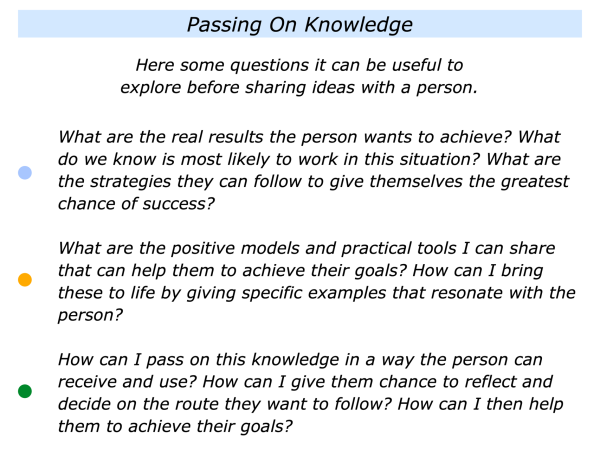
Before sharing any ideas with the person, however, it can then be useful to say something along the following lines.
Looking ahead, is it okay for me to share some ideas that sometimes work in these kind of situations? You can take the ideas you like and use them in your own way.
The person will probably say ‘Yes, of course.’ But it can be useful to get their psychological permission before sharing any ideas. You can then say something along the following lines.
Bearing in mind what you can control in the situation, here are some other options it may be worth considering.
One option could be: To … For example, to …
Another option could be: To … For example, to …
Another option could be: To … For example, to …
Again, there may pluses and minuses to each option.
Imagine that you have shared some of these ideas. When appropriate, you may then want to give the person a chance to reflect. When doing so, you may want to say something along the following line.
Let’s take time to reflect. Looking at the first topic you wanted to explore, we have clarified the real results you want to achieve. We have then considered many of the possible ways forward.
Bearing these in mind, I would like to you think about the route – or the combination of routes – you may want to follow. We can then focus on how to translate this into action.
Imagine that the person has taken time to reflect and decided on their chosen way forwards. If appropriate, you can then help the person to take the following steps.
To clarify the key strategies they can follow to give themselves the greatest chance of success;
To clarify how to translate these strategies into a clear action plan and get some quick wins on the way towards achieving success;
To clarify how to anticipate and manage any challenges they may encounter on the way towards achieving the picture of success.
Later we will look at how you can follow up with the person to help them to achieve their chosen goal. If appropriate, however, at this point you can move on and focus on the next theme the person wants to explore.
Looking at this next theme, you can clarify the results to achieve, the possible ways forward and their action plan. You can continue following this process until the person feels they have covered their chosen topics.
Let’s assume that you are approaching the end of the session. You can then give the person chance to reflect and, if appropriate, focus on how to translate some of their plans into action.
Sometimes you may also follow up with the person to provide support on their journey. If so, this may mean focusing on the final step.
The Picture Of Success
Imagine that the person has clarified their plans. They may then move into action, follow their chosen strategy and get some early wins. You can then help them to do their best to achieve their picture of success.
There may also be times when it is appropriate to offer ongoing support on their journey. Different professionals may aim to do this in different ways. Here are some of these approaches.
The Mentor’s Approach
Some mentors provide ongoing encouragement that helps mentees to achieve their goals. These sessions are often driven by the mentee who meet with their mentor on a regular or when appropriate basis.
The mentor may then continue to act as a trusted advisor. They will aim to create a stimulating sanctuary in which the mentee feels at ease and able to explore their aims.
The mentor will then pass on knowledge and practical tools that the person can use in their own way. They will also help the person to find solutions to challenge and do their best to achieve their picture of success.
The Solutions-Focused
Therapist’s Approach
Therapists who take this approach encourage a person to build on their inner resources, set goals and shape a positive future. Here is a description of this approach from the British Association for Counselling and Psychotherapy website.
Solution-focused brief therapy is a short-term therapy which focuses on setting goals and working out how to achieve them.
It’s about the future rather than the past and promotes positive change by encouraging you to focus on what you can do rather than what you can’t.
The Specialist’s Approach
Specialists provide specific expertise that can help people to achieve their goals. They may do this when working as a subject matter expert, trusted advisor, technical specialist or in another professional role.
Such specialists start by clarifying people’s challenges or goals. They then use their expertise to help people to solve problems, follow strategies that work and achieve success. They sometimes also pass on knowledge that helps people to shape a positive future.
There are many ways to help people. One approach is to start by clarifying their goals. It is then to offer them practical tools that they can use to achieve their picture of success.
People who take this approach often get pleasure from helping others. They may also sometimes experience the helper’s high, but that is a by-product. Their main aim is to help other people to reach their goals.
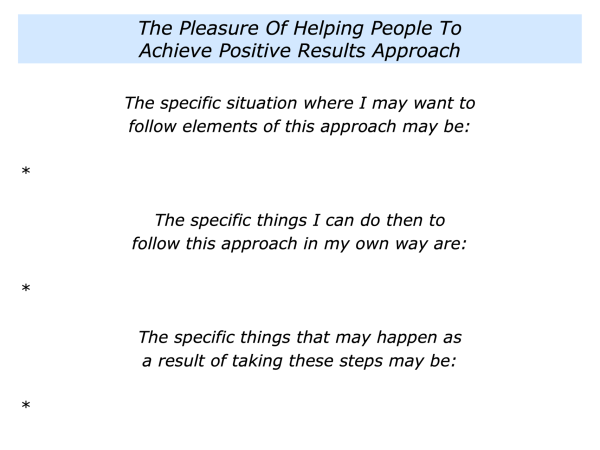
Let’s return to your own work. Looking ahead, can you think of a situation where you may want to follow elements of this approach? How can you do this in your own way?
If you wish, try tackling the exercise on this theme. This invites you to complete the following sentences.

Leave a Reply