



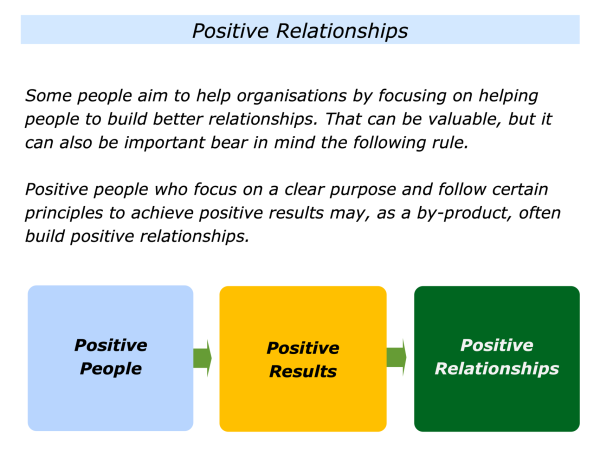
Some people try to help organisations by immediately focusing on helping people to build better relationships. That can sometimes be valuable, but it can also be important to bear in mind the following rule.
Positive people who focus on a clear purpose and follow certain principles to achieve positive results may, as a by-product, often build positive relationships.
Different organisations focus on these themes in different ways. The following section explores some of the factors they need to bear in mind when considering the culture in their teams. Let’s look at two examples.
Company A
Company A was performing poorly and had problems with morale. Its response was to hire a consultant firm that focused on the company’s culture. The report they produced highlighted the following issues.
First, people felt there was a lack of trust in the company.
They did not feel trusted to do their jobs. They also found it difficult to trust some of the senior leaders who briefed against their own colleagues in the leadership team.
Second, some people felt quite fearful and were worried about being criticised in front of their colleagues.
They expressed concerns about the style of some managers. These managers seemed to think that people would improve by being criticised or compared to other colleagues in the company.
Third, people found it hard to connect with the direction of the company and their parts in making it happen.
They were confused by the various changes in strategy. They were also weary of being put through a succession of change programmes that did not produce real changes.
Some of these issues were exacerbated by the company giving people confusing messages. For example:
It told people to cooperate and work well together;
It then used an old-fashioned Bell Curve to rate people against each other when it came to performance management.
The company responded by hiring the consultant firm to do several training programmes. These invited people: a) to focus on trust issues; b) to highlight what people saw as ‘blockers’ to delivering high performance.
These sessions gave people a chance to voice their concerns but did not improve the morale or relationships. The company continued to lose people and plateaued at a low level of performance. Let’s look at another example
Company B
Company B was performing well. It had a positive and professional culture where people worked well together to produce positive results. This led to, as a by-product, people enjoying good relationships.
The following piece is based on a company that I had the opportunity to work with over several years. There were several reasons why the company was successful. These included the following
First, the CEO and senior leadership team provided positive leadership and this had a good effect throughout the company.
They were positive, predictable and created an environment in which motivated people could perform superb work. They also ensured that each of the middle management teams embodied these qualities.
Second, the senior leadership team continually communicated the company’s purpose, principles and picture of success.
They began meetings by reminding people of these things before moving on to the other agenda items. They also aimed to recruit and retain people who followed the principles.
Third, the company encouraged people to build on their strengths and and make their best contributions to achieving the picture of success.
The company created a positive atmosphere but it also expected its people to behave in a professional way. This was part of the professional working contract.
There were also occasions when the company acted immediately to protect the culture. It then quickly dealt with situations where people behaved in ways that hurt others or created collateral damage.
Many people enjoyed their time working in the company. Several went on to found other businesses. They also aimed to follow some of the principles they had learned in the company.
There are many ways to try to improve relationships in organisations. One approach is to focus on issues such as lack of trust or other psychological challenges. Another approach is:
To employ positive people … To encourage people to focus on a clear purpose, follow certain principles and deliver positive results … To then, as a by-product, develop positive relationships.
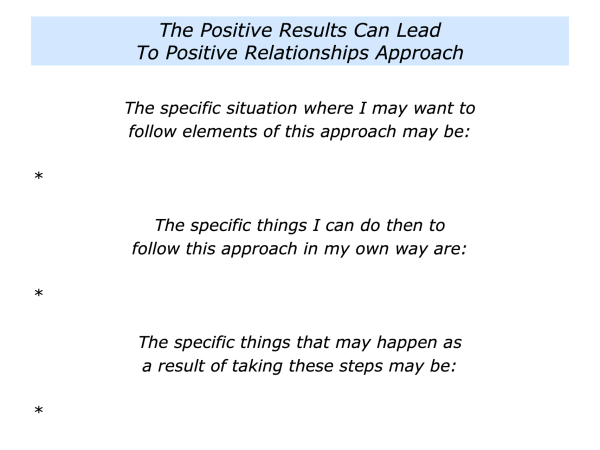
Let’s return to your own life and work. Looking ahead, can you think of a situation where you may want to follow elements of this approach? If you wish, try tackling the exercise on this theme.

Leave a Reply