



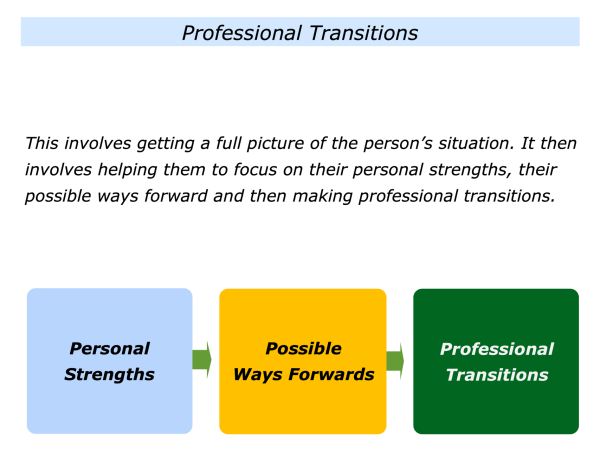
There are many ways to help people to make transitions in their professional lives. One approach starts by getting a full picture of a person’s situation.
It then involves helping them to focus on the themes of their personal strengths, the possible ways forward and, when appropriate, making professional transitions.
There are various situations in which it is possible to follow elements of this approach. Here are some the scenarios that may affect different individuals in their careers.
They may be a person who has lost their job because of market conditions, new technology or other events.
They may be a person who has experienced a challenging situation and wants to maintain their wellbeing whilst also earning a reasonable salary.
They may be an athlete who is looking at how to use their transferable skills after finishing their sporting career.
They may be a seemingly successful professional who wants to regain their zest for life and do more stimulating work in the future.
They may be somebody who recognises there are fewer predictable career paths anymore – but there will always be projects – and they want to pursue a satisfying career.
Imagine that a person wants to make a positive transition in their career. If appropriate, this can involve helping them by focusing on the following themes.
The Full Picture
There are many ways to help a person to shape their future. One approach is to move straight away into focusing on the next steps they can take in their professional career.
Another approach is to start by, if the person is willing, to get a full picture of their present situation. This can sometimes provide information that helps to find a more sustainable solution.
Imagine that a person is willing to give a fuller picture of what may be happening in their life and work. When appropriate, and only with the person’s permission, it can be useful to explore the following topics.
What is happening in the person’s life at the moment? What has happened – or is happening – in their professional life? What have they already done to focus on shaping their future career?
What may be happening in their personal life? If appropriate, are they willing to share any things that it may be useful to bear in mind when exploring the possible ways forward?
What are the things they want to do in their life? What may be their future personal or professional goals? Are there any other things it may be useful to bear in mind when looking to the future?
Imagine that you have explored some of these themes with the person and have got a fuller picture of the situation. It may then be time to move on to the next theme.
Personal Strengths
Every person has strengths. It can be useful to explore these under the general heading of their personal strengths but this will also include their professional strengths.
One approach is to begin by focusing on aspects of their personality. A person may be kind and good at encouraging others. They may also know how to create a positive environment and help people to develop.
A former athlete, for example, may be good at setting goals and following a specific action plan. They may also be resilient, able to find solutions to challenges and also rise to the occasion when it matters.
Many people have personal qualities that can actually become transferable skills when focusing on certain activities. It can be useful to explore these and then move on to their professional strengths.
Imagine that you want to follow elements of this approach. Here are some of the themes it can be useful to explore when focusing on their strengths.
Personal Strengths
What are their personal strengths? What are their personality characteristics? Are they kind, encouraging, supportive, dynamic or do they have other characteristics?
When do they come alive? What are their passions? What do they believe is important in life? What are the principles they try to follow? What are some of the things they may have achieved in their life?
What are their drives? How do they try to follow these drives in their life or work? When do they demonstrate resilience? When are they good at finding solutions to challenges?
What are the three words you would use to describe the person’s spirit? What may be some examples of when they translate this spirit into action? What do other people say about the person?
Professional Strengths
What are their professional strengths? What are the specific activities where they may deliver As rather than Bs or Cs? What are the activities where they have a track record of delivering success?
What are the activities where they feel in their element? What are those where they see patterns quickly? What are those were they see the destination quickly … they go ‘A, B … and then leap to Z?’
What is their successful style of working? What are some of the satisfying projects – in the broadest sense of the word – they have done in their life? What did they find satisfying when doing these projects?
What is their preferred way of working? Do they like to work by themselves, within a team or as a leader? What is the kind of role in which they could make their best contribution?
What is their service ethic? Who are the kinds of customers – or the kind of manager – with whom they work best? What do they do well when working with these people?
What do other people say about the person’s contribution in a professional role? Would they rehire or like to work with the person again? If so, what would they hire them to deliver?
What are the specific things the person can deliver for an employer or a customer? What would be the benefits of them delivering these things? How would these help an employer or a customer to achieve success?
Imagine that you have helped a person to explore these themes. If appropriate, you can then invite them to do the following exercise.
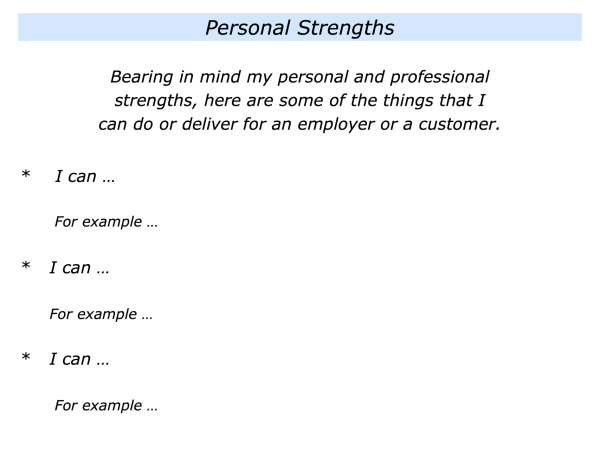
Bearing in mind their personal and professional strengths, this invites them to describe some of the things they may have the ability to do or deliver for an employer or a customer.
Some people may find this challenging. So, if appropriate, you can encourage them to focus on certain themes – such as encouraging people, delivering certain project or other activities. They may then be able to bring these to life by giving specific examples.
Here is the exercise on this topic. This can be adapted in different ways, of course, but the key is to clarify what the person can deliver to help a potential employer or customer to achieve their goals.
Imagine that you have done this exercise with a person. It can then be time to move on to the next step in shaping their professional career.
Possible Ways Forward
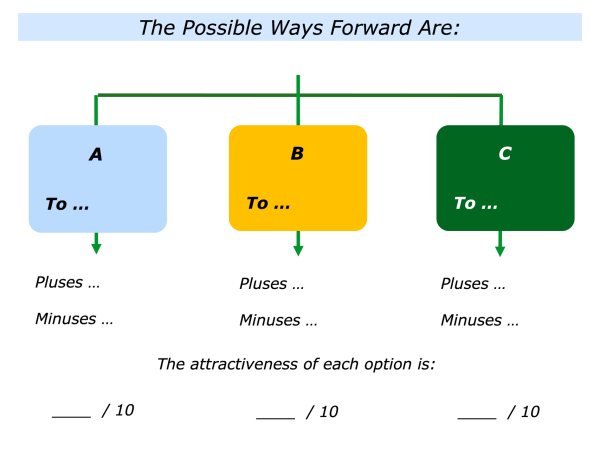
This step begins by brainstorming the possible routes the person can follow in the future. When doing this, it can be useful to bear in mind: a) the person’s strengths; b) the kinds of work they would find satisfying.
At this point it can be important to explore all the possible routes rather than be concerned about how to pursue them. That part can come later. Bearing this in mind, it can be useful to brainstorm:
The possible routes the person can follow in the future … The pluses and minuses of each option … The attractiveness of each option on a scale 0 -10.
Different people will brainstorm different options. Bearing in mind their strengths, here are some of the most common routes. They may consider aiming:
To stay in their present role in their organisation;
To build on their strengths and create a more satisfying role in their present organisation;
To move to a more satisfying role in another organisation;
To go the professional freelancer route and do various projects;
To set up their own business and work with certain kinds of customers;
To consider making a radical shift in their lifestyle and work;
To explore other possible options.
Again, much depends on the person’s situation, but it can be worth helping them to brainstorm the potential options going forwards. Here is the exercise on this theme.
Imagine at a person has begun to map out the possible routes they can travel. If appropriate, you can then help them to take time to reflect and consider the various options.
At a certain point you may also invite them to look at the various options and explore the following themes.
Which for them is the most attractive option? Looking ahead, are there any other potential options? For example, is it possible to combine some of the elements each route and create another option?
At some point you may also use your creativity to explore any other potential ways forward. When doing so, it can be useful to ask the person if it is okay to share some ideas.
Imagine that the person has said it is okay to share your ideas. If so, you may want to say something along the following lines.
“Another option could be to …
“Another could be to …
“Another could be to …”
This calls for sharing ideas that could help the person to move forward. When doing so, it can also be good to look for any of the ideas that resonate with the person.
Again, you are focusing on the possible ways forward. You are not yet looking at how you to make these happen. When appropriate, you may then move on to the next stage.
Professional Transitions
Imagine that the person and you have explored the previous stages. At this point is can be useful for the person to decide on the route they want to pursue.
Different people will choose different ways forwards. A person may choose to improve their present role, move to another organisation, embark on a totally new career or pursue another option.
Whichever route they choose, it can be useful to help them to focus on how they can set positive goals, follow positive strategies and do their best to get positive results. Let’s explore these themes.
Positive Goals
This step involves helping the person to set positive goals. Much depends, of course, on the route they have chosen to follow. Let’s consider one example.
Imagine that the person has decided to try to find a role where they can build on their strengths and do satisfying work. This could involve them taking the follow steps. They can aim:
To clarify the specific things they can deliver that will enable a potential employer to achieve;
To clarify the specific things they can do to find or create a potential role where they can deliver these things to help a potential employer to achieve success.
To clarify the specific things they can then do to get some quick wins and deliver ongoing success.
Different people will, of course, set different goals when focusing on their desired picture of success. Whatever route they follow, however, they may then focus on the next step.
Positive Strategies
This step involves following the strategies most likely to work. Again, much depends on the kind of work the person is aiming to do in the future.
Bearing this in mind, however, let’s return to the example of a person who is aiming to do satisfying work with a potential employer. One approach is for them to take some of the following steps.
They can look for suitable roles
and apply for these directly
This approach can sometimes work but many experienced people find it can be time-consuming and challenging. It can also sap their confidence. Bearing this in mind, let’s explore another option.
They can aim to find a role by
focusing on their professional network
Many people get jobs through their network. This is because decision makers are more likely to hire people they know who can deliver certain results. There are several ways to find a role through their network. These can involve either:
The person being hired by somebody they have worked with in the past;
The person being recommended to others by somebody in their network.
There are several things to bear in mind when taking this route. Some of these sound counter intuitive but they can lay the ground for achieving success. The first one is this:
Real networking is about encouraging other people and helping them to succeed. It is not about self-promotion.
People who get work through their network have often spent a lot of time encouraging others. They do not suddenly send people an email asking for a job.
The best time for a person to give to their network is when they have a job. They can then aim toencourage people in their network by showing an interest in them and their aspirations.
One approach is to meet people or keep in touch via Zoom. It can then be useful to do some research before the session. This involves aiming:
To clarify what is happening in the other person’s world;
To clarify any challenges the person faces or the goals they want to achieve;
To clarify how to pass on knowledge or practical tools to help the person to achieve success.
Different people follow this approach in different ways. Some meet face to face. Some send articles, materials or ideas that people may find interesting.
People who take this approach often find it rewarding to encourage others. Sometimes it can lead to conversations that produce future job possibilities. This can also overlap with the next step.
They can communicate what they can
deliver to help people, teams or
organisations to achieve success
As mentioned earlier, it is vital to have previously taken the following steps. First, to clarify their strengths. Second, to clarify the specific things they can deliver to help people, teams or organisations to achieve success.
Imagine that a person is clear on these things. They can then move on to the next stage. They can aim:
To clarify how they can position what they offer in a way that could be attractive to potential employers.
The latter point is crucial. It is vital to focus on the potential employer’s agenda.
Some individuals make their application about them. They often list their skills and experience. Whilst this may be relevant, the key is for a person to describe what they can deliver to help the employer to achieve success.
Let’s explore how a person can follow this approach when communicating with people in their network. Depending on their situation, there are at least two kinds of emails they can send to people
The Passing On What Works Email
The first type of email is where they do some research and focus on the person’s or organisation’s goals. If appropriate, they can then share positive models and practical tools they have seen work in these areas.
When doing this, it is important that: a) they have seen specific examples that work; b) they just want to share the ideas without asking for anything in return.
People buy success rather than the theory of success. So it can be useful to share what they have seen work. They may want, in their own way, to write something along the following line.
Positive Results
Dear …
Hope that things are going well with your various ventures.
Looking at some of the things your organisation is focusing on, it seems that you are aiming to do superb work in the following areas:
*
*
*
I am sure that things are progressing well. If you are ever interested, however, I would be happy to share some of the positive models and practical tools that I have seen work in these areas.
You will, of course, have your own approach. But if you – or any of your colleagues are interested – I can pass these ideas on.
This would be done on an informal basis. People can then use these practical tools in their own ways to tackle challenges or reach the goals.
Let me know if you may ever be interested and then we can go from there.
The Professional Update Email
The second type of email is one where they are sharing that, whilst they may be happy in their present role, they are aiming to deliver certain things to an employer in the future
Below is an example of the kind of email that some people may send when exploring new possibilities. This is quite business-like in terms of describing what it is possible to deliver to a potential employer.
This gives one example of what a specific person would be able to deliver – such as leading superb teams. But each person will be able to deliver different things to help an employer achieve success. It is therefore important for a person to tailor this approach in their own way.
A Professional Update
Dear …
As you know, I have been working at … some time. This has been enjoyable and also rewarding to work with excellent people.
Looking ahead, however, there will come a point when I begin exploring possibilities for moving on. The aim will be to work with an organisation that wants to continue to deliver excellence in its chosen field.
Much depends on the organisation’s goals, of course, but here are some things that I could deliver for such an organisation. These include the following:
To build superb teams that coordinate their strengths and align their efforts to achieve the organisation’s goals;
To enable people to perform excellent work, focus on continuous improvement and help the organisation to build a great reputation;
To maintain a positive culture in which people take responsibility, have high morale and help the organisation to achieve ongoing success.
There are lots of practical examples I can give about how to achieve these results. But the key would be to focus on helping the organisation to achieve its specific goals.
Looking ahead, let me know if you think there may be any people in your network who may be interested in having these things delivered for their organisation.
I would then be happy to have an informal conversation with them about how it would be possible to deliver these results.
As mentioned earlier, many jobs come via a person’s network. When taking this approach, however, it is important to do so in a way that does not put pressure on people.
They can prepare properly for an
interview with a potential employer
There are many ways to prepare properly for an interview. Before doing so it is vital to do lots of research. This includes a person focusing on a specific role and exploring the following themes.
What are the organisation’s goals? Looking at the role, what will be the results I will be required to deliver towards achieving these goals? Bearing in mind my strengths, to what extent will I find the role satisfying?
What is the organisation’s culture? What may be the potential pluses and minuses of working in the culture? Who will be the stakeholders I need to satisfy? What is their style of leading, managing or working?
Looking at these things, do I want to go for the role? If so, what can I do to prepare properly for the interviews? How can I show that I want to make a positive contribution towards achieving the organisation’s goals?
Imagine that the person wants to apply for role. As mentioned earlier, there are many ways to prepare for an interview. The following section describes one approach.
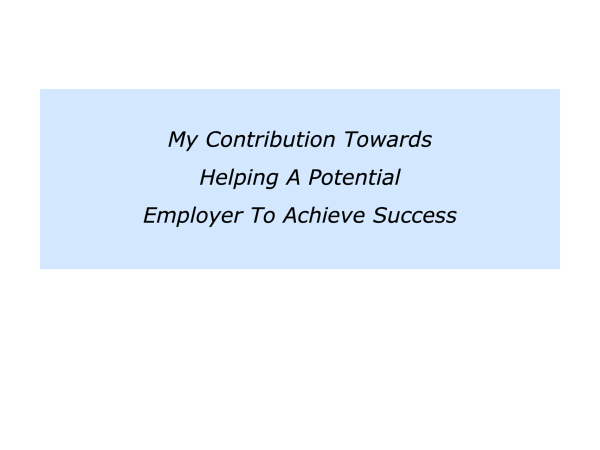
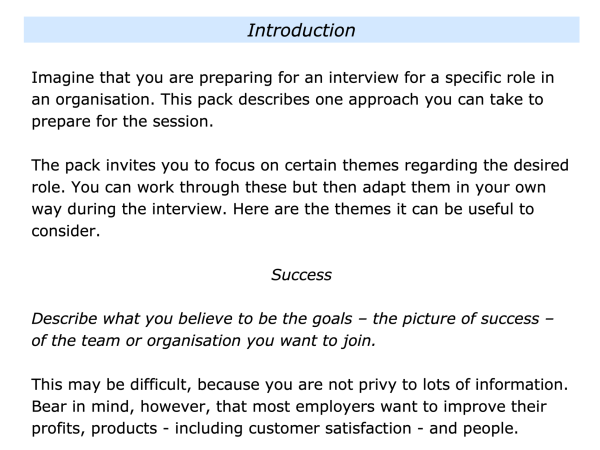
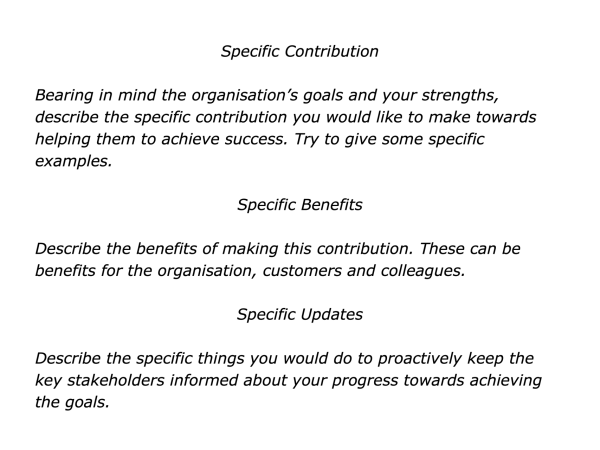
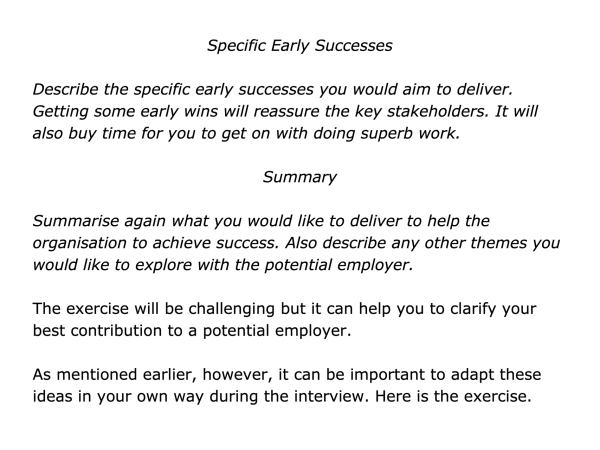
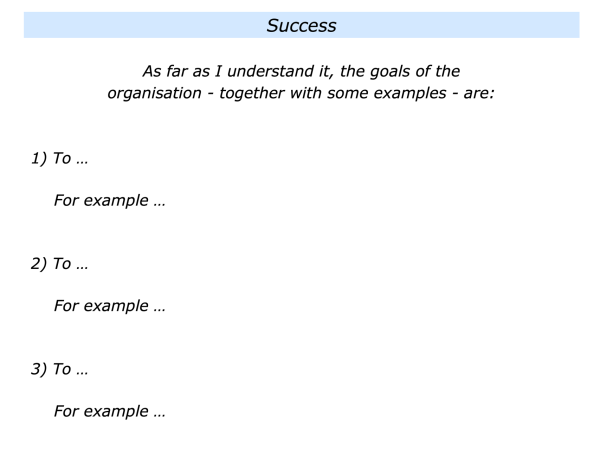
This involves a person working through a pack that invites them to clarify their contribution towards helping a potential employer to achieve success. The pack was created many years to help people who had been laid off when their company went into administration.
The key was to focus on how they wanted to help the potential employer to achieve success rather than to try to sell themselves. Many people found it useful and reported it gave them a head start when going for interviews.
Different people will, however, adapt the pack in their own ways. Here are the topics it invites a person to explore when focusing on a specific role.
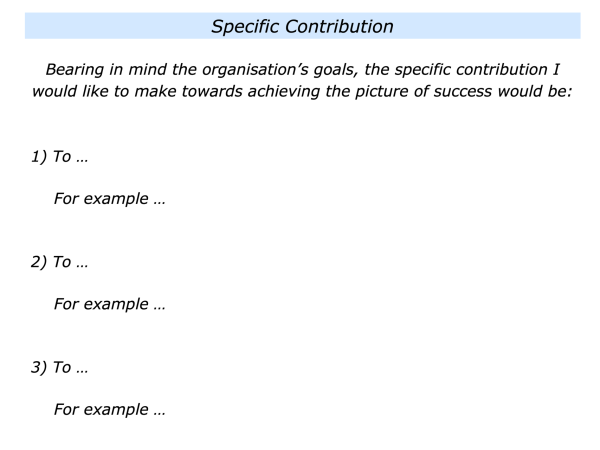
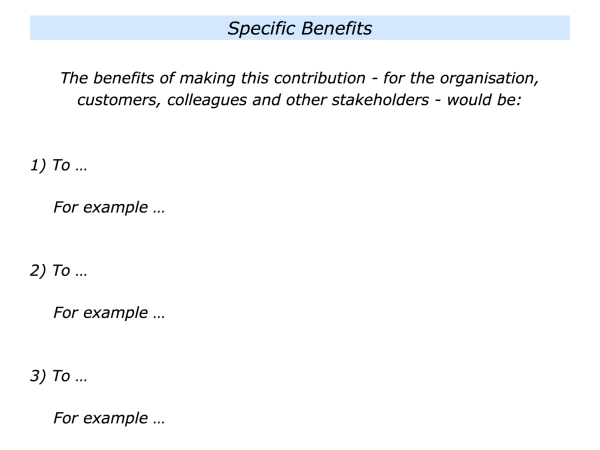
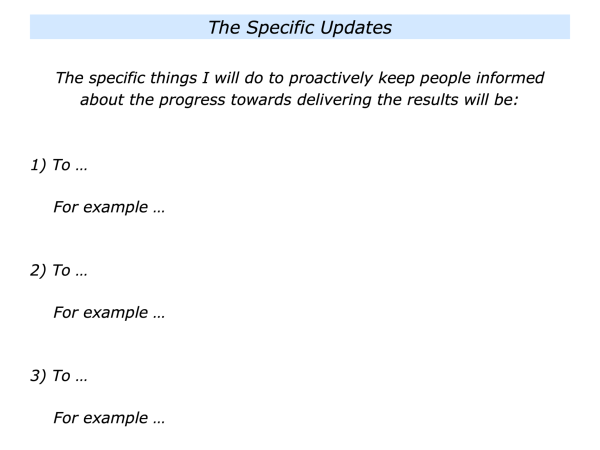
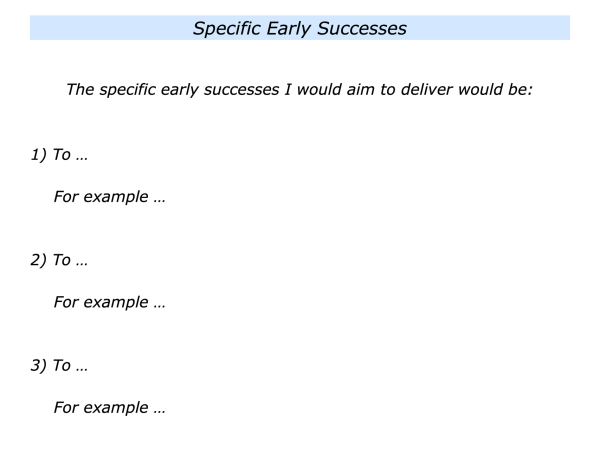
Imagine that the person has worked through these or other steps and has found their next role. It can then be time to move on to the next stage.
Positive Results
This step involves a person doing their best to get some quick wins and then going on to deliver positive results. The way they do this will often depend on the kind of work they are doing.
A person moving into a sales role, for example, will aim to get some early sales. This can help to reassure their new employer and also help to build their credibility.
A person setting up their own business may focus on helping people in their network. This may begin on a non-funded advisory basis but may then turn into doing a funded project that delivers success.
A person taking over an organisation may communicate the purpose, principles and picture of success. They may then work with some of the positive people to produce quick wins and builds momentum.
Whatever route a person takes, it can be important to help them to get an early success. This can help to build confidence and buy time. It can also create the platform for achieving future success.
Let’s return to the beginning. There are many ways to help a person to make professional transitions. One approach is to start by getting the full picture of their situation.
You can then help the person: a) to clarify their personal strengths; b) to clarify their possible ways forwards; c) to follow their chosen path and make a positive transition.
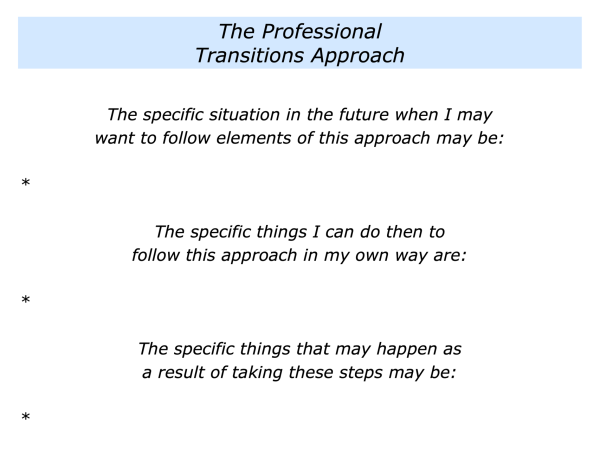
Looking ahead, can you think of a situation where you may want to follow elements of this approach? How can you do this in your own way? What may happen as a result of taking these steps.
If you wish, try tackling the exercise on this theme. This invites you to complete the following sentences.

Leave a Reply