



Roger made a great contribution to peace. Known for his books on negotiation such as Getting To Yes, his obituary in the Economist described him as a lawyer, teacher and peacemaker.
His approach was different from that of many lawyers. Roger focused on creating alignment, rather than seeing negotiation as an adversarial process. He believed the keys were for people:
To sit down together side-by-side;
To show respect, listen and understand each other’s needs;
To focus on the job to do – which was to find a solution;
To work together to solve the problem;
To build the foundations for ongoing peace.
Roger was invited to help people to resolve differences in many parts of the world. He often began by helping people to get to know each other and build rapport.
This involved doing simple things such as eating together, listening actively and focusing on common interests. When appropriate, he would then say:
“We have a shared concern here. Let’s work together. How do you see it?”
Background
Roger served in the Second World War as a weather reconnaissance officer. But he was strongly affected by the loss of many friends.
During his service he also flew morning flights over Japan. This was before the bombing of Hiroshima and Nagasaki. According to people who knew him, the memory of these flights – and the unnecessary deaths of many people in war – weighed on him.
Although building a great reputation in the academic world, he threw himself into applying the ideas in practice. This involved him working in Europe on the Marshall Plan.
Later he contributed to seeking peace in the Middle East. This involved working on President Sadat’s trip to Jerusalem and the subsequent summit at Camp David.
He played a significant part in helping to release the United States citizens taken hostage in Iran in 1981.
Roger helped to resolve the war between Ecuador and Peru. He also spent considerable time in South Africa, helping to bring together people to end Apartheid.
Philosophy
Roger believed it was important for people to build on what they had in common. He taught law students to focus on alignment. This was uncommon in law, where people often took adversarial positions.
He also believed it was vital for the parties involved to show respect to each other as human beings. Wherever possible, it was important to separate the ‘problem’ from the people.
Roger also said it was vital to focus on the basic needs. These are often the most powerful interests motivating people. He described this approach in the following way.
In searching for the basic interests behind a declared position, look particularly for those bedrock concerns that motivate all people.
Basic human needs include: security, economic well-being, a sense of belonging, recognition and control over one’s life.
If you can take care of such basic needs, you increase the chance both of reaching agreement and, if an agreement is reached, of the other side’s keeping to it.
Roger believed that, providing you looked at what each of the people wanted, it was then often possible to solve the problem.
The difficulty was that the solvable problem had often become complicated by the personal feelings – such as anger and disappointment – becoming wrapped in the problem.
His work became widely known as a result of the book he co-wrote with William Ury, Getting To Yes. Since its publication in 1981 it has sold many millions of copies. This described how people could follow five principles to find solutions.
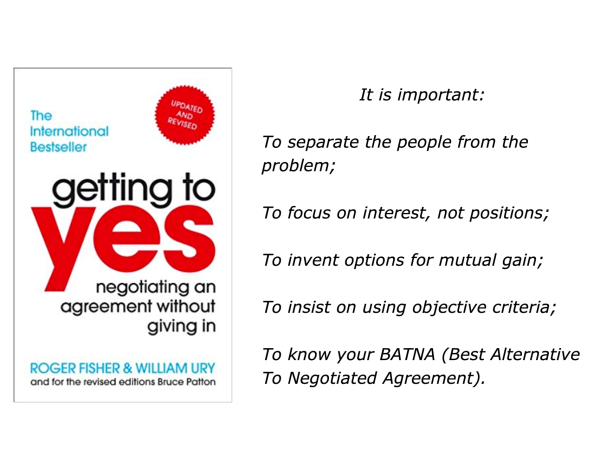
Roger used his warmth, compassion and skill to help many people find solutions to challenges. He summarised his approach in the following way.
Any method of negotiation may be fairly judged by three criteria:
It should produce a wise agreement if agreement is possible;
It should be efficient;
And it should improve or at least not damage the relationship between the parties.
Roger spent more than 40 years as an academic at Harvard, where he taught law. But he also immersed himself in helping people around the world to find solutions to challenges.
The Economist magazine highlighted this when publishing an obituary about his life and work. Here is an excerpt from how it described his approach.
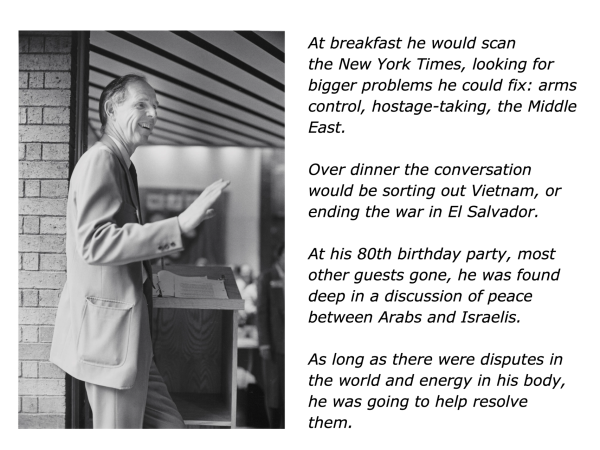
Roger Fisher was really a fixer. He would relax by mending the plumbing, or laying brick terraces at the summer house he loved in Martha’s Vineyard. But that was tiddler stuff.

Leave a Reply