



Imagine that you lead an organisation. One approach is to build on the positive people who behave in a professional way. You can encourage them to use their strengths to help the organisation to achieve its goals.
There may be one person, however, who behaves in a way that creates collateral damage. The following section explores several ways that you may want to focus on this situation.
You Can Decide If You
Would Rehire The Person
This can be the first theme you may want to explore. It is to ask the following question:
“If this person left and then reapplied to work in the organisation, would I rehire them?”
If the answer is ‘No,’ then you have a decision to make. You may choose either:
To replace them straight way;
To replace them when you have found a way to replace the work they are doing and, in the meantime, act to reduce any damage they may cause;
To give them the opportunity to choose to behave in a more professional way;
To explore other options, such as sidelining them or them doing a specific project where their behaviour does not affect other people.
One key will be to make a decision that is based on what is best for the organisation. It is then to implement this decision in a moral way.
Imagine, however, that you have decided to give the person a chance to choose to behave in a more professional way.
The following section looks at several ways to follow this approach. The first route could be considered ‘softer’ but also clear. The second is extremely clear. Let’s explore these possible ways forward.
You Can Describe The Best Way That
The Person Can Help The Organisation
This is an approach that can be followed when, for example, a person has been with an organisation for a long time. Let’s look at one such situation.
One senior person had been with the company for ten years. They had previously played a key role in helping to shape and implement the company’s strategy.
Since the company had grown, however, the senior person found themselves being asked to do a specialist role. Whilst being good in their area of expertise, they also felt the need to interfere in other areas.
The leaders of other departments now found the person’s behaviour to cause problems. Whilst trying to show respect to the senior person, they found their interference to be distracting.
The senior person had strong views about various aspects of the company, however, and wanted to make these known. But there were two issues with their chosen approach.
First, the senior person sometimes expressed these views in a critical way rather than using their expertise to offer potential options for going forwards.
Second, the senior person’s views were sometimes not necessarily applicable to how a modern organisation could perform at its best in a fast evolving world.
The Chief Executive Officer therefore decided to have conversation with the senior person. They chose to do this in a positive and friendly way, however, to see if this might work.
This involved positioning the possible way forward in a certain way. They met with the person and gave them the following messages.
“As we know, you have specific strengths. These include the following. You are able: a) to … b) to … c) to … These can bring great value to the company.
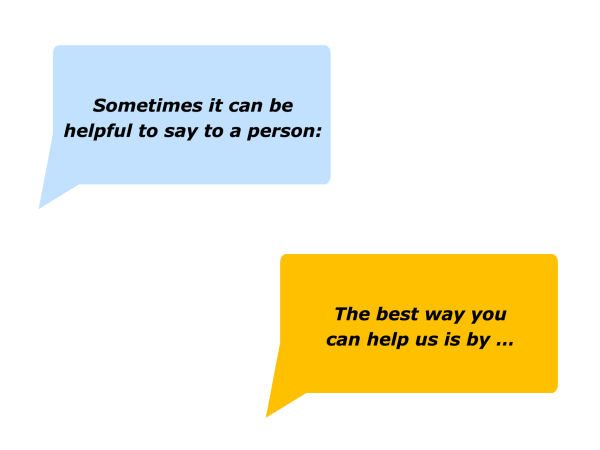
“Looking ahead, I believe the best way you can help us as a company would be by doing the following things.
“To focus on doing this specific project. The benefits to the company of delivering this successfully would be …
“To when appropriate – and this may be more challenging – to offer possible options for going forwards in certain situations.
“You have a lot of knowledge. So it would be good if you could offer such options in a way that makes it easier for people to learn from your experience.
“So, in summary, here are the things I would like you to consider.
“First, to focus specifically on the important project you are doing.
“Second, to offer possible options to people in a way that they may find easier to receive.
“Let me know what you think about these suggestions. Then, if appropriate, we can explore how to translate them into action.
“I believe that doing so will help to make sure that you continue to make your best contribution to the company.”
Whilst the senior person respected the CEO, they were slightly taken aback. And, at first, they began to explain why they behaved in a certain way at times.
The CEO listened. But then again repeated how the senior person could make their best contribution to the company. They agreed to meet the following week to focus on an action plan.
During the next few months there were some false starts, but eventually the senior person focused primarily on their specific project. The next challenge was to find another project that built on their strengths and also helped the business.
The person found it harder to channel their passion during some meetings. The other leaders found ways to manage this, however, and sometimes make good use of the senior person’s ideas.
The CEO continued to meet regularly with the senior person. They did this in a sincere way to give them the chance to be listened to and to share their ideas. So far this has worked in a relatively fruitful way.
Let’s look at another approach to tackling this kind of situation in an organisation.
You Can Ask The Person To Decide If They Want
To Follow The Desired Professional Standards
Imagine that you have suggested how a person can make their best contribution but they have not responded in a positive way. Bearing this in mind, you may therefore move on to the final approach.
You can give a person the chance to decide if they are prepared to follow certain professional standards in the future. Whilst this can be a moral approach, it can be important to bear the following things in mind.
You can decide whether you really want to take this approach – because it can take time and effort.
You can clarify the professional standards you want the person to follow in the future.
You can rehearse what you are going to say and how the person may react – plus your back up plans for each scenario – and avoid getting into arguments.
Imagine that you want to follow this approach. When appropriate, you can meet with the person. Then, if you wish and using your own words, you may want to say something along the following lines.
“As you know, the purpose of our organisation is to …
“Bearing this in mind, we want our people to follow certain professional standards. For example:
“To …
“To …
“To …
“Looking to the future, I would like you to take time to reflect and decide if you want to follow these standards. This is your choice.
“If you do want to follow these standards, then we can focus on how you want to translate these into action. If not, then we will find another way forwards.
“As I said, this is your choice. So I would like you to take time to reflect and then get back to me with your decision.”
Different people may react in different ways. Some may be open to the ideas. Some may want to argue. Some may say they will follow the standards but then relapse. Some may threaten legal action.
Imagine that you have anticipated all these scenarios and planned your responses. As mentioned earlier, it important not to get into arguments. If appropriate, you can simply repeat the following message.
“As I said, this is your choice. I would like you to take time to reflect and decide if you want to follow these professional standards. We can then go from there.”
Sometimes this approach can work. It can take a lot of time and effort, however, so it is important to decide if you want to follow it. Whatever approach you use, it can be important to have a back up plan.
Let’s return to your own work. Can you think of a situation where you may want to follow the softer but clear approach. This would be to say to a person something along the following lines:
“Looking ahead, the best way you can help us is by …”
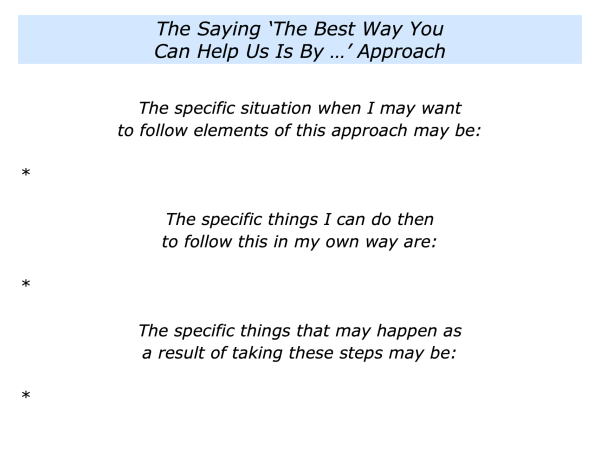
What may be the situation where you may want to take this approach? How could you follow it in your own way? What do you think may happen as a result of taking these steps?
If you wish, try tackling the exercise on this theme. This invites you to complete the following sentences.

Leave a Reply