



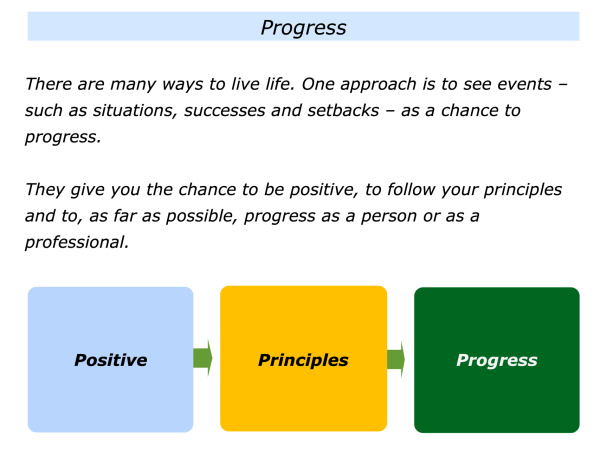
There are many ways to live life. One approach is to see events – such as situations, successes and setbacks you experiences in life – as a chance to progress.
They give you the chance to be positive, to follow your principles and to work towards your view of progress. They give you the chance to do this as a person or as a professional.
There are, of course, many views about what people see as progress. Here are some of the most common approaches.
Some see progress as gaining money, recognition, promotion or other definitions of success. They may also compare themselves to others in terms of achieving certain kinds of prizes or status.
Some see progress as taking steps towards achieving their life goals. They may aim to continue to build positive relationships, do positive work and make a positive contribution during their time on the planet.
Some see progress as a lifelong journey. They see it as continuing to be positive, being better at following their principles and doing their best to achieve positive results.
The following sections explore how people may aim to follow the latter approach in their lives or work. This can involve focusing on the following themes.
Seeing Situations As
A Chance To Progress
Different people see different situations as a chance to progress. They may then focus on how they can follow their principles and achieve positive results. Let’s look at some examples.
An athlete may aim to do their best when it matters. They may prepare properly and rehearse what they are going to do. They may then move into action, be fully present and aim to deliver a peak performance.
An educator may aim to help their students to develop. They may clarify what the students want to learn and their specific goals. They may then provide them with practical tools they can use to achieve success.
A medic may aim to perform a necessary life-saving operation that stretches their abilities. They will then follow the key procedures, focus on the intricate details and save the patient’s life.
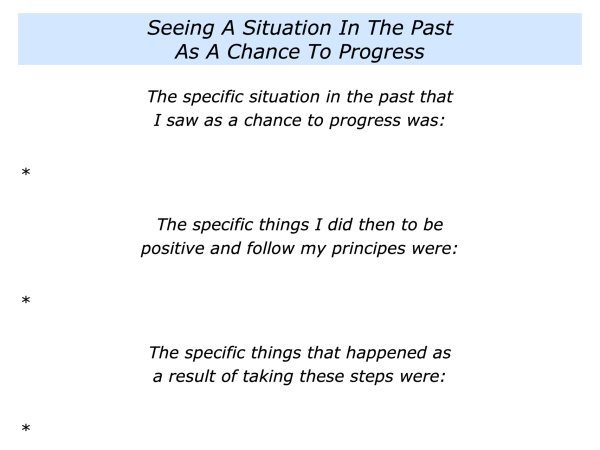
Let’s return to your own life and work. Looking back, can you think of a situation that you saw as a chance to progress? This could have been in your personal or professional life.
You may have aimed to do your best to pass an exam, get a job, run a marathon or develop a skill. You may have aimed to perform in a musical, build a website or test yourself by tackling a challenge.
What did you do then to have a positive attitude? What were the principles you aimed to follow? How did you translate these into action? What did you do to, as far as possible, achieve your picture of success?
If you wish, try tackling the exercise on this theme. This invites you to complete the following sentences.
Seeing Successes As
A Chance To Progress
There is a commonly held view that people can learn more from their mistakes than their successes. But this assumes that people have the ability to focus on what they could do better in the future.
Great workers also learn from their successes. Much of sports psychology involves athletes learning from the times when they have performed brilliantly. This often involves inviting them aiming:
To clarify a specific situation in the past when they delivered a peak performance;
To clarify what they did right then – such as the principles they followed and how they translated these into action – to deliver a peak performance;
To clarify how they can follow these principles – plus maybe add other skills – to deliver peak performances in the future.
Many people can learn from their positive history. A company I worked with did this several years ago. During one of our sessions they described a challenge they faced in the following way.
“We used to be successful at pitching for business but that is no longer the case. We are having a deep dive inquest into finding out why we are failing.”
Another approach would be to recall the times when they had a higher success rate. We therefore explored what the company had done right when pitching for business during its early days.
People focused on several situations in the past when they had won business. After half an hour they produced a flip chart that showed the principles they had followed. This included the following points.
We were hungry … We did lots of research about the potential client’s challenges and goals … We clarified the exact topics to be covered during the pitch … We clarified who would be the final decision makers.
We put together the right team … We rehearsed a lot ahead of time … We started the pitch by focusing on the client and their needs – not by describing how wonderful we were.
We showed how we could help them to succeed … We presented the approach in an attractive way … We also gave specific examples that resonated with the potential client.
The company decided to return to these principles. They put together hungry a pitch team that aimed:
To really get to know the potential client … To show how the company could help them to achieve their goals … To practice, practice, practice – and then to deliver a pitch that was attractive to the client.
During the next months they won a greater percentage of pitches. Whilst they kept follow certain principles, they also expressed these in a modern way that could help the client to achieve success.
Seeing Setbacks As
A Chance To Progress
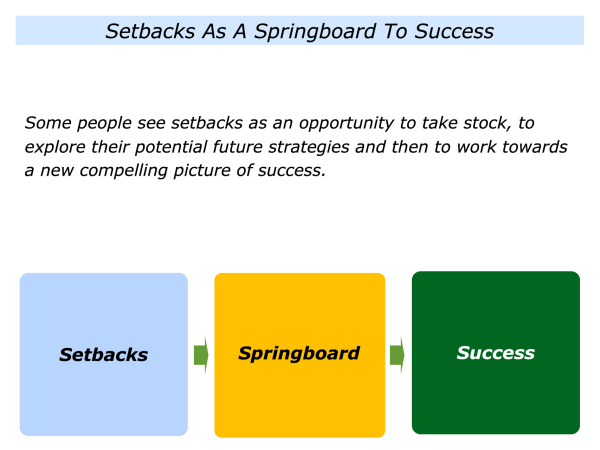
Everybody has both successes and setbacks. Some people build on the successes. Some people also use the setbacks as a springboard to achieving future success.
Different people follow the latter approach in different ways. Some focus on the following themes:
They take time to reflect, recover and manage the emotions involved with the setback;
They begin to see the setback as an opportunity to take stock and consider their potential future strategies;
They then use the setback as a springboard towards achieving future success.
Such a person may then aim to have a positive attitude, follow certain principles and work towards their picture of success.
A young football player may be discarded by their club or suffer a career-ending injury. They may reframe this as an opportunity to become a coach or provide advisory services for young players who find their dreams have been dashed.
A person with a harmful addiction may have a traumatic experience. This may lead them to making a decision regarding their future. They may ask:
“Do I want to live longer? Or do I or want to continue with my addictions and die soon?”
They may then aim to follow the principles embodied in a recovery programme. These can include taking responsibility, helping others and staying healthy one day at a time.
A company that hits the rocks may see it as an opportunity to shape a better future. They may return to doing what they do best with the customers with whom they work best. They may then build a company that creates wins for all its stakeholders.
There are many ways to live life. One approach is to see events – such as situations, successes and setbacks you experiences in life – as a chance to progress.
They give you the chance to be positive, to follow your principles and to work towards your view of progress. They give you the chance to do this as a person or as a professional.
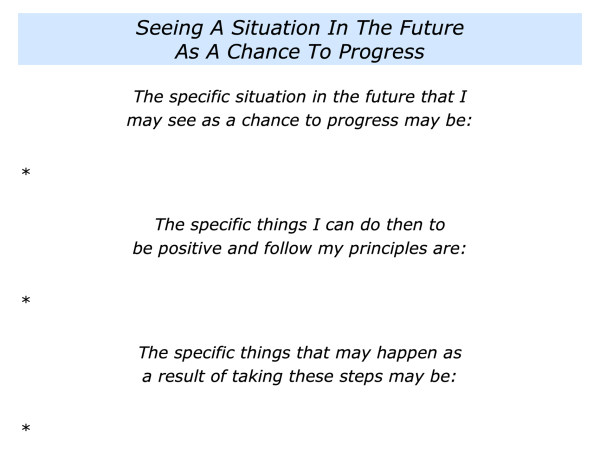
Let’s return to your own life and work. Looking ahead, can you think of a situation where you may want to follow elements of this approach? How can you do this in your own way?
If you wish, try tackling the exercise on this theme. This invites you to complete the following sentences.

Leave a Reply