



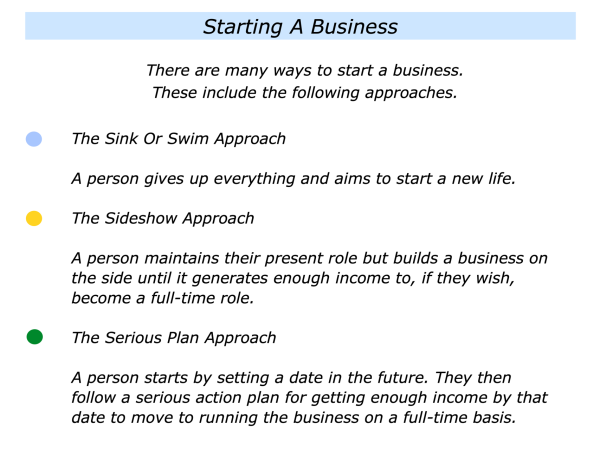
There are many ways to start a business. The following section looks at three different approaches. Some of these include setting a deadline. If appropriate, you could help a person to explore and follow their chosen route.
The Sink Or Swim Approach
A person may reach a point where they feel unhappy in their work and want to change everything immediately. They may say something like the following.
“I am totally fed-up with my present job. So I will hand-in my notice on Friday, give-up everything and start my own business. I will make it or bust.”
This sounds brave and it sometimes works. There may also be certain kinds of people who may pursue this route successfully. These include the following.
First, emigrants who leave their country and start again with few assets. They work hard from day one and are streetwise. Spurred on by needing to put food on the table, they find or invent creative ways to achieve success.
Second, entrepreneurs who start their business fired by anger. They may have got sacked or become frustrated when trying to get an idea through the bureaucracy of an organisation. They may say something like the following.
“I will show them. I will never be beholden to anybody again.”
There are some people for whom this approach is less likely to work. Those who are semi-institutionalised or think that if they have a good idea the money will roll-in.
The pluses of the sink or swim approach are that a person can start straight away. They are forced to use their creativity and feel great if they succeed. The minuses are that they may have little security, few customers and may use all their energy just to survive.
The Sideshow Approach
People who follow the sideshow approach often take a longer-term view and minimise the risk when starting a business. Looking ahead, they may say something along the following lines.
“I will keep my full-time job, but develop my own business on the side. I want to make sure that the business works before making the transition.
“If the business does take off, then I will quit my present job. I will invest the time and money needed to make the business into a profitable enterprise.”
The person who takes this approach may need: a) to continue to be super professional in their present role; b) to make sure the new business does not clash with their present employer’s goals.
The pluses of this approach are that a person retains a sense of security. They can also test many ideas to see what works. They can then transition to the side business without risking everything.
The minuses are that the person may feel split and exhausted. They may never be able to sufficiently build the business to generate enough income. They may also still need to take a calculated risk before going full-time.
The Serious Plan Approach
A person who takes this approach starts by setting a date in the future. They then follow a serious action plan for getting enough income by that date to move to running the business on a full-time basis. Such a person may say something along the following lines.
“I will stay in my present job for the moment, but aim to transition to my new business in six months. By that date I aim to have enough customer orders to bring in a profit for the first quarter.
“Starting from the end goal and working backwards, I will make a specific plan that shows the concrete things I must do each month to translate the dream into a reality.
“I will then aim to get some quick wins and then do something every day towards getting future customers. This will increase the chances of achieving the goal by my chosen date.”
The serious plan approach can succeed, but it needs a person to act with an appropriate sense of urgency. This final point is crucial because they need to be decisive rather than just to drift. One approach is to invite them to consider the following scenario.
“Imagine that your present job is going to disappear in six months and by that time you want to be running your own business. Who would be the first three potential customers you would contact?
“Bearing in mind your strengths, what would you offer to these people? What could you deliver that would help them to be successful? Bearing this in mind, do you think you would be able to survive?”
People invariably say they would survive, perhaps even thrive. They may only leap into action, however, when the knife is on their throat or they aim to get the business up and running by a certain date.
The pluses of this approach are that a person can build a customer base and minimise the risks. They can also reach specific milestones along the road and create the basis for building a successful business.
The minuses are that they must continue to be disciplined and encourage themselves on the journey. Like many driven business people, however, they may never feel 100% certain of financial security.
There are many ways to start a business. These include the sink or swim, sideshow or serious plan approaches. As mentioned earlier, each of these has both pluses and minuses.

Leave a Reply