



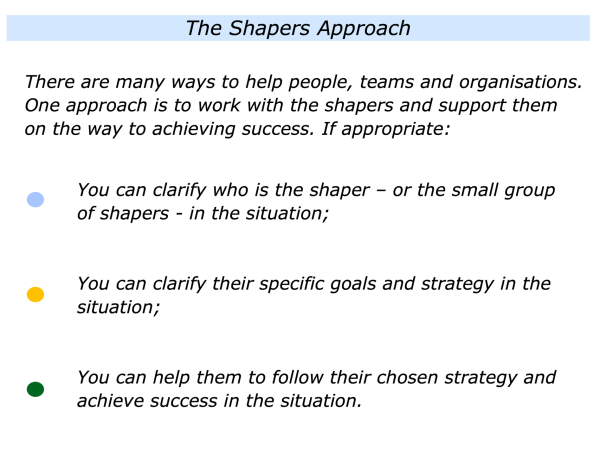
There are many ways to help people, teams and organisations. One approach is to work with the shapers and support them on the way to achieving success.
This is a more effective approach than, for example, being a consultant who shares ideas with lots of people in a situation. Whilst that can sometimes bear fruit:
It can be more effective to focus on the person – or the small group
of people – who have the ability to shape the future in a situation.
Imagine that you are aiming to help a person or a group of people to achieve certain goals. One approach is to focus on the following themes.
You Can Clarify Who Is
The Shaper In A Situation
You can clarify who is the shaper in a situation. The way you do this will obviously depend on who you may be aiming to help. Let’s look at some examples.
Working With An Individual
Imagine that you may be helping an individual to work towards their personal or professional goals. That person is obviously the shaper in this situation providing:
They are choosing to take responsibility … They are focusing on what they can control … They are prepared to work towards achieving their chosen goals.
They will have an internal locus of control and say things like: “I can make things happen.” They will not have an external locus on control and say: “Things happen to me.”
Such a person will aim to shape their future. They will then do their best to work towards their picture of success.
Working With An Organisation
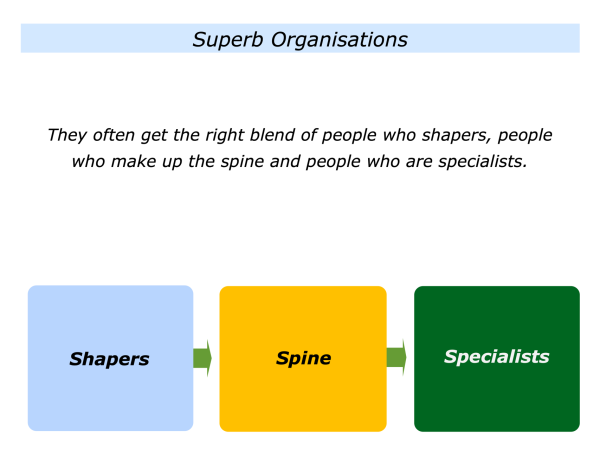
Imagine you are helping an organisation to achieve its aims. Some organisations are made up of people who play the following roles when making their specific contributions.
The Shapers
Such people often have strong personalities and make the key strategic decisions. This may be one person, two people or a small group who set the organisation’s direction and goals.
The Spine
These are senior leaders or managers who aim to translate the strategy into action. They make clear contracts about the outcomes to deliver and then aim to deliver these goals in their parts of the organisation.
The Specialists
These are people who offer specific skills. It is important for them to make clear contracts about the outcomes they are to deliver and then make their best contributions towards achieving the organisation’s goals.
One point can be worth bearing in mind. Some senior people in the C-Suite may believe they are shaping the strategy. Whilst they may be asked for their input, many organisations have one or two key people who make the key decisions.
Some C-Suite members may be in charge of the spine and making sure the strategy is implemented. Such people may be shapers in their own parts of the organisation, however, where they shape the culture.
Imagine that you have the chance to work with the key shaper or a small group of people who are shapers. There are certain things to bear in mind that can increase the chances of success. It can be helpful:
To establish credibility with the shaper, or the small group of shapers, but to do this in your own way – don’t try to be something you are not;
To connect with them in a way that shows you understand their challenges and goals;
To share knowledge and practical tools they can use to achieve their goals.
Later we will explore how you can work with the shaper – or a small group of shapers – to help them to achieve their goals. Before then, let’s consider another scenario.
Working With A Small
Group Of People Or A Team
Imagine you are helping a small group of people to deliver something specific. It can be helpful to clarify the extent to which they have the authority to shape things. Such people may have been asked:
To tackle a particular challenge and find solutions that will deliver ongoing success;
To launch a new product or service that will help the organisation and its customers to achieve success;
To build a successful a prototype that will help the organisation to achieve future success.
The small group or team will need: a) to clarify the specific goals to achieve; b) to clarify the guidelines to follow; c) to clarify the autonomy they have – within certain parameters – to deliver the goals.
Such people need to make clear contracts with their key stakeholders about each of these areas. This can provide clarity regarding the extent to which the can shape things on the way towards achieving the goals.
Let’s return to the main theme. Imagine that you have clarified who is the main shaper – or small group of shapers – in a situation. This can lead to focusing on the next theme.
You Can Clarify Their Specific
Goals And Strategy In A Situation
Let’s assume you know what a person or a group of people can do to shape things in a situation. You can then clarify their specific goals and the strategy they want to follow to deliver success.
Working With An Individual
This step can be relatively simple when you are working with an individual. Bearing in mind what they can control in their life and work, the person can aim:
To clarify their specific goals – the real results they want to achieve – and translate these into a clear picture of success;
To clarify the strategy they can follow to do their best to achieve their picture of success;
To clarify how they can build on the pluses and manage any minuses involved on the way to achieving the picture of success.
Imagine that a person has worked through these steps. If appropriate, you can also check their motivation rating. Bearing in mind the pluses and minuses involved, one approach is to ask them the following question.
On a scale 0-10, how high would you rate your motivation to do what is required to achieve your goals?
It is important that the person’s motivation rating is at least 7+/10. If appropriate, you can then explore the specific things they can do to maintain or improve the rating.
Finally, you can invite the person to take time to reflect. They can then decide if they really want to commit themselves to working towards achieving their chosen goals.
As mentioned earlier, this approach can be relatively simple when working with an individual. There can be other situations, however, where it can be more complex. Let’s consider one scenario.
Working With A CEO
Imagine you are supporting the CEO of a pioneering business. The company has so far been successful but it now needs to make some key decisions in order to shape a positive future.
The CEO faces a specific challenge. They and their Board recognise what needs to be done, but not all of the leadership team are aligned. Looking ahead, the CEO and Board have taken the following steps.
They have clarified the specific goals the company aims to achieve and translated these into a clear picture of success.
They have clarified the possible options going forwards – and the pluses and minuses of each option – for working towards the picture of success.
They have settled on their strategy – together with some of the tough decisions that need to be made – to achieve the picture of success.
The CEO would like your views on how to build on the pluses and manage some of the minuses regarding implementing the strategy. Several of these involve finding solutions to some of the people issues.
Imagine, for example, that: a) the CEO and the Board believe it is vital for the company to develop in a particular way, but: b) there are several senior leaders who want to carry on with business as usual.
This is where you can earn your corn. If appropriate, you can share your knowledge, experience and practical ideas regarding the situation by exploring the following question:
How can we find, as far as possible, win-win solutions in this situation?
Looking back at my own experiences, it is often possible to find such solutions. If you working with the CEO, however, it is important:
To clarify all the possible options … To clarify the pluses and minuses of each option … To clarify the option that the CEO wants to pursue.
Imagine that you have helped a shaper to clarify their specific goals and the strategy they want to follow in a particular situation. It can then be time to move on to the next stage.
You Can Help Them To Follow Their Chosen
Strategy And Achieve Success In A Situation
Different shapers want different kinds of support when following their strategy. One approach is to make clear contracts about the role they may want you to play to help them to achieve their goals.
Shapers are often highly driven and decisive. Bearing this in mind, some may simply prefer you to act as a sounding board and occasional reality check as they work towards their goals.
Some Chief Executives may ask you to support some of their colleagues when implementing a strategy. Such an approach can work – but only if those colleagues would like such support.
When appropriate, you can act as a guide on the side to the people who are open to such an approach. With their permission, you can then aim:
To focus on any specific topics they want to explore;
To share practical tools they can use and possible solutions to challenges;
To help them to deliver their part of the picture of success.
When meeting the Chief Executive’s colleagues, it is important that these sessions are confidential. People will then feel more able to open up, explore ideas and apply the ideas in their own ways.
As mentioned earlier, there are many ways to help people, teams and organisations. One approach is to work with the shapers and support them on the way to achieving success.
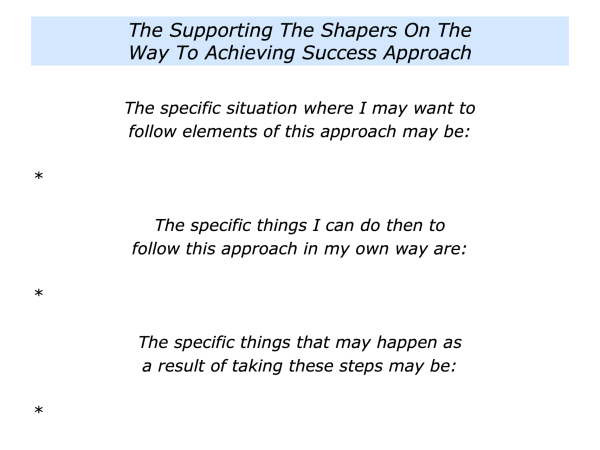
Let’s return to your own life and work. Looking ahead, can you think of a specific situation where you may want to follow elements of this approach? How can you do this in your own way?
If you wish, try tackling the exercise on this theme. This invites you to complete the following sentences.

Leave a Reply