


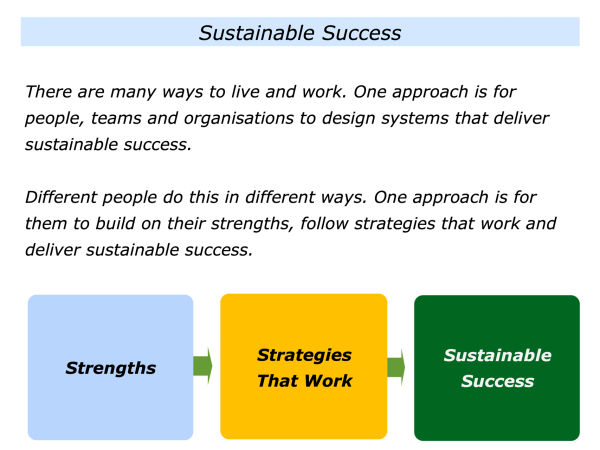
There are many ways to live and work. One approach is for people, teams or organisations to design systems that deliver sustainable success.
This approach starts with people making a decision that they want to shape a positive future. It then involves them aiming:
To build on their strengths … To follow strategies that work … To achieve sustainable success.
Different people do this in different situations. A person may decide they want to develop a healthier lifestyle rather than just deal with their present symptoms.
Such a person may want to take care of their health, spend time with positive people and do more satisfying work. They may then follow good habits one day as a time on the way to achieve their picture of success.
A pioneering organisation may decide it wants to go beyond fixing problems with today’s business. It may then follow it chosen strategy to build tomorrow’s business and shape future success.
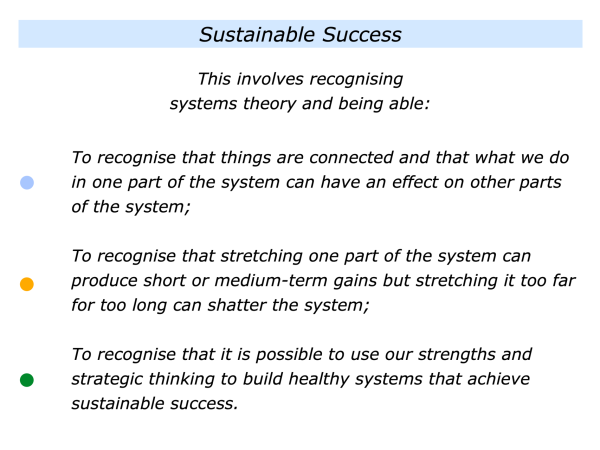
Today many people are aware of systems theory. They recognise: a) that things are connected; b) that what we do in one part can affect other parts of the system.
Such people recognise that stretching a system can sometimes produce short and medium-term success. But continually over-stretching it can lead to the system becoming shattered.
Some people are therefore aiming to build healthy systems. They aim to use their strengths and strategic thinking to build systems that achieve sustainable success.
They see this as a way forward for individuals, teams, organisations, societies and the planet.
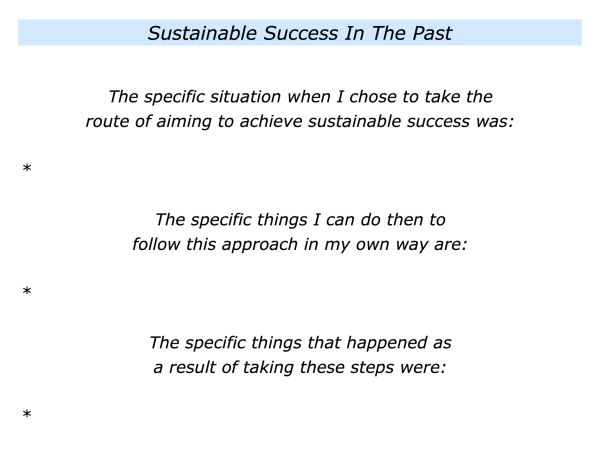
Looking back, can you think of a situation when you aimed to achieve sustainable success? This could have been in your personal or professional life.
You may have chosen to take control of your finances and put your bank balance into the black rather than the red. How did you take this step? How did you maintain this pattern and stay ahead of the game?
You may have moved from a debilitating job to doing satisfying work. What did you do to plan properly, explore all the options and make the move? You may then have continued to be proactive by moving to new stimulating projects in your career.
If you wish, try tackling the exercise on this theme. This invites you to describe when you aimed to achieve sustainable success in a part of your life.
The following pages explore some ways that individuals and organisations can work towards achieving sustainable success.
Clarifying The Picture Of Success
The first step is for people to decide they want to achieve a certain goal. Some decide in an instant after having a Road to Damascus experience. They then translate this enlightenment into action by focusing on effectiveness and delivering excellence.
Some individuals take longer. They like to explore options, let the ideas incubate and make a considered decision. They then make a serious plan, set milestones and work towards achieving success.
People are more likely to follow a particular route if they see the benefits for themselves or other people. Here are some reasons why people may choose to behave in a certain way.
Pleasure
People choose to do things that give them pleasure. They may aim to feel better, be happier or get an adrenaline high. Sometimes they opt for instant gratification, sometimes they work towards a long-term goal.
Pain
People choose to do things that take away physical or psychological pain. They may do this in healthy or unhealthy ways. Sometimes they try to numb the pain, but eventually they may take action to heal themselves.
Profit
People choose to do things that are – in the widest sense – profitable. This can be on an economic or emotional level. It can involve doing things that make them feel better or be better off financially.
The following section explores how individuals and organisations may aim to achieve certain goals. This often involves clarifying their picture of success.
The Individual Approach
Imagine there is an area of your life where you want to achieve sustainable success. You may want to improve your lifestyle, do satisfying work or focus on another area.
Try casting yourself into the future. What will be the specific things that will be happening that will show you have achieved sustainable success in this area? What will be the benefits of achieving this goal?
The Organisational Approach
Imagine you lead an organisation that wants to achieve sustainable success in a specific area. Looking ahead, what will be happening that will show the organisation has achieved its goal? What will be the specific benefits of achieving this goal?
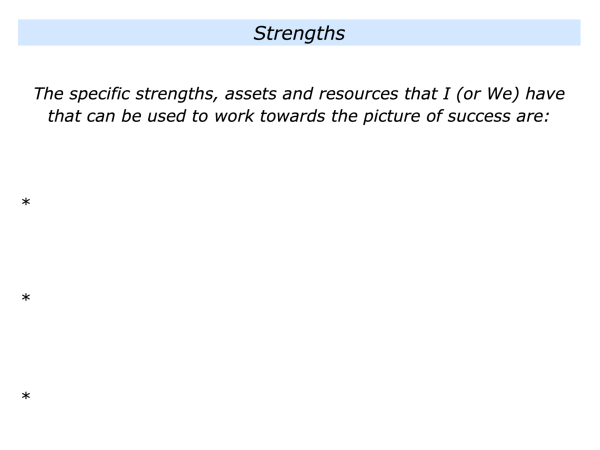
Strengths
Imagine that you are focusing on your own life or work. Let’s assume that you have clarified your picture of success. How can you do your best to achieve this aim?
One approach is to start by clarifying the strengths you have that can be used to help to achieve the goal. This also includes any other assets and resources. Let’s explore this theme.
The Individual Approach
Let’s begin with the first scenario. You may want to develop a healthy lifestyle, do satisfying work or achieve another aim. Bearing this in mind, it can be useful to ask yourself the following questions.
What are my strengths? What are the activities where I can deliver As rather than Bs or Cs? What are my personal and professional assets? What are my other potential resources?
Imagine that you have explored these themes. You can than describe the strengths, assets and resources you can use to work towards your goals.
The Organisational Approach
Imagine that you lead an organisation that wants to achieve sustainable success in a particular area. It can be useful to explore the following questions.
What are our strengths? What are the specific activities where we can deliver As rather than Bs or Cs? What are our assets? What are our other potential resources?
You can describe the organisation’s strengths, assets and resources that can be used to work towards the picture of success. Here is an exercise you can do as an individual or as a leader to explore these themes.
Strategies The Work
Let’s assume that a person or an organisation has clarified their picture of success and strengths. The next step will be to move into action.
The Individual Approach
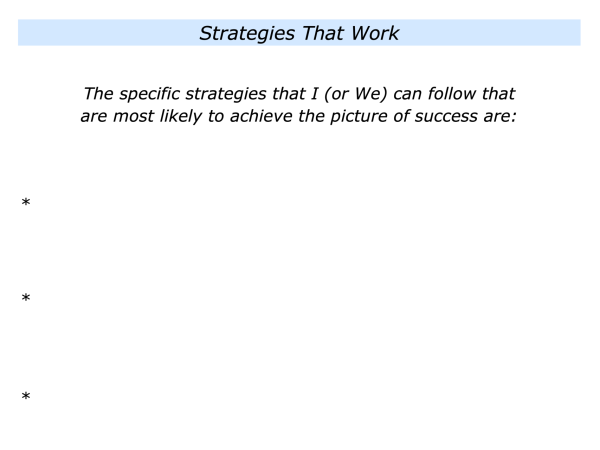
Imagine that a person wants to develop a healthy lifestyle, do satisfying work or achieve another aim. They can clarify the strategies most likely to work. One approach is to explore the following questions.
Looking back, when have I achieved a similar goal in the past? What did I do right then? What were the principles I followed? How did I translate these into action? What happened as a result?
Looking around the world, when have other people achieved a similar goal? What were the principles they followed? How did they translate these into action? What happened as a result?
Bearing in mind the goal I want to achieve, what are the key strategies I can follow to give myself the greatest chance of success? How can I translate these strategies into action? How can I get some quick wins?
How can I keep following good habits? How can I maintain the momentum? How can I anticipate and manage any challenges? How can I do my best to achieve the picture of success?
Different people will follow the strategies that are most likely to work in their own ways. Whatever route they take, however, it will be important for them to get some quick wins and keep following good habits.
The Organisational Approach
Imagine you lead an organisation that wants to achieve sustainable success in a particular area. People have clarified the picture of success and the organisation’s strengths. They may then explore the following questions.
Looking back, when have we achieved a similar goal in the past? What did we do right then? What were the principles we followed? How did we translate these into action? What happened as a result?
Looking around the world, when have other people achieved a similar goal? What were the principles they followed? How did they translate these into action? What happened as a result?
Looking at the kind of work we do, what are the changes that could affect our work the future? What are the things that may affect our customers? What are the things we need to do to thrive in the future?
Let’s return to the goal we want to achieve in a particular area. What are the key strategies we can follow to give ourselves the greatest chance of success? How can we translate these strategies into action?
People can then create and follow their action plan. Here are exercises that can be used by a person or an organisation.
Sustainable Success
Imagine that a person or an organisation is pursuing their chosen strategies. They will aim to do their best each day on the way to achieving sustainable success.
The Individual Approach
Different people will aim to achieve different things. Imagine, for example, that a person wants to follow a sustainable lifestyle. Depending on their picture of success, they may aim:
To take care of their physical health … To eat nutritious food … To do enough exercise … To pace themselves properly … To have regular health checks … To earn enough money to support their chosen lifestyle.
To take care of their psychological health … To have a positive attitude … To do things that give them positive energy … To encourage their loved ones … To spend time with positive people … To set reachable goals and achieve success.
To take care of their philosophical health … To develop a sense of purpose … To follow their life principles … To do satisfying work … To aim to make a positive contribution during their time on the planet.
Such a person may also aim to enjoy the journey and follow good habits one day at a time on the way towards achieving their goal.
The Organisational Approach
Different organisations may aim to achieve different things in terms of achieving sustainable success in a particular area. Bearing this in mind, however, one approach may be for them to take the following steps.
To focus on their purpose … To follow their principles … To create a positive environment … To put the right people in the right places … To give people the support they need to deliver the goods.
To encourage people to follow high professional standards … To deliver great service … To produce success stories that show how people have followed the principles and performed superb work.
To perform superb work … To focus on continuous improvement … To keep building on what is working … To tackle areas for improvement … To never walk past a quality problem and to fix it immediately.
To shape a positive future … To keep delivering today’s business whilst also shaping tomorrow’s business … To help their stakeholders to achieve their goals … To achieve their picture of success.
There are many ways to live and work. One approach is for people, teams or organisations to build on their strengths. They can then aim to follow strategies that work and deliver sustainable success.
If you wish, try tackling the final exercise on this theme. This invites you to complete the following sentences.

Leave a Reply