



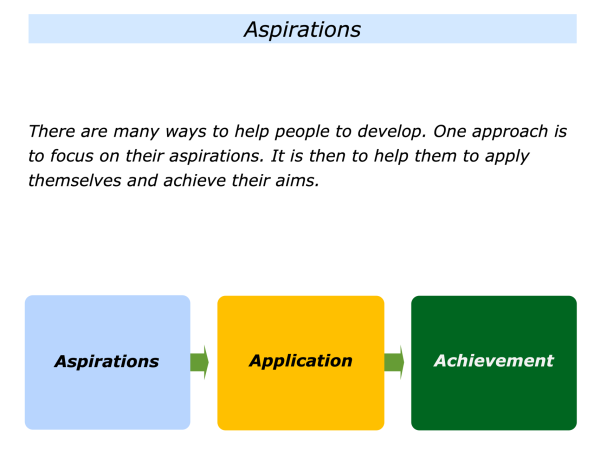
There are many ways to help people to develop. One approach is to focus on their aspirations. It is then to help them to apply themselves and achieve their aims. Let’s explore these themes.
Aspirations
Every person has aspirations. They may have passions they want to follow, challenges they want to solve or goals they want to achieve. They can be helped to translate these into achievable aims and do their best to achieve success.
Let’s assume that somebody has asked for your help in continuing to develop. Here are some of the questions that it is possible to explore: a) before meeting the person; b) when meeting them, seeing them in action or seeing examples of their work.
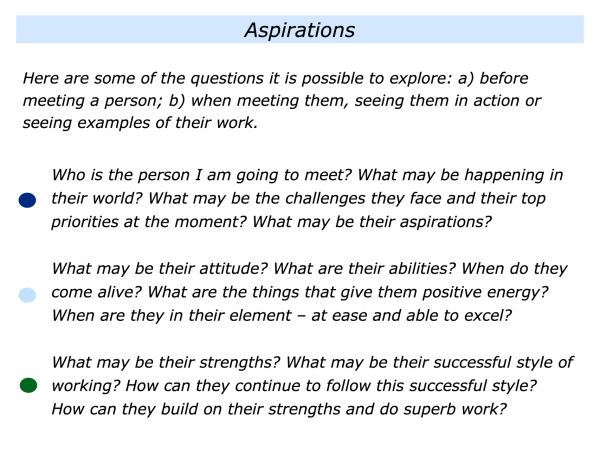
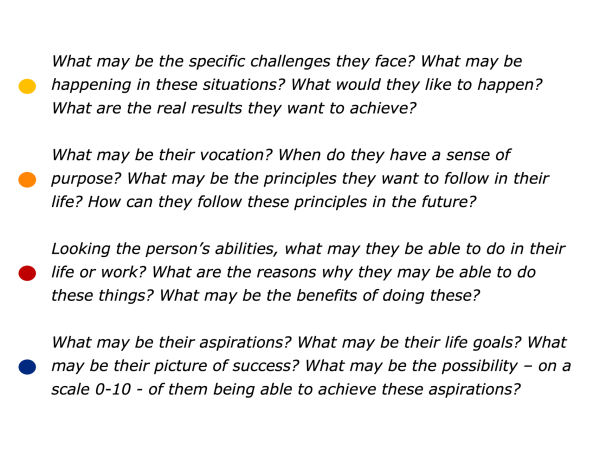
Imagine that you have moved on to meeting the person. You will aim to create an encouraging environment in which they feel at ease and able to explore. If appropriate, you can then take the following approach to helping them to work towards achieving their aspirations.
You can clarify the topics they
want to explore and the
goals they want to achieve
Different people will obviously want to explore different topics. Here are some of the many themes that individuals may mention.
How to regain control of my life … How to do satisfying work … How to help my son who is having difficulties at school … How to stay calm in certain situations … How to build a positive culture in an organisation.
Imagine that the person has described some of the goals they want to achieve in their life or work. You can then move on to the next stage.
You can focus on the first topic and
clarify the real results they want
to achieve – the picture of success
You can focus on the first topic they want to explore. Clarity is vital. Bearing in mind what they can control in the situation, it is important to clarify the real results they want to achieve.
Imagine that a person has said they want to achieve a particular goal. If appropriate, you may want to clarify their aspirations by exploring the following questions with them.
What is their specific goal? What are the real results they want to achieve? What is the picture of success? What will be the benefits of achieving the goal?
What will be happening that will show they have achieved the goal? What will be the things that they or, if appropriate, other people will be feeling, saying or doing?
What may be the pluses and minuses involved in working towards achieving the goal? Bearing this in mind, on a scale 0-10 how motivated is the person to do what is required to achieve the goals?
Imagine that you have explored this step. Before moving forwards, it can be useful to check that you are clear on what the person wants to achieve. You may want to say something along the following lines.
“As far as I understand, the real results you want to achieve in this situation are:
“To …
“To …
“To …
“Is that right?”
Imagine that you are both clear on the results they want to achieve. If appropriate, you can then move on to the next stage.
Application
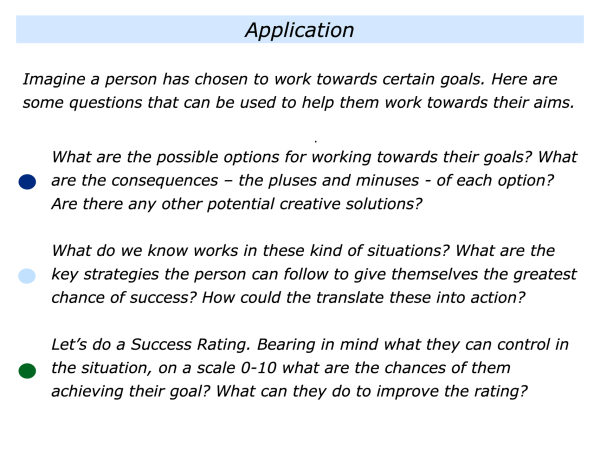
Many people have aspirations but the key is to apply themselves properly when working towards their aims. Bearing in mind what they can control in the situation, one approach is to take the following steps.
You can clarify the strategies the person
can follow to give themselves
the greatest chance of success
Imagine that you are helping a person to work towards their aims. One approach is to clarify the strategies they can follow to give themselves the greatest chance of success. It appropriate, you can explore the following themes with the person.
What are the possible routes the person can follow towards achieving their goals? What are the consequences – the pluses and minuses – of each option? What is the attractiveness – on a scale 0-10 – of each option?
What do we know works in these kind of situations? Looking back, when has the person – or other people – tackled similar situations successfully? What did they do right then to achieve success?
Bearing these things in mind, what is the route – or combination of routes – the person wants to take? What are the strategies that can follow to give themselves the greatest chance of success?
Imagine that you have clarified the strategies the person can follow to do their best to achieve their goals. If appropriate, you may then want to move on to the next step.
You can clarify how the
person can increase the
chances of achieving success
This step involves doing a reality check. Let’s assume the person is clear on: a) the goals they want to achieve; b) the strategies they want to follow to achieve their goals.
Bearing in mind what the person can control in the situation, you can explore the following themes.
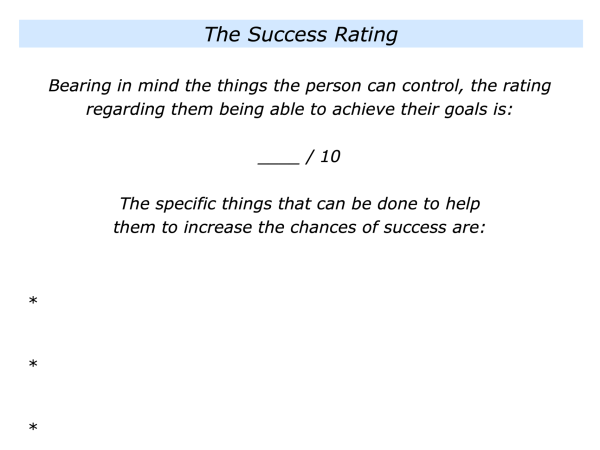
What is the present rating – on a scale 0-10 – of the person being able to achieve their goals?
What are the specific things that can be done to improve the rating?
This can be a useful exercise to do before moving into action. You can then help the person to clarify the specific things that can be done to improve the chances of success. Here is the exercise on this theme.
You can clarify how the person can
follow the strategies and rehearse
doing their best to achieve success
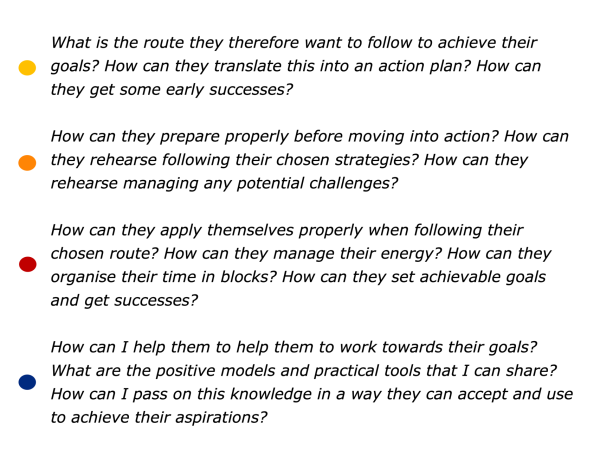
Great workers translate their strategies into a specific action plan. They also organise their time in blocks so they apply themselves fully. Such workers also do lots of rehearsal. This often involves them taking the following steps.
They rehearse following their chosen strategies on the way to achieving the picture of success.
They rehearse managing any potential challenges on the way to achieving the picture of success.
They again rehearse translating their chosen strategies into action and doing their best to achieve the picture of success.
Here is a summary of the steps you can take to help a person to apply themselves properly.
Achievement
Imagine that the person has moved into action. If appropriate, you help them to take the following steps on the way towards achieving their aspirations.
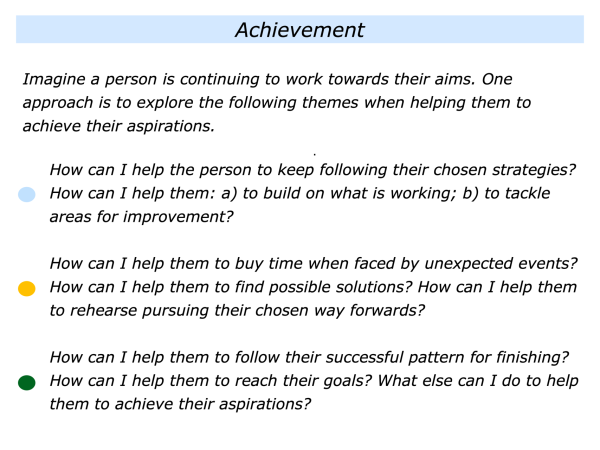
They can follow their chosen strategies, get some early successes and aim to do superb work.
They can keep reading reality and embody continuous improvement by aiming: a) to build on what is working; b) to tackle areas for improvement.
They can follow their successful pattern for finishing and do their best to achieve their picture of success.
This final point can be crucial. If appropriate, you can help them to recall situations in the past when they have finished things successfully. What did they do right then?
What were the principles they followed? How did they translate these into action? How can they follow similar principles – plus maybe add other skills – to reach their present goals successfully?
There may also be situations where they need to manage unexpected events. It can be useful to help them to buy time to think in such situations. This often involves exploring the following themes.
What are the real results I want achieve in this situation? What are the short, medium and long-term results? What are the possible options going forwards? What are the pluses and minuses of each option?
What is the route – or combination of routes – I want to follow? How can I translate this into action? How can I build on the pluses and manage the consequences of any minuses? How can I do my best to achieve success?
Imagine that you are helping a person to work towards achieving their aspirations. Here is a summary of the themes it can be useful to consider at this stage.
There are many ways to help a person to develop. One approach is to help them to focus on their aspirations. It then to help them to apply themselves and do their best to achieve their aims.
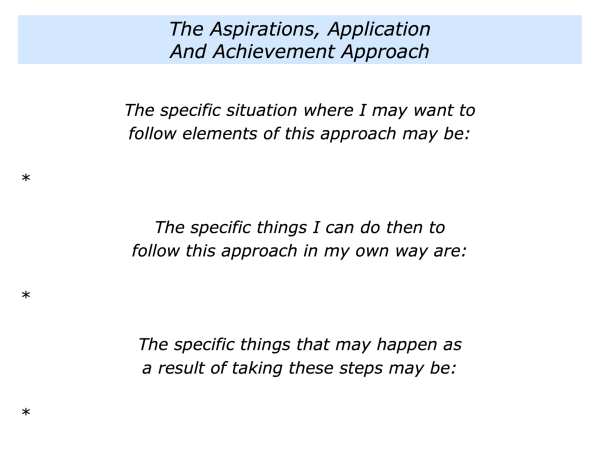
Let’s return to your own life and work. Looking ahead, can you think of a situation where you may want to follow elements of this approach? This could be in your personal or professional life.
If you wish, try tackling the exercise on this theme. This invites you to complete the following sentences.

Leave a Reply