



Good coaches often use the coaching contracting approach when working with people. They may do this when encouraging athletes, learners and in other professional situations.
Imagine that somebody has asked you to be their coach. Clear contracting is vital in any relationship. This is especially so between the coach and the coachee.
Bearing this in mind, it can be useful to agree on the coaching contract. The following process sounds very structured but you can adapt it in your own way. It can provide the basis for building a successful coaching relationship.
Imagine that you want to follow elements of this approach. This can involve focusing on the following themes.
You can invite the person to
fill in the coaching contract
You may start by having an informal conversation with the person. This may be face-to-face or via email. Looking at my own work, here is an example of the kind of email I may send to a person before the first meeting.
The Coaching Session
Hello …
Looking forward to seeing you for our first session on …
As you know, the sessions are confidential and we can explore any topics you wish. The aim of the sessions are to focus on your aims and provide practical tools you can use to achieve your goals.
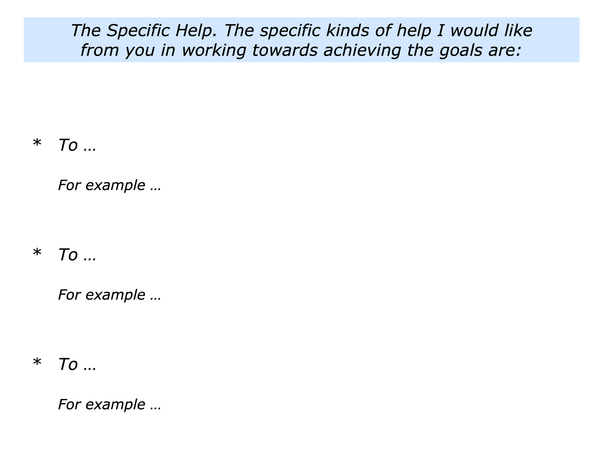
If you have time before the first session, it could be useful to have a go at describing some of your goals. Bearing this in mind, I am sending along the framework for a coaching contract.
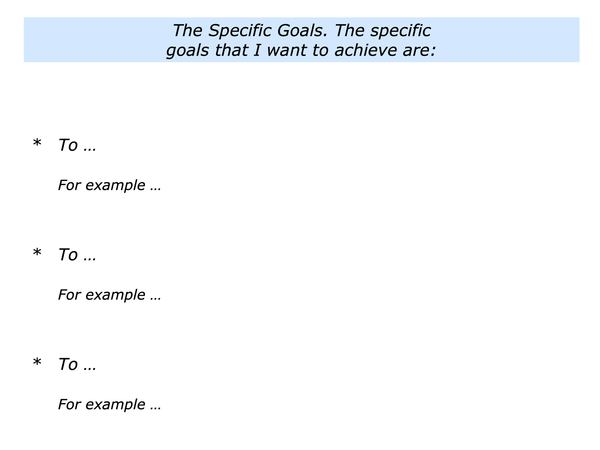
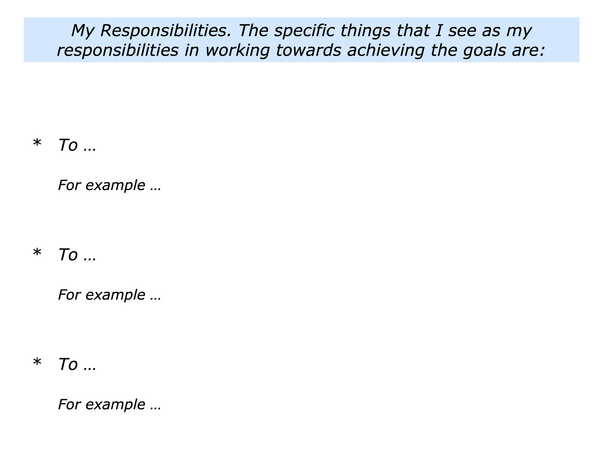
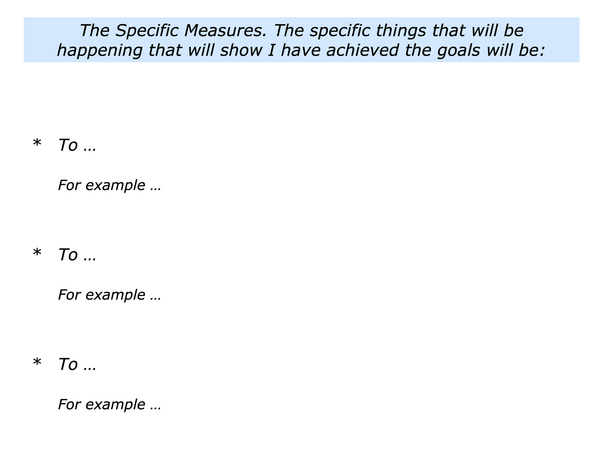
This may seem a bit daunting, but it would be useful if you can have a go at filling it in. This will invite you to focus on the following things.
The specific goals you may want to achieve in your personal or professional life;
The specific things you see as your responsibilities in working towards achieving the goals;
The specific kinds of help you would like from me in working towards achieving the goals;
The specific things that will be happening that will show you have achieved your goals.
As mentioned earlier, it can be useful to have a go at exploring the following framework. After agreeing on your aims, we will then focus on the practical strategies you can follow to achieve your goals.
You can meet with the person
to explore the coaching contract
Imagine that the person has had a first go at the coaching contract and you are having the first meeting. You will aim to create an encouraging environment in which the person feels at ease and able explore.
You may then spend some time discussing the contract in depth. If appropriate, you may say something along the following lines.
Thank you for filling in the coaching contract. I am sure that we are both prepared to do our best to help you to achieve your goals.
Before finalising the agreement, however, it would be good to explore the themes in some depth. We may well end up confirming what you have already written. So let’s make a start.
Looking at each goal in turn, let talk more about:
The real results you want to achieve and the benefits of achieving the goal;
The motivation you have – on a scale 0-10 – for doing the work involved in achieving the goal;
The key is to be very honest, rather than giving the right answer. We can then focus on how you can achieve your goal.
You can encourage the person to talk honestly. It can also be important to agree on the mutual responsibilities when working together.
If appropriate, you can then create a time-out to enable the person to reflect. You can then make sure you are both agreed on the specific goals, the mutual responsibilities and the measures.
You can then embark
on the actual coaching
You may then both want to launch into the actual coaching. If so, you can invite the person to choose the first topic they want to tackle. You may then aim:
To clarify the specific goal the person wants to achieve;
To clarify the specific things they have done so far to work towards achieving the goal;
To, when appropriate and with the person’s permission, offer strategies and practical tools they can use to work towards achieving the goal.
This final part is crucial. It helps to create the psychological contract that it is okay to share ideas. You can then pass on knowledge and see which ideas resonate with the person. If appropriate, you can then explore these further.
Different coaches pass on knowledge in different ways. Some adapt elements of the following approach.
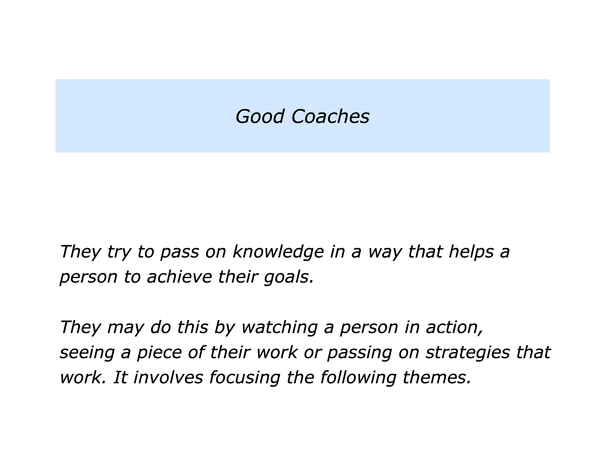
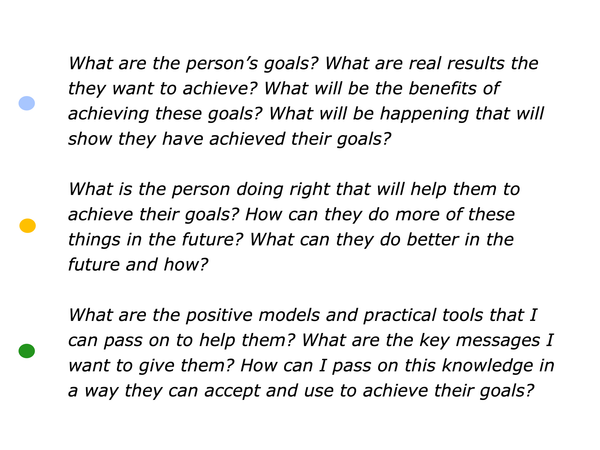
Good coaches then do their best to help the person to achieve their goals. One approach is for them to say something along the following lines.
Let’s return to the goal you want to achieve. Bearing this in mind, it could be an idea to take a time to reflect. If appropriate, you may want to consider some of the following things.
Looking at the goal you want to achieve, what may be the strategy you want to follow? How could you follow this in your own way? How could you translate it into a clear action plan?
How could you get some quick successes? How could you encourage yourself on the journey? What may be some of the challenges you may face? How could you manage some of these challenges?
Bearing these things in mind, how can you do your best to achieve the goal? How can you do some reality checks? How can you build on what is working and tackle any areas for improvement? When would you like to begin?
Imagine that you have gone through some of these steps to help a person to clarify their plan for working towards one of their goals. If appropriate, you can then move on to the next goal they want to achieve and repeat the process.
You can keep coming back
to the coaching contract
Good coaches may sometimes keep going back to the coaching contract to help a person to focus on their aims. There may also be times, of course, when the person may wish to re-evaluate their aims or set new goals.
Let’s consider another scenario. What happens if the coachee breaks the agreed contract? Much will then depend on what the person actually did and the consequences of their actions.
Depending on the situation, the coach may immediately stop working with the person. This may be the case, for example, if they are working with somebody who behaved in a way that hurts other people.
There may be other occasions, however, when the coach decides it is more appropriate to go back to the coaching contract. They may then say something along the following lines.
Let’s go back to the goals you want to achieve? Do you still want to achieve these goals?
What do you see as your responsibilities in working to achieve the goals? Are you prepared to do those things?
If so, then we may have the basis for working together. If not, then that is your choice. And, as we know, every choice has consequences.
If you wish, take time to reflect. Then let me know your answer.
Good coaches are encouraging but they also give people clear messages about the importance taking responsibility. If the person chooses not to take responsibility, then the coach is prepared to follow through on the consequences.
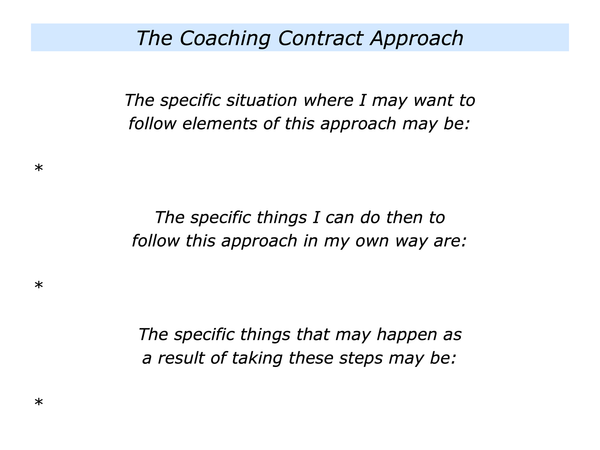
Let’s return to your own life and work. Looking ahead, can you think of a situation where you may want to follow elements of the coaching contract approach? How could you do this in your own way?
If you wish, try tackling the exercise on this theme. This invites you to complete the following sentences.

Leave a Reply