


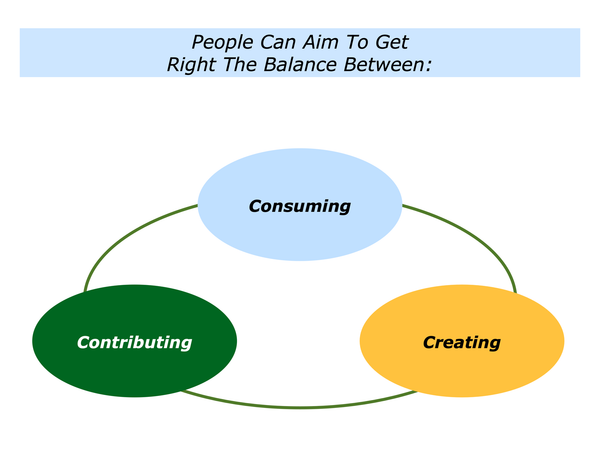
There are many ways to live life. One approach is for people to get the right balance between consuming and creating. Sometimes they may also translate this into making a contribution to helping people or the planet.
One reason for this approach is because people are living systems. They may therefore need to get the right balance in order to stay healthy. Sometimes this can also help them to achieve sustainable success.
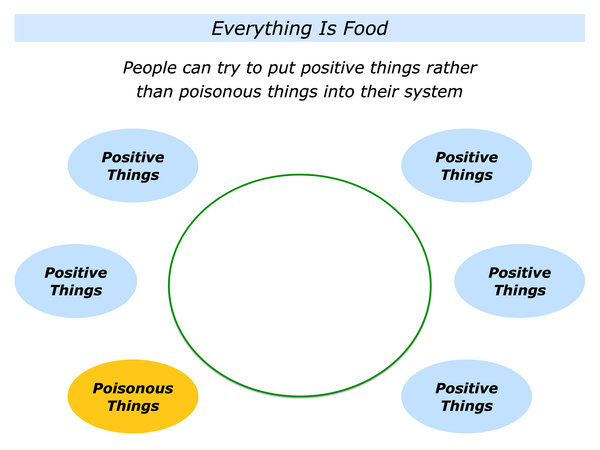
Consuming can take many forms. It is not just about food. It also includes the environment and the things people experience in their daily lives and work. As the old saying goes: ‘Everything is Food’.
It can therefore be good to put positive things rather than poisonous things into our system. It is to follow the ‘Good Things In, Good Thing Out’ approach rather than the ‘Garbage In, Garbage Out’ approach.
A person may consume lots of bad news, for example, and go into a doom loop which can overload their system. Another person may consume lots of ideas without creating but then feel overloaded and stodgy.
Creating can take many forms. It can include writing, playing music, solving problems, designing things, producing something new or doing other creative activities.
Contributing can also take many forms. It can include giving to others, encouraging people, doing good work, passing on knowledge or helping to build a better world.
Imagine you want to get the right balance in your own life and work. One approach is to focus on the following themes.
Consuming
You can start by considering what you want to put into your body and soul. One person described how they took this approach.
“I began by listing the physical and psychological things I wanted to consume. On the physical side, I aimed to eat good food, spend time in the fresh air and take care of my health.
“On the psychological side, I wanted to get stimulating ideas, read uplifting articles, work on energising projects and spend time with encouraging people.
“The hard part was doing this in my daily life. Some things were easy to cut out, but others took more effort. I have managed to take many of these steps but it is still a work in progress.”
Creating
How can you make good use of the things you consume? One approach is to ask yourself some of the questions.
“What am I taking into my body and soul? What am I feeling or thinking? How can I channel these experiences in a creative way?”
You may choose to translate your experiences into encouraging others, writing, painting or cooking. You may choose to focus on exercising, gardening, finding solutions, working or doing other activities.
People often feel better if they can get the right balance between taking things in and getting things out. The key can be to find healthy ways for making this happen.
Contributing
Some people go a step further. They ask themselves the following questions.
“How can I use these experiences in a positive way? How can I contribute something that helps people or the planet?”
Many people who have setbacks use these to pass on knowledge that helps other people. They may choose:
To create websites for patients … To help the homeless … To help prisoners of conscience … To help people change their careers … To pass on knowledge that helps people to shape their future lives.
Jill Bolte Taylor, for example, translated adversity into doing brilliant work that helps others. Here is the introduction to her well-known TED Talk.
Neuroanatomist Jill Bolte Taylor had an opportunity few brain scientists would wish for. One morning she realised she was having a massive stroke.
As it happened – as she felt her brain functions slip away one by one, speech, movement, understanding – she studied and remembered every moment.
She went on publish My Stroke of Insight. Here is an excerpt from her website that explains some themes she explores in the book.
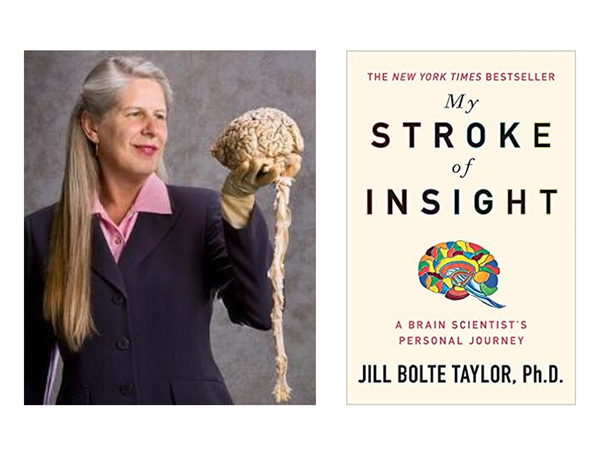
Jill shares with us her recommendations for recovery and the insight she gained into the unique functions of the right and left hemispheres of her brain.
She helps others not only rebuild their brains from trauma, but helps those of us with normal brains better understand how we can ‘tend the garden of our minds’ to maximize our quality of life.
Jill teaches us through her own example how we might more readily exercise our right hemispheric circuitry with the intention of helping all human beings become more humane.
There are many ways to live life. One approach is to get the right balance between consuming and creating. Sometimes this can also lead to making a contribution that can help people or the planet.
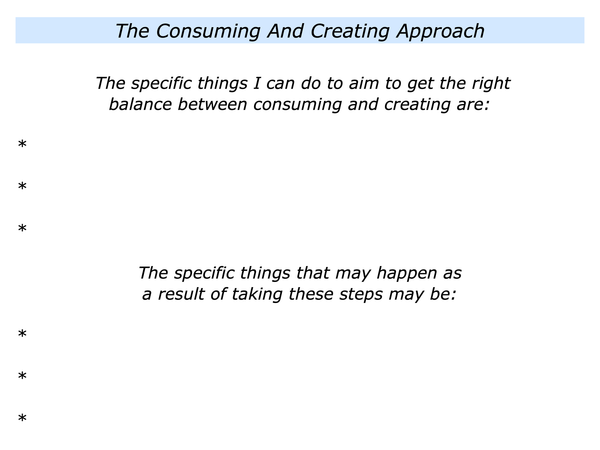
Let’s return to your own life. Imagine that you want to follow elements of this approach. How can you do this in your own way? What may happen as a result? If you wish, try tackling the exercise on this theme.

Leave a Reply