



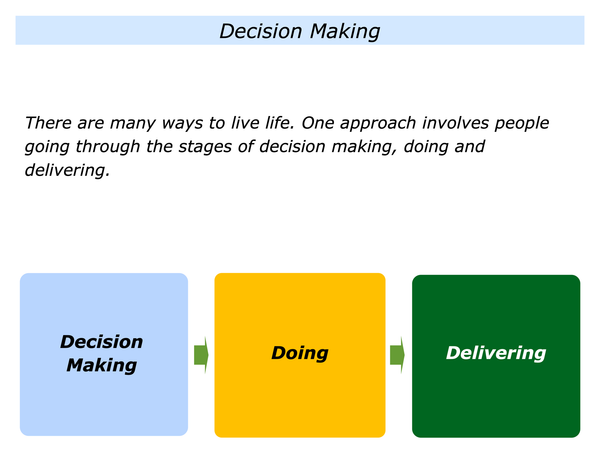
There are many ways to live life. One approach involves people going through the stages of decision making, doing and delivering. The ways that people do this can have consequences for both themselves and other people.
Different people follow this approach in different situations. They may follow it as individuals, teams or organisations. Whatever the situation, however, it often involves focusing on the following steps.
Decision Making
People make decisions all the time. They start by deciding on the attitude they will take in various situations. They then decide on the actions they will take to achieve certain things their personal and professional lives.
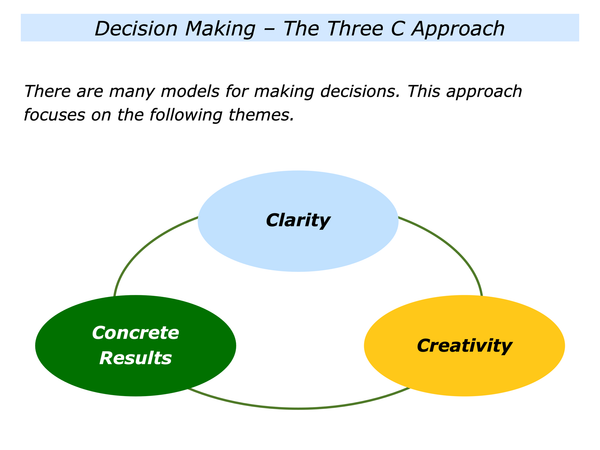
Different people use different models when making decisions. The following pages describe the Three C approach that can be used in many situations. This involves focusing on the following themes.
Clarity: This involves establishing clarity – the real results to achieve.
Creativity: This involves exploring the possible choices, consequences and potential creative solutions.
Concrete Results: This involves focusing on the chosen way forward and doing their best to get the desired concrete results.
Good leaders, for example, often start by gathering lots of information about what may be happening in a situation. Bearing in mind what they can control in the situation, they then explore the following themes.
Clarity
What are the real results we want to achieve? What is the picture of success? What will be the benefits of achieving these goals? What will be happening that will show we have achieved the picture of success?
Creativity
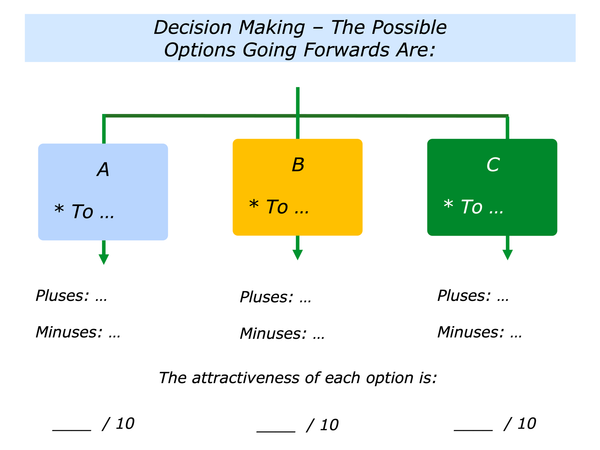
What are the possible choices going forward? What are the consequences – the pluses and minuses – of each option? What is the attractiveness of each option on a scale 0-10? Are there any other creative solutions?
What do we know works in these kinds of situation? When have we or other people tackled such situations successfully? What did they do right? What were the principles they followed? What happened as a result?
What are the key strategies we can follow to give ourselves the greatest chance of success? What may be the pluses and minuses involved? How can we build on the pluses and manage any potential minuses?
Concrete Results
What is the route – or combination or routes – we therefore want to follow? How can we translate this into action? How can we get some early wins? How can we then do our best to achieve the picture of success?
Imagine that a person, team or organisation has decided about the strategy they want to follow. They may then aim to translate this into action. This involves focusing on the following theme.
Doing
Good decision makers focus on following their chosen strategy and doing superb work. They may do this in either: a) by doing the good work themselves; b) by enabling other people to do good work.
Such people often take the following steps when doing the work. The ways they translate these into action will, of course, depend on the kind of work they are doing.
They do what is required
to follow the strategies
Superb workers are actually serious about doing their best to deliver the goods. They are different from people who may say they want to achieve certain goals but are not prepared to do what is required.
Such people aim to do work that is effective and excellent. When leading teams, they encourage others to follow these principles, deliver excellence and even sometimes do something extraordinary.
They do what is required
to deliver high standards
Superb workers often start by getting some early wins. This helps to create momentum and, when appropriate, can be motivating for both themselves and other people.
Such workers then aim to follow good habits. They get the right balance between consistency and creativity. This calls for them performing superb work and delivering consistently high standards.
They do what is required
to keep improving
Superb workers are good at reading reality. They use their antennae to stay aware and recognise what is actually happening. They are also be prepared to be agile.
Whilst following their chosen strategies, they keep scanning the situation and taking the following steps.
They clarify the specific things that are working;
They clarify the specific things that can be improved;
They clarify the specific things they can do to build on what is working and tackle the areas for improvement.
Such workers then take the necessary actions. Sometimes this can involve simply following the philosophy of Kaizen and focusing on continuous improvement.
Sometimes they may face unexpected events and need to find solutions to challenges. They then aim: a) to buy time to think; b) to explore the possible options for going forwards; c) to rehearse and then follow their chosen strategy for tackling the challenge.
Imagine that a person, team or organisation is taking these steps. When appropriate, they may then move on to the final stage.
Delivering
Great workers are good finishers. They do their best to do what is required to deliver the goods. Different people, teams and organisations do this in different ways. Some take the following approach.
They clarify their successful pattern for finishing by recalling specific situations when they finished things successfully.
They clarify the principles they followed then – and how they translated these into action – to finish successfully.
They clarify how they can follow similar principles – plus maybe express these in modern ways – to finish the present piece of work successfully.
Such workers then apply themselves fully. Sometimes they go into their equivalent of the zone and aim to flow, focus and finish. Sometimes they also add that touch of class to deliver the goods successfully.
There are many ways to live life. One approach involves people going through the stages of decision making, doing and delivering. One key point, however, is worth underlining.
The Decision Making Stage Is Crucial
The quality of the decision making sets the scene for following the strategies, doing superb work and delivering success.
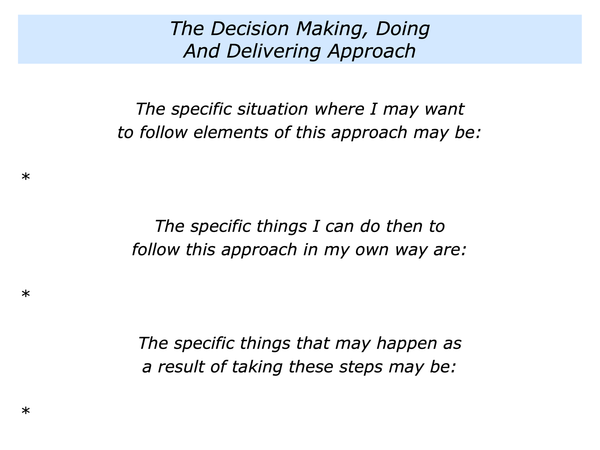
Let’s return to your own life and work. Looking ahead, can you think of a situation where you may want to follow elements of this approach? How can you do this in your own way?
If you wish, try tackling the exercise on this theme. This invites you to complete the following sentences.

Leave a Reply