



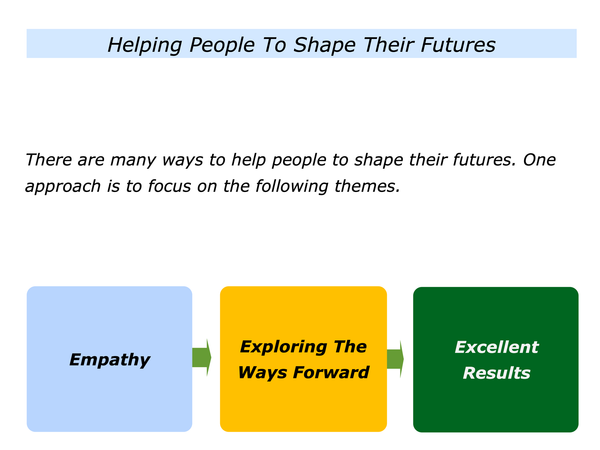
There are many ways to help people to shape their futures. One approach is to focus on the following themes to help them to do their best to achieve the desired results.
Empathy – To show empathy by recognising both their actual situation and also their potential aspirations.
Exploring The Ways Forward – To explore the possible options for working towards achieving their aims.
Excellent Results – To help them to follow their chosen route and achieve the desired excellent results.
Let’s assume that somebody has asked for your help in shaping their future. If appropriate, one approach is to focus on the following themes.
Empathy
Imagine you are going to meet with a person who wants to develop. You may start by using your imagination to prepare for the meeting. One approach is to ask yourself the following questions.
Who is the person I am going to meet? What may be happening in their world? What may be the challenges they face? What may be their personal or professional goals?
What may be the topics they want to explore in the session? Looking at each of these themes, what may be the real results they want to achieve? How may I be able to help them to achieve their picture of success?
Imagine that you have prepared properly. You may have also rehearsed how you can help the person to achieve success. It will then be time to move on to the actual meeting.
One approach is to start by creating an encouraging atmosphere in which the person feels at ease. When appropriate, you will invite them to describe the topics they want to explore
Imagine that you are focusing on the first topic they want to discuss. This is the point where it can be useful to follow elements of the empathy approach.
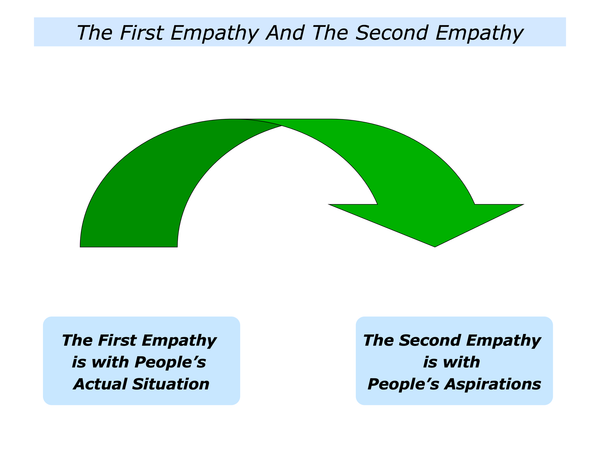
Lots of people talk about the importance of empathy. There are, however, several ways of demonstrating this quality. Let’s consider two kinds of empathy.
The First Empathy
The first empathy involves having empathy with the person’s actual situation. This involves being able to, as far as possible, imagine the world from the other person’s point of view. It also involves checking to make sure you have the right understanding.
This kind of empathy is important but it can have both pluses and minuses. The pluses can include showing the person that you can, as far as possible, try understand their present situation.
The minuses can include a caring person getting caught up in the person’s present feelings. This can sometimes result in both people finding it difficult to move forwards in a positive way.
The Second Empathy
The second empathy involves having empathy with the person’s aspirations. It involves seeing the person’s abilities and the possible things they may be able to achieve in their life or work.
Sometimes it can be important to play back these ideas to see which resonate with the person. One approach is to say something along the following lines.
Looking ahead, I believe that you could achieve the following goal …
I believe is this possible because you have the following qualities ….
Is this something you would like to work towards achieving?
Let’s assume that you have taken the following steps with the person. You have aimed:
To clarify what is happening in their world;
To clarify the topics they want to explore;
To clarify some of the things they may want to achieve in the future.
Bearing these in mind, it can then be time to move on to the next stage.
Exploring The Ways Forward
Imagine that you are focusing on the first topic the person wants to explore. If appropriate, you may want to get more background about the situation. When appropriate, you can then go through the following steps.
You Can Clarify The Real Results
The Person Wants To Achieve
Clarity is crucial. Bearing in mind what the person can control in the situation, it can be important to explore the following questions.
What are the real results they want to achieve in the situation? What is their picture of success? What may be the benefits of achieving these goals? What will be happening that will show they have achieved the desired results.
Let’s assume that you have explored these themes with the person. It can then be useful to play back your understanding of what they want to achieve. If appropriate, you may say something along the following lines.
The Picture Of Success
As far as I understand, the real results you want to achieve in this situation are:
To …
To …
To …
Is that right? Are there any other things you want to add?
Imagine that both the person and yourself are clear on the picture of success – the desired results to achieve. It can then be time to move on to the next step.
You Can Clarify The Possible Ways
Forward For Achieving The Desired Results
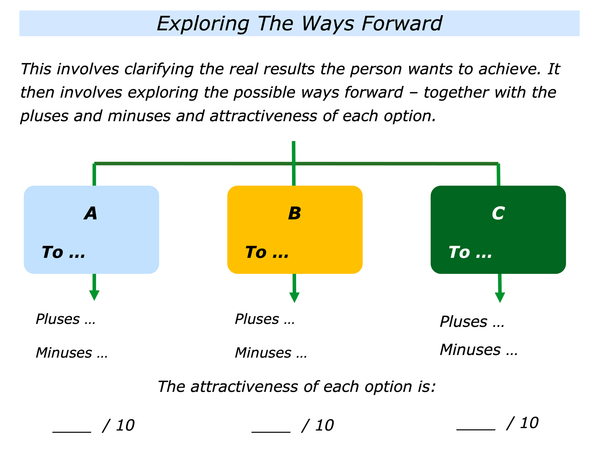
Looking ahead, you can work with the person to explore the possible ways forward. One approach is to help them to explore the following themes:
The possible routes – the possible options – they can follow;
The pluses and minuses of each of option;
The attractiveness rating – on a scale 0-10 – of each option.
It is important to brainstorm all the possible options – even those the person may dismiss straight away. It can then be useful to explore the following questions.
Are there any other options? Is it possible to combine the parts of each option into another option? Are there any other potential creative solutions?
What do we know works in these kinds of situations? When have you or others tackled a similar situation successfully? What were the principles you or they followed? How could you follow those in this situation?
Bearing all these things in mind, it can then be useful to draw the possible options going forwards.
You Can Clarify The Route
The Person Wants To Follow
Imagine that the person has taken time to reflect on the possible ways forwards. When appropriate, they may then aim to decide on the route – or the combination or routes – they want to follow.
Bearing this in mind, the next step will be to make an action plan. When doing so, it can be useful for them:
To clarify the strategies they can follow to give themselves the greatest chance of success;
To translate these into a clear action plan – including how to get some early successes and encourage themselves on the journey;
To rehearse how to follow their chosen strategies – plus how to manage any challenges – on the way towards achieving the desired results.
Imagine that the person has taken these steps. When appropriate, you may then help them to move on to the next stage.
Excellent Results
There are many ways to help a person to do their best to achieve excellent results. If appropriate, you can encourage them to take the following steps.
You can encourage them to get some early successes. Taking approach can help to build their confidence and also maintain momentum. It can also create the platform for delivering future success.
You can encourage them to follow their chosen strategies. It is important for them to do this by being proactive, following good habits and getting positive results.
You can encourage them to focus on continuous improvement. They can keep reading reality and aim: a) to build on what is going well; b) to tackle areas for improvement.
Life can sometimes produce unexpected events. When appropriate, you can therefore help the person to buy time to think with encountering certain challenges.
You can then invite them: a) to clarify again the real results they want to achieve; b) to clarify the possible options going forwards; c) to clarify and follow the option most likely to achieve the longer term results.
Finally, sometimes it can be useful to encourage the person take time to reflect. They can rest, refocus and rehearse what they are going to do next. They can then do their best to achieve the desired results.
There are many ways to help people. One approach is to go through the stages of demonstrating empathy and exploring the ways forward. It is then to help to achieve excellent results.
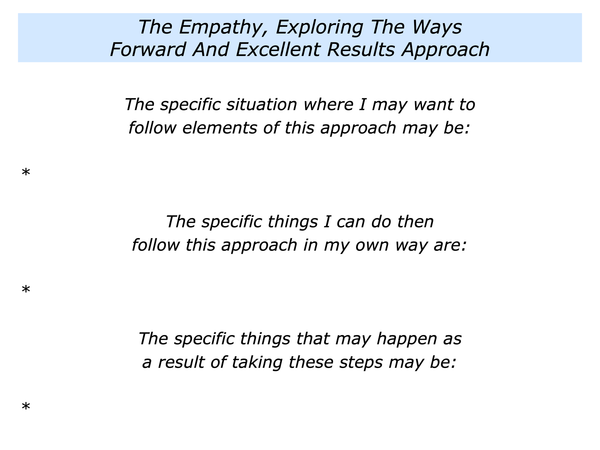
Let’s return to your own life and work. Looking ahead, can you think of a situation where you may want to follow elements of this approach? How can you do this in your own way?
If you wish, try tackling the exercise on this theme. This invites you to complete the following sentences.

Leave a Reply