



This is an approach that is sometimes used in sports psychology. It starts by helping athletes to build on their strengths. They then set specific goals and follow the strategies most likely to achieve success.
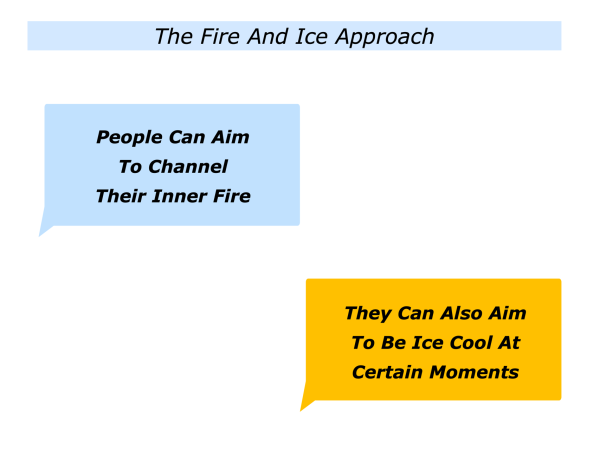
It then involves helping athletes to channel their inner fire but also to be ice cool at certain moments. They are then more likely to deliver superb performances.
Imagine that you want to follow elements of this approach. You may be encouraging people, performing creative work, tackling a challenge, leading a team or doing another activity.
You can aim to build on your strengths when doing this activity. Bearing in mind what you can control in the situation, you can set specific goals and follow the strategies most likely to achieve success.
Let’s assume that you are embarking on doing the specific activity. If appropriate, this may involve getting the right blend of fire and ice. Let’s explore these themes.
The Fire Approach
Great workers often learn how to channel their inner fire. They learn how to channel their passion in a positive way. This can be vital if they are to perform superb work.
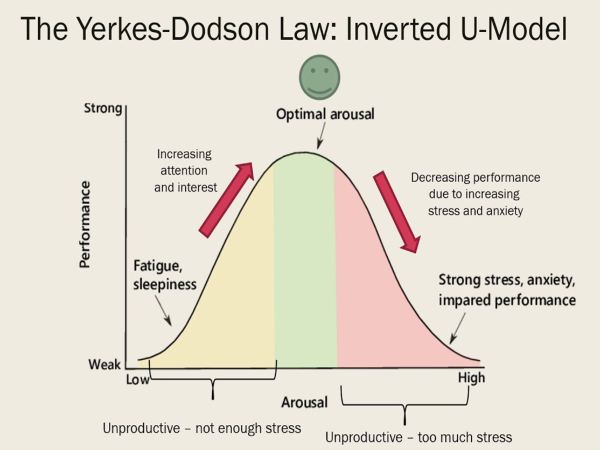
Many sports psychologists refer to the Yerkes-Dodson Model. This describes what people may experience at different stages of the physical and psychological arousal curve. They called this the Inverted U-Model.
The model shows that, for some sports, it can be important to aim for the peak of the optimal arousal curve. This can certainly be the case in certain activities.
There may be some sports, however, where it can be important to be calmer and focus your attention when climbing the curve. This can be when playing snooker, for example, or when putting in golf.
People may sometimes find it useful to follow in similar approach when pursuing a specific activity. They need to know how to channel their passion in a way that helps them:
To be fully present;
To focus on the principle they are aiming to follow;
To do their best to achieve peak performance.
Let’s assume that you are channelling your inner fire in a positive way. This may sometimes lead to focusing on the next stage.
The Ice Approach
Imagine that there may be times when it can be useful to switch into the ice mode. You may aim to be cool, calm and collected when, for example, making a key decision or facing a particular challenge.
Different people do this in different ways. Some aim to relax, recentre and refocus. Buying time to think, they may then use the Three C model for choosing their way forwards. They work through the following steps.
Clarity: They clarify the real results they want to achieve and translate this into a clear picture of success.
Creativity: They clarify their potential choices going and the consequences of each option on the road to achieving the picture of success.
Concrete Results: They clarify the route they want to follow and then aim to do their best to achieve the picture of success.
Such a person may then take time to breathe, slow down and rehearse what they are going to do next. They then follow their ritual for moving into action and aim to do their best.
Different people do this in different ways. Some people learn from people in other fields. The next section explores one such approach
Learning From Biathletes
Tom Weede wrote an article on this theme for Men’s Fitness magazine. He describes how people competing in the biathlon must switch from high intensity skiing to the calmness required to shoot at a target.
He interviewed top US biathletes such as Jay Hakkinen, plus the team coach Algis Shalna.
DE-STRESS IN SECONDS
As a result of the alternating demands of furious cardio and calm precision, these biathletes have to know how to relax and focus in highly stressful situations.
Remain Calm
On days when you’ll be called upon to do something stressful, practise staying relaxed throughout the day — as opposed to hastily trying to compose yourself when you’re about to give a presentation or line up a one-metre putt.
Breathe Deeply
In addition to being in good condition, biathletes increase their ability to relax and lower their heart rates by breathing correctly, deeply inhaling and exhaling as they approach the shooting range during a race.
Make It Mechanical
One way to reduce stress is by practising something over and over until it becomes automatic.
But biathletes can miss their targets, just as the rest of us miss free throws or lose our train of thought. So what happens if you fall out of the automatic mode and mess up?
“You definitely have to stop,” says team member Jeremy Teela, who deals with such times by taking two breaths, closing his eyes for a second and then starting over.
“I jump back into it, just like I would if it was a new shooting,” he says. “And then I shoot the next shots just as fast as normal … so I totally clear what I just did (from my mind) and then start over.”
Different people use different tools for following the ice approach. Some of these techniques involve going through the following process.
Relax
You can relax your mind and body. You can breathe deeply and buy time – even if only for a few seconds.
Rehearse
You can clarify the real results you want to achieve in the situation. You can then rehearse how to achieve these aims.
Refocus
You can focus fully on the situation and move into action. You can be totally aware of what is happening and aim to achieve the desired results.
There are many ways to do fine work. One approach is to build on your strengths, set specific goals and follow strategies that work. It is then to do your best to achieve the picture of success.
Sometimes it can be useful to borrow from sports psychology. It is to channel your inner fire and be ice cool at certain moments. You are then more likely to deliver superb performances.
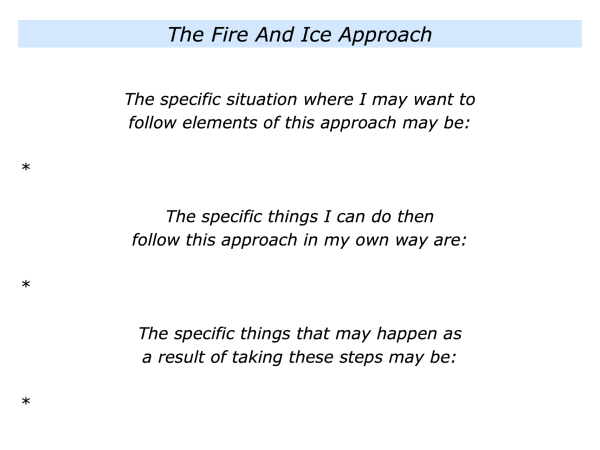
Let’s return to your life and work. Looking ahead, can you think of a situation where you may want to follow elements of this approach? How can you do this in your own way?
If you wish, try tackling the exercise on this theme. This invites you to complete the following sentences.

Leave a Reply