


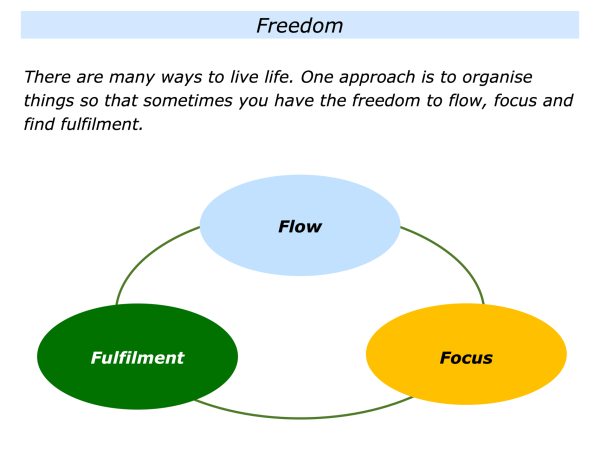
There are many ways to live life. One approach is to try to organise things so that sometimes you have the freedom to flow, focus and find fulfilment.
Different people may follow this approach in different ways and at different times of their lives. Bearing this in mind, let’s explore how people may sometimes focus on these themes.
Freedom
People like to feel in control. They like to have the freedom to shape their futures. Different people may experience this feeling at different times of their lives.
Freedom In Personal Life
Some people hark back to their childhood. They recall a time when felt free and able to explore the world. They may also have been given the necessary support and encouraged to follow their interests.
Some people recall their later teenage years. They may then have been able to follow their passion, travel or do other things that expanded their horizons.
Some people enjoy a sense of freedom in their personal lives when they can set aside even a short time to relax. They may enjoy just being free to walk, think or have a cup of coffee. They love those times in the day when they can ponder.
Freedom In Professional Life
Some people recall enjoying a sense of freedom in their early working years. They may have thrown themselves into a job they loved, continued to develop and also enjoyed their free time on weekends.
Some people may have felt free when pursuing their vocation. They may have prioritised taking this approach – rather than going the Faustian route – and been happy with a more frugal lifestyle.
Some people may have simply needed to earn money, however, and not felt much freedom. They may have done a boring job and worked all hours to support their family.
Such people may have experienced some freedom on weekends or holidays. They may then have spent time and money doing certain activities to heal themselves.
Some people may have freedom in their professional lives. They may do this by following their rhythm – their preferred way of working – and earning a reasonable salary. They may do this when working as a freelancer, doing certain projects or running their own business.
Some people may have found a way to enjoy freedom – within certain parameters – when working in organisations. They may have done this by building on their strengths, doing satisfying work and delivering success.
Daniel Pink described the importance of people enjoying a sense of autonomy in his book Drive. Here is an introduction to his findings regarding what motivates people to do good work.
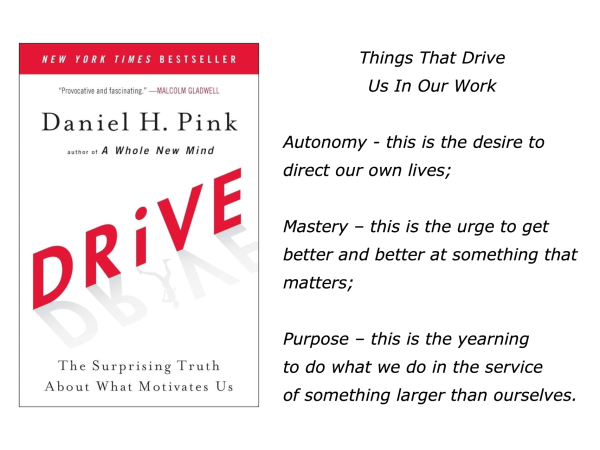
Daniel Pink’s work provides many pointers to how we can enable people to take charge of their working lives and deliver the goods. Here are some quotes from the book.
“Human beings have an innate inner drive to be autonomous, self-determined, and connected to one another. And when that drive is liberated, people achieve more and live richer lives.”
“The science shows that the secret to high performance isn’t our biological drive or our reward-and-punishment drive, but our third drive – our deep-seated desire to direct our own lives, to extend and expand our abilities, and to live a life of purpose.”
Some people may get to a point where they have enough money to free up their days and do what they want. They may then need to focus on finding and following a purpose. This can also lead to another stage.
Freedom After Fulfilling A Purpose
People love to have a sense of purpose. A person may strive to win a gold medal, sell a business, write a book or reach retirement. They work hard and feel exhilarated when achieving their goal.
The sense of satisfaction may last for a while, but then something else can happen. It may be replaced by a feeling of emptiness, even one of angst. The person’s sense of purpose has disappeared.
The good news is that, perhaps after a difficult time, some people emerge stronger and even feel more at peace. There are many strategies for managing post-purpose situations successfully.
One approach is for a person to give themselves permission to rest before tackling the next challenge. This is a strategy used by some peak performers who have been in a state of flow. They have felt high when competing in an event, playing on stage or performing at their best.
Coming out of this state can lead to restlessness. They long to return to feeling fully alive. Sometimes it can be appropriate for them to embark on the next challenge. On other occasions it can be useful for them to stay fallow for a while.
During this time the person can rest, reflect and revitalise themselves. When appropriate, they can research what they want to do next. Switching into full attention mode, they can then refocus and rehearse pursuing the next challenge.
Different people choose different ways to revitalise themselves. Some do things that give them positive energy. Some focus on their passions and translate these into doing specific projects. Some work towards their personal goals. Some aim to leave a positive legacy.
People like to feel free and shape their futures. Sometimes they may do this for a short time, sometimes for a longer time. Bearing this in mind, some people then focus on the following theme in their lives or work.
Flow
Looking at your own life, when you do experience a sense of flow? When do you become so immersed in a task that time goes away? When do you find that your sense of self disappears but then emerges stronger?
Mihaly Csikszentmihalyi did much of the pioneering work on flow. He described his findings in books such as Flow: The psychology of optimal experience and Creativity: Flow and the psychology of discovery and invention.
Before Mihaly’s work some people talked about flow in terms of being in the zone or having peak experiences. Timothy Gallwey touched on these themes with his books The Inner Game of Tennis and Inner Skiing.
Mihaly says that flow experiences are those where you become completely absorbed in an activity. You start by tackling a stimulating task that you have a chance of completing. Setting clear goals, you embark on the work.
You feel a sense of control, concentrate and get immediate feedback. Becoming absorbed in the task, you experience a deep and effortless involvement that removes the frustrations of everyday life.
Your sense of self disappears when doing the task but afterwards you emerge stronger. Mihaly explains this in the following way in his writing.
We have all experienced times when, instead of being buffeted by anonymous forces, we do feel in control of our actions, masters of our own fate.
On the rare occasions that it happens, we feel a sense of exhilaration, a deep sense of enjoyment that is long cherished and that becomes a landmark in memory for what life should be like.
The best moments usually occur when a person’s body or mind is stretched to its limits in a voluntary effort to accomplish something difficult and worthwhile.
Optimal experience is therefore something that we make happen.
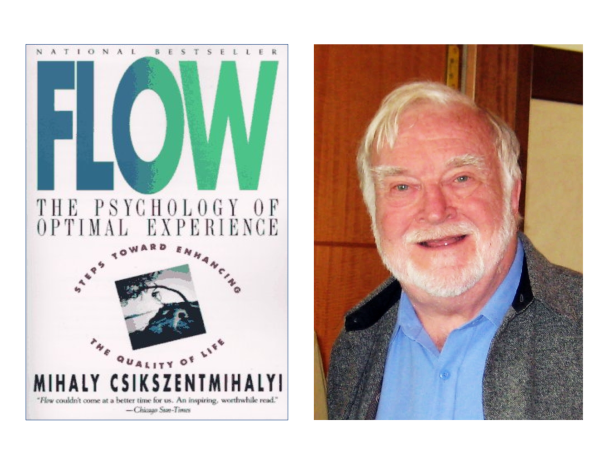
Mihaly was born in Rijecka, Croatia. His family was Hungarian, and his father Alfred, a diplomat, had been posted to Italy. Living in cities such as Rome and Florence exposed Mihaly to different cultures and he became fluent in Hungarian, Italian and German.
Despite being a child, he was interned in Italy for a while and tried to make sense of events. Interviewed years later by Dava Sobel for Omni Magazine, he explained this in the following way.
“As a child in World War 2 Europe, I was dismayed to find that grown-ups had no idea what was going on and were helpless to extricate themselves from the mess they had created.
“I resolved to figure out how one could live a better life. I tried many things, such as art, fiction, philosophy and working in youth organisations.
“I discovered psychology through the writings of C.J. Jung, and thought that perhaps this was the best way to understand behaviour and history. I can’t say I have, but in the process I learned a lot and had a good time.”
Travelling to Switzerland when he was around 16, Mihaly heard Carl Jung lecture about the human soul and this had a profound effect on him. He told Sobel:
“Because as a child in the war I’d seen something drastically wrong with how adults – the grown-ups I trusted – organised their thinking.
“I was trying to find a better system to order my life. Jung seemed to be trying to cope with some of the more positive aspects of human experience.”
Choosing to study psychology at university level, he found the most attractive courses were in America. He applied to the University of Chicago and, despite speaking little English, was accepted.
Mihaly arrived in Chicago in 1956 with little more than a dollar in his pocket. He did well at university and went on to study for a Masters.
Explaining his chosen field of study, Mihaly told Elizabeth Debold of Enlightenment Magazine:
“I did my doctoral dissertation on young students at the Chicago Art Institute.
“One thing that I noticed – and I knew also from my own experience – is that when they started painting, they almost fell into a trance.
“They didn’t seem to notice anything, and they just moved as if they were possessed by something inside themselves.
“When they finished a painting, they would look at it, and they’d feel good for about five or ten minutes. Then they’d put the painting away and not look at it much after that. What became important was the next canvas.
“So I tried to understand what psychologists have written about this kind of thing, this state of complete involvement.”
Mihaly moved on to studying chess players, rock climbers, musicians and basketball players. He asked them to describe what happened ‘when what they were doing was really going well’.
Despite coming from different fields, people reported similar experiences. Explaining this in an interview with Sarah Trevelyan, Mihaly said:
“Women who weave tapestries in the highlands of Borneo, meditating monks in Europe, also Catholic Dominican monks, and so forth. They all said these same things. So ‘flow’ seems to be a phenomenological state that is the same across cultures.
“Many of the interviewees described their feeling as ‘being carried away by a force greater than myself,’ or ‘being in a current,’ or ‘being in flow.’ I chose the last of these analogies as being the most simple.”
Looking at your own life, when do you experience a sense of flow? You may do this when encouraging a person, gardening, painting, cooking, dancing, playing music, riding a horse, solving a certain kind of problem or doing another activity.
Looking ahead, which of these activities would you like to pursue further in the future? What are the reasons why you would like to pursue this activity? What would be the benefits for you and for other people?
If you wish, try tackling the exercise on this theme. This invites you to complete the following sentences.
Focus
Imagine that you have settled on an activity that you want to pursue. You may now want to follow your flow and translate this into working towards achieving a specific goal.
You may want to write an article, climb a mountain, perform a piece of music, run a marathon or do another activity. If appropriate, you may want to take the following steps. You may aim:
To focus on achieving a specific goal;
To focus on the key strategies you can follow to achieve the specific goal;
To focus fully on the tasks you are doing when working towards achieving the specific goal.
Many individuals and teams take this approach. Looking at teams, Mihaly gave the following example in his writing.
Surgeons say that during a difficult operation they have the sensation that the entire operating team is a single organism, moved by the same purpose.
They describe it as a ‘ballet’ in which the individual is subordinated to the group performance, and all involved share in a feeling of harmony and power.
Great workers aim to focus fully on the work. Some cut themselves off physically by going to a specific place where they can focus on the work.
Some cut themselves off psychologically by going into their own world. Some make full use of their talent by pursuing the following approach.
Deep Work
Cal Newport’s writing has helped many people to take control of their diaries and do deep work. Here is an extract from his book that shows the benefits of doing deep work.
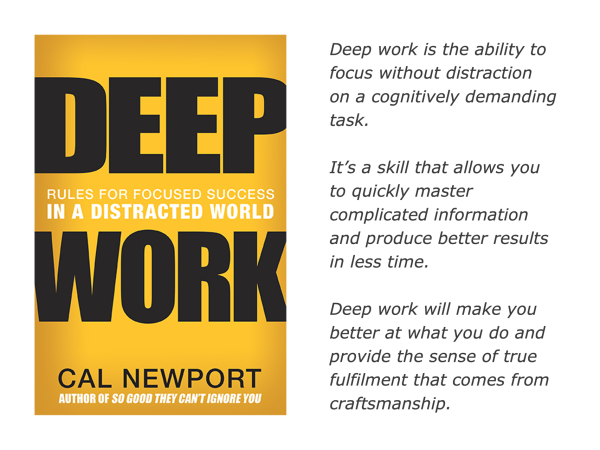
There are many ways to do deep work. This approach involves going through the following steps.
Decision Making
Great workers decide to commit themselves fully to the task. They often do this after doing lots of research. Bearing in mind the activity they want to pursue, they take the following steps.
They clarify the real results they want to achieve and the key strategies they can follow to achieve the goals.
They clarify the pluses and minuses involved in working to achieve the goals.
They clarify their motivation to achieve the goals – and make sure it is at least 8+/10 – and commit themselves fully to achieving the goals.
Imagine that you have followed some of these steps in your own way. You may then move on to the next stage.
Deep Work
Great workers aim to follow certain strategies and also a certain structure when doing a piece of work. Bearing this in mind, they start by preparing properly. They often do this by exploring the following steps.
They clarify the real results to achieve – the picture of success.
They clarify the strategies they can follow to give themselves the greatest chance of success.
They clarify how they can pursue these strategies by following a certain structure on the way towards achieving the picture of success.
Such workers make a plan for following this structure. They aim to follow their chosen rhythm – their preferred way of working – when working towards the goals. They aim to make good use of their prime times, which are the times of the day when they have most energy. They also build in time for rest and recovery when doing the work.
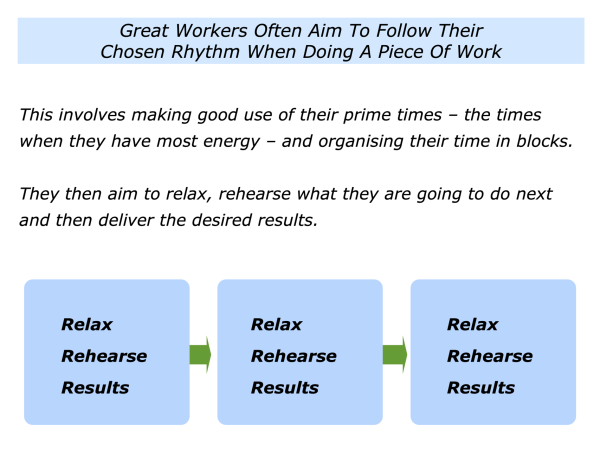
Such workers then dive deeply into the work. As mentioned earlier, they sometimes go through the process of absorption, adventure and achievement.
They also follow certain disciplines to make sure they can stay focused. This often involves removing distractions plus also knowing how to deal with any random events. They then do their best to deliver the goods.
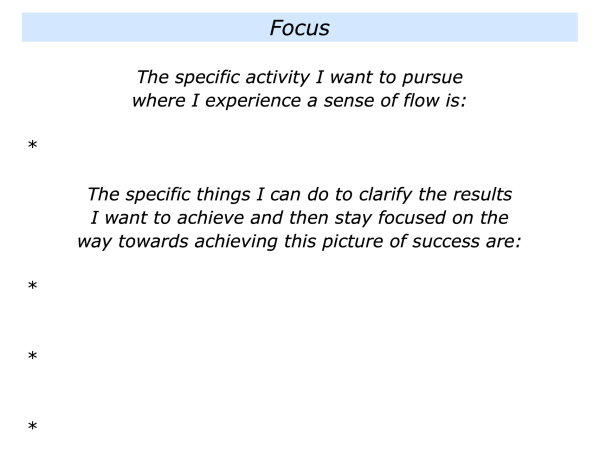
Let’s return to your own life. Imagine that you are pursuing an activity. How can you clarify the results you want to achieve? How can you stay focused and do deep work on the way towards achieving those results?
If you wish, try tackling the exercise on this theme. This invites you to complete the following sentences.
Fulfilment
There are many parts to taking this step. These sometimes involve doing fine work, finishing and, as a by-product, finding fulfilment. Let’s explore how you may want to follow these steps in your own way.
Fine Work
Imagine that you are pursuing an activity in which you experience a sense of flow and are working towards a specific goal. How can you do fine work? There are many definitions for such work. These include the following:
Great Workmanship … Excellent … High Quality … Very Good … Outstanding … Superior.
People who do work they care about are more likely to put their hearts into what they are doing. They may be encouraging a person, cooking food, painting, playing music, renovating a house or doing another activity.
Kahlil Gibran described this approach in his writing. Here is an extract from what he said.
Work is love made visible
And what is it to work with love?
It is to weave the cloth with threads drawn from your heart,
even as if your beloved were to wear the cloth.
It is to build a house with affection,
even as if your beloved were to dwell in the house.
It is to sow seeds with tenderness and reap the harvest with joy,
even as if your beloved were to eat the fruit.
Finishing
Imagine that you are doing a piece of work. How can you finish it properly? One approach is to follow your successful pattern for finishing.
Looking back, when have you finished something properly? You may have written an article, run a marathon, renovated a house, led a team to success or done another activity.
What did you do right then to finish? What were the principles you followed? For example, you may have chosen:
To commit yourself to finishing properly … To set aside time to finish … To rehearse what you were going to do … To break down the work into manageable pieces … To set reachable goals for each work session.
To click into action … To become absorbed in the work … To keep doing the right things in the right way … To encourage yourself on the journey … To build in time for rest and recovery … To keep going until you felt satisfied you had finished properly.
How can you follow some of these principles – plus maybe add other skills – to follow your successful pattern for finishing? If appropriate, how can you then add that touch of class?
Fulfilment
Imagine that you have done fine work and followed some of your successful principles for finishing. You may then experience a sense of fulfilment.
Sometimes this can happen during the work, sometimes at the end. Sometimes it comes from stretching yourself to reach a goal that is stimulating and achievable.
Mihaly describes people who took this path when recovering after accidents. Tragedies Transformed is the title of a study conducted by Professor Fausto Massimini who interviewed paraplegics.
Many said their accident had produced both positive and negative consequences. Tragic events presented them with extremely clear goals. Learning to live again was in itself a matter of pride.
People who mastered the fresh challenges experienced a clarity of purpose they had not felt before their accidents. Lucio had been a 20-year-old gas station attendant when a motorcycle accident paralysed him below the waist. He explained what he had done since the accident.
“When I became paraplegic, it was like being born again. I had to learn from scratch everything I used to know, but in a different way.
“I had to learn to dress myself, to use my head better. I had to become part of the environment, and use it without trying to control it. It took commitment, willpower and patience.
“As far as the future is concerned, I hope to keep improving, to keep breaking through the limitations of my handicap. Everybody must have a purpose. After becoming a paraplegic, these improvements have become my life goal.”
Franco also has paraplegia. Before his accident his most intense flow experiences came from acrobatic dancing on Saturday nights. Now paralysed from the waist down, he has set new targets. The most important goal in his life is:
“To feel that I can be of use to others, help recent victims accept their situation.”
Franco, Lucio and other paraplegics have focused on what they want to accomplish in their lives. They have set specific goals and strived to reach them on the way towards achieving their pictures of success.
There are many ways to live life. Some people aim to make use of their freedom by aiming to flow, focus and, as a by-product, sometimes find fulfilment
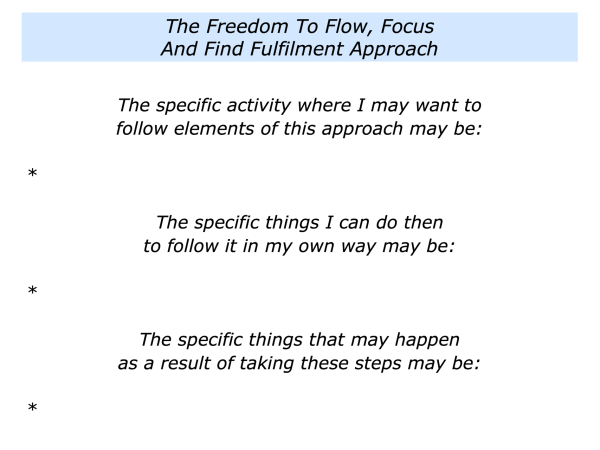
Let’s return to your own life. Looking ahead, can you think of an activity where you may want to follow elements of this approach? How can you do this in your own way? What may happen as result of taking these steps?
If you wish, try tackling the exercise on this theme. This invites you to complete the following sentences.

Leave a Reply