



Good workers often take the following steps when doing work for other people. They may be doing this work for a manager, a customer or other stakeholders.
First, they clarify the goals – such as the specific outcomes to deliver. Second, they clarify any guidelines to follow – such as any Does and Don’ts. Third, they get the things done and deliver the desired results.
Different people will follow this approach in different situations. Let’s explore how they may translate these steps into action.
They Clarify The Goals
Imagine that you are going to do a piece of work for your manager. Whilst we will focus on this kind of situation, you can also apply the same principles when working for a customer or another stakeholder.
Clear contracting is important in many areas of life. This is especially so in professional situations. Clarity is vital. It helps people to make sure they are working towards the same goals.
Bearing this in mind, it will be important to make clear contracts about the outcomes to achieve. Before then, however, it may be useful to explore the following questions before meeting with your manager.
What is the role my manager plays in the organisation? What are the goals they are asked to deliver? What may be some of the challenges they face? What can I do to help them to achieve their goals?
What is the piece of work they may ask me to do? What may be the goals – the outcomes – they want me to deliver? What may be any guidelines – Dos or Don’ts – they may want me to follow?
How can I prepare properly for the meeting with my manager? How can I make clear contracts about the outcomes to achieve with the work? How can I play back my understanding and reassure them I can deliver the goods?
Let’s assume that you have explored these themes. Whilst you may have an idea about the work to be done, it can be important to go into the meeting with your manager aiming to help them to succeed. That is because:
They are your key stakeholder – your key customer – and it will be important to do your part to help them to reach their goals.
Imagine that you are actually in the meeting with your manager. It can be useful to show that you understand the world from their point of view. But then it will be vital to take the following steps.
First, to clarify the specific piece of work to be done.
Much depend on your role, of course. The aim may be do a something specific to improve the profits, product quality or people’s morale. It could be to deliver great service, run an induction programme or do another piece of work.
Second, to clarify the specific outcomes to achieve.
This is a vital part. It is important to clarify the goals in outcome terms – the real results to achieve – rather than just the activities you may do. You can then keep focusing on doing your best to deliver these outcomes.
Third, to clarify the specific time frame for delivering these outcomes.
Some managers worry and slip into micromanagement. It can therefore be important: a) to clarify when specific things need to be delivered; b) to describe how you will proactively keep your manager informed about the progress being made towards the goals.
It can then be useful to play back your understanding the goals. This helps to make sure that everybody has the same picture. You may say something along the following lines.
The Goals To Achieve
As far as I understand, the specific outcomes to achieve when doing this piece of work are:
* To …
For example …
* To …
For example …
* To …
For example …
Is that right? Are there any other outcomes to achieve?
Imagine that you have played back and agreed on the goals. It can then be time to explore the next step that some people take before doing a piece of work.
They Clarify The Guidelines
Clear contracting often involves more than clarifying the goals. It can also involve clarifying the guidelines – the possible Dos and Don’ts – to follow when working to achieve the picture of success.
Some people throw themselves into doing the work. But then find themselves interrupted by their manager – or other stakeholders – who tell them not to do certain things.
It can therefore be useful to clarify some of the guidelines to follow when doing the work. The aim is to be aware of the key Dos and Don’ts, however, rather than it being an invitation for micromanagement.
The company, for example, may encourage people to follow certain principles. These could include pursuing specific strategies when working with customers, colleagues and other stakeholders.
The manager may also want you to follow certain strategies. These could include staying within budget, keeping them informed in a certain way or do other things on the road towards delivering the agreed outcomes.
Bearing this in mind, one approach is to say something along the following lines to the manager.
The Guidelines To Follow
Looking ahead, are there are any overall guidelines – Dos and Don’ts – that you would like me to bear in mind when working towards the goals?
I will obviously keep you informed about the progress being made, but it would be good to know about any other things that I need to bear in mind.
Some managers may be clear on the specific things regarding the Dos and Don’ts. Others may be rather vague. Whatever their approach, it can be good to get an idea about these guidelines.
Clear contracting is often about: a) The What – the specific goals to achieve; b) The How – the specific guidelines to follow; c) The When – the specific timelines for achieving the goals.
Imagine that you have clarified these with your manager. If appropriate, you may want to summarise your understanding of the overall guidelines by saying something along the following lines.
The Guidelines To Follow
As far as I understand, the guidelines – the Dos and Don’ts – to bear in mind when working towards delivering the goals are these.
* To …
For example …
* To …
For example …
* To …
For example …
Is that right? Are there any other things to bear in mind?
One key point is worth mentioning at this stage. Sometimes there may be situations where you may want to explore the following question.
What happens if I am going to find it personally or professionally difficult to follow the suggested guidelines?
Depending on your circumstances, there may be times when you are prepared: a) to, as far as possible, retain your integrity; b) to do your best to work within certain guidelines.
There may be other times when you choose to make another decision. Sometimes this can be complicated: but it is important to – as far as possible – always have a back-up plan for shaping your career.
Let’s assume, however, that you want to go ahead with the piece of work for your manager. People who take this approach then move on to the next step.
They Get Things Done
Good workers get things done. Imagine that you want to follow this approach in your own way. If appropriate, you can take some of the following steps
You can take responsibility, be proactive and get some quick wins. This can help to build momentum and demonstrate that the show is on the road.
You can reassure your manager by updating them on the progress being made. One approach is to inform them about what things are in the Green, Amber and Red Zones. Plus how you are addressing these things.
You can, in an appropriate way, keeping checking if the priorities regarding the outcomes remain the same. This can be important because the priorities may change but this is not always communicated to people.
You can find solutions to challenges. Sometimes you can do this in a proactive way without needing to inform anybody. Sometimes you can share the possible options and, when appropriate, get the go ahead from the key stakeholders.
You can deliver the agreed outcomes: because results are the best reassurance. When appropriate, you can then meet with your manager and focus on doing the next piece of work.
Good workers often take this route. They aim to clarify the goals and the guidelines. They then aim to get things done, do superb work and deliver the goods.
Let’s return to your own life and work. Looking ahead, can you think of a situation where you may want to follow elements of this approach? How can you do this in your own way?
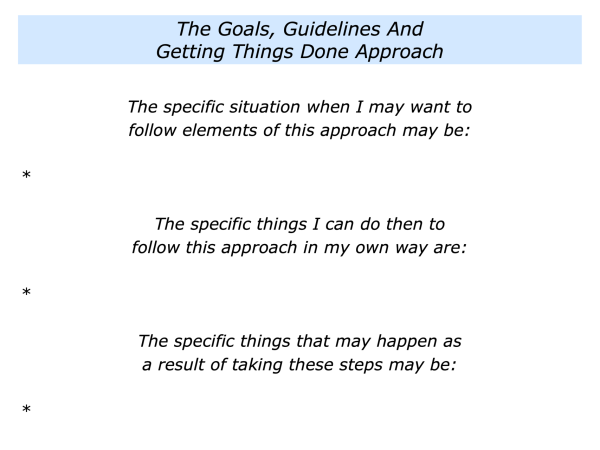
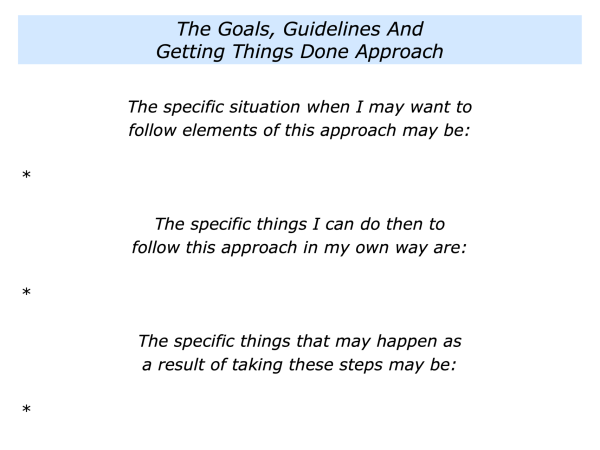
If you wish, try tackling the exercise on this theme. This invites you to complete the following sentences.

Leave a Reply