



During the 1980s it become common to focus on the customer’s journey when they interacted with an organisation or did business with a company.
This approach still applies today though the nature of many interactions have changed. This calls for getting the right balance between high touch – focusing on the person – and high tech to create a good experience.
Back in the 1980s many steps of the journey were designed to make life easy for a company rather than for the customer. When using an airline, for example, it could involve going to a travel agent or taking the following steps.
Finding the telephone number … Ringing up … Waiting to be answered … Enquiring about the flights …Booking a seat … Fixing the payment … Waiting for the ticket to arrive by post … And so on.
Jan Carlzon, the then President of Scandinavian Airlines Systems, recognised this process was tortuous. He took the lead to become more customer focused and aimed to put the customer first rather than last.
SAS plotted the journey from the customer’s point of view. It focused particularly on what were called the moments of truth. These were key moments when the customer interacted with the company. For example:
Making a booking … Getting to the airport … Parking a car … Standing in line at the check-in … Getting through security … Spending time in the waiting area.
Sometimes having a flight delayed … Boarding the plane … Having a meal … Arriving at the destination … Waiting for the baggage … Sometimes having baggage missing … Travelling from the airport … etc.
Carlzon recognised that most airlines offered a similar product for their customers. They transferred people from A to Z in a metal tube. Bearing this in mind he explored the following theme.
What could make the difference?
He believed it was how the company behaved during these key moments of truth that could make the difference. If the airline and its staff performed brilliantly, the customers were more likely to continue to book with the airline.
SAS embarked on researching what the customers wanted. These included the following things.
They wanted the actual flight to be on-time, safe and reliable. The airline did not get an extra plaudits for making this happen.
They wanted the customer’s journey to be simplified – by putting the customer first – rather than to be an obstacle race.
They wanted the airline to pull-out all the stops if things went wrong and then fix things for the customer.
Bearing this in mind, SAS embarked on a process where they involved both their customers and staff in aiming to improve the service. This involved exploring the following things.
How can we keep improving our core product and service? How can we
continue to make it safe, reliable and attractive? How can we make it
easy for the customer to do business with us?
How can we simplify the customer’s journey? How can we make sure it is designed to make it good for the customer? How can we get processes right? How can we remove or improve each moment of truth?
How can we behave brilliantly if things go wrong? How can we recover from mistakes? How can we turn a complaining customer into a customer for life?
SAS introduced massive improvements and led the field for many years. Eventually they were overtaken, however, by other airlines that bettered the ideas.
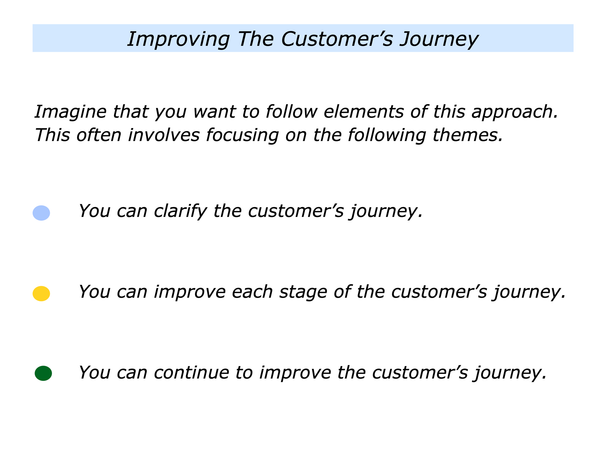
Let’s return to your own situation. Imagine you have been charged with improving customer service in your company. One place to start is by improving their journey. Let’s explore how to make this happen.
You can clarify
the customer’s journey
Try tackling the exercise on this theme. Begin by plotting the customer’s journey when they do business with your company. Pay special attention to the moments of truth.
These are key stages when the customer interacts with your business. The things that people experience at these moments can play a big part in how they regard your company.
There are many different kinds of customer journeys. These may depend on whether customers do business via phone, on the internet or visiting an outlet. But let’s focus on the journey made by most of your customers.
What is the first contact that a potential customer has with your company? This could be when seeing an advert, approaching a store or trying to contact your company.
What is the impression that a customer may get during this time? Is it easy for them to interact with you? What could be done to improve the customer experience?
What is the next contact that a potential customer may have with your company? What are the things that could be done to make it a good experience for the customer?
Good companies map the many stages of the customer’s journey. These go from the first interaction, through the actual transaction and then, in some cases, to the follow up and after-care.
Let’s assume that you have mapped every stage of the customer’s journey. When appropriate, you may then move on to the next stage.
You can improve each stage
of the customer’s journey
Scandinavian Airlines began by making it simpler for the customers to do the following things. These are common today but they were revolutionary in the early 80s.
They made it easier for them: a) to buy a ticket which could be picked up at the airport; b) to be picked up at their home and transported to the airport; c) to be fast-tracked through check-in. Etc.
Imagine that you want to improve the customer’s journey in your company. One approach is to also involve your people in the process. If appropriate, you can also involve some of your customers.
When doing this, you may want to start with the obvious question: Can any of the stages be removed to make it simpler for the customer?
Looking back, many companies created steps that made it easier for them rather than the customers. It is vital to maintain security, of course, but you may wish to explore if any of the stages can be removed.
You can them move on to focusing on each stage on the customer’s journey. Looking at each of these, you can ask yourself the following questions.
How can we improve this stage of the customer’s journey? How can we make it easy for them to do business with us? How can we make this stage simpler?
How can we put the right processes in place? How can we, when appropriate, add the personal touch? What else can we do to improve the customer’s experience?
If you wish, you can invite people to do the following exercise. You can keep going until they have covered all the stages in the journey.
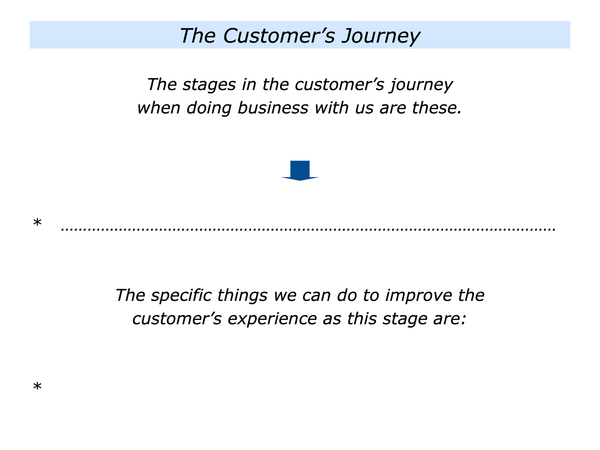
Imagine that you have produced many ideas about how to improve the customer’s journey. You may then aim to do the following things.
You can run a pilot to with some of your people who want to translate the ideas into action. You can build on what works well and find solutions to any challenges. You can then expand the approach and give your people the support they need to improve the customer’s journey.
You can get feedback from the customers, build on what works and fix any problems. You can then move onto the next stage.
You can continue to
improve the customer’s journey
“Today’s luxury becomes tomorrow’s expectation,” we are told and customers will continue to be demanding. So how can you keep improving? One approach in today’s world is to follow elements of the following approach.
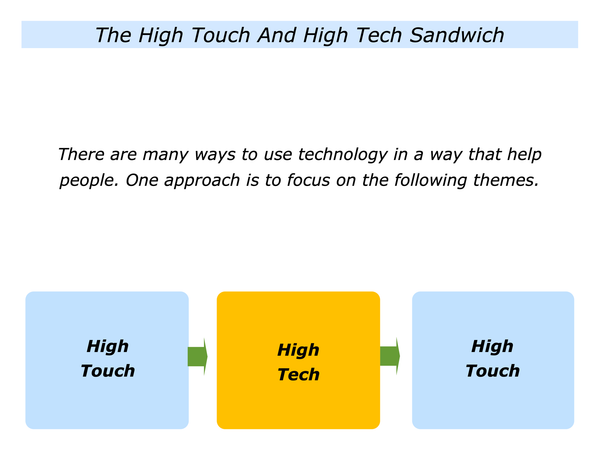
There are many ways to use technology in a human way. John Naisbitt described how this could be done more than forty years ago in his two books Megatrends and High Tech, High Touch.
Looking to the future, he said that it would be vital for service providers to get the right balance between the following aspects.
High Tech – This would involve providing technology that simplified people’s lives and helped them to achieve success.
High Touch – This would also involve providing the personal touch that added something extra to help people to achieve success.
Today this approach calls for starting with High Touch – the human dimension. Let’s look at an example of what a good doctor does when meeting a patient. They go through the following stages.
High Touch – They start by making the person feel welcome and asking them about their situation.
High Tech – They then use High Tech (or Low Tech) to find out more about the patient and provide the treatment.
High Touch – They then finish the session by focusing on the patient and advising on the specific next steps.
The High Touch, High Tech, High Touch approach can work in many fields. Beware of people who immediately jump to High Tech first and prescribe an answer without factoring in the human dimension.
Imagine that you are writing a proposal for a client who wants to use AI or another tool. You may focus on the following themes.
High Touch
This involves starting by customising the proposal and focusing on the people aspect. It is important to show you understand the people’s or organisation’s needs, strengths, culture, challenges and goals.
High Tech
It then involves showing how it is possible to use High Tech to help the people or organisation to simplify their lives, tackle challenges and achieve success.
High Touch
It concludes by returning to the people aspect. This involves describing the specific next steps that can be taken to help them or their organisation to achieve their goals.
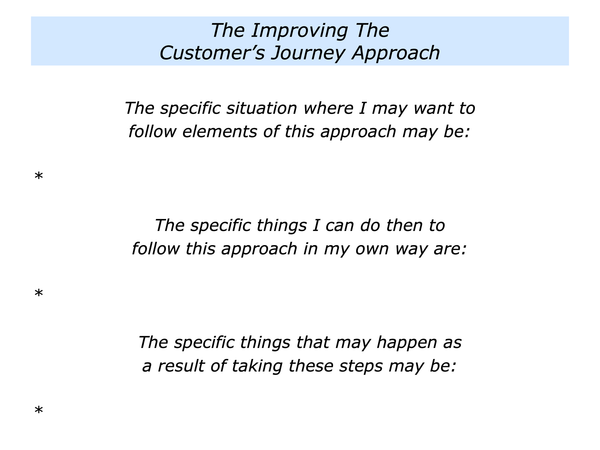
Let’s return to your own work and the customer’s journey. Looking ahead, can you think of a situation where you may want to improve the customer’s experience? How can you do this in your own way?
If you wish, try tackling the exercise on this theme. This invites you to complete the following sentences.

Leave a Reply