



The next play approach was popularised by the college basketball coach Mike Krzyzewski. It has since by applied by many people in different areas of life.
The approach involves moving on from the success or disappointment you just experienced. It is then to be fully present and do your personal best to shape a positive future. Mike explained this in the following way.
In basketball and in life, I have always maintained the philosophy of ‘next play.’ What it means is that what you have just done is not nearly as important as what you are doing right now.
The ‘next play’ philosophy emphasizes the fact that the most important play of the game or life moment on which you should always focus is the next one.
Whenever you got knocked back individually and collectively, it is: OK, the next play. What am I going to do next?
This philosophy has been adopted by individuals, teams and even organisations. It has also been the topic of many articles, books and seminars.
The next play approach can be used to channel your emotions in a positive way in many situations. For example:
When aiming to recover from a mistake … When aiming to encourage another person … When aiming to communicate in a positive way.
When aiming to turnaround an organisation … When aiming to help other people to succeed … When aiming to build a better world.
Different people, teams and organisations use different mantras to channel their feelings in positive ways. Some individuals focus on the following themes when taking this step. They ask themselves:
What do I want to do next? What is the real result I want to achieve? How can I do my best to achieve that result?
The next play approach embodies some elements of the concept of continuous improvement. One difference, however, is that the continuous improvement approach sometimes builds on the best from the past.
It encourages people: a) to focus what they have done well and how they can follow those principles in the future; b) to focus on what they can do better in the future and how.
The specific things it has in common, however, is that it encourages people to be fully present and keep improving. They can then aim to do their best to shape a positive future.
Let’s return to your own life and work. Can you think of a situation where you may want to follow elements of this approach? This could be, for example, when you aim:
To build on a success … To recover from a setback … To channel your feelings in a positive way … To communicate with a person … To continue to build a good relationship … To take the next step in your life or work.
Looking ahead, what do you want to achieve in the situation? How can you do your best to achieve that result? How can you translate your aim into action?
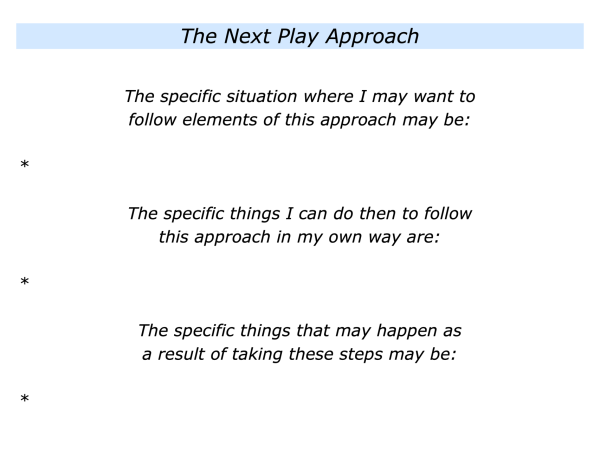
If you wish, try tackling the exercise on this theme. This invites you to focus on how you follow this next play approach in your own way.

Leave a Reply