


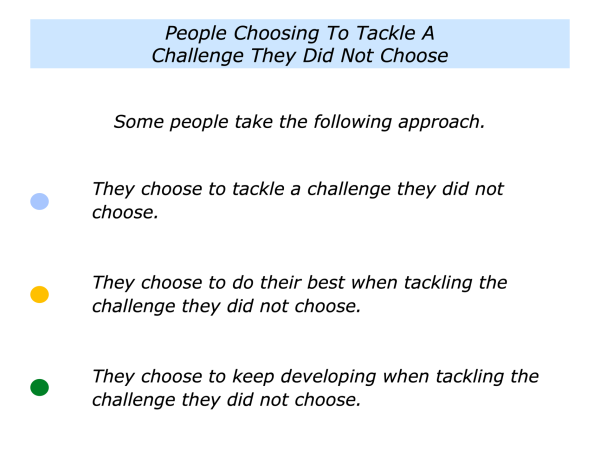
People may sometimes choose to tackle a challenge they did not choose in their life or work. They may choose to deal with an illness, manage a crisis or tackle another situation.
People who take this approach commit themselves and aim to do their best. They may also find they keep developing when tackling the challenge. Some do this by taking the following steps.
They choose to tackle the
challenge they did not choose
Some people may follow this approach after experiencing a shock or an unexpected event. Some may do so when feeling motivated to tackle an injustice or a daunting challenge.
Looking back, can you think of a situation when you may have followed elements of this approach? Let’s consider some examples.
You may have felt healthy but then had a shock diagnosis. This may have led to you embarking on a programme of treatment for cancer or another illness.
You may have felt secure in pursuing a career but then suddenly found yourself out of work. This may have led to you throwing everything into finding your next role.
You may have been asked for help by somebody whose life had been upturned. Bearing in mind what you could control in the situation, this may have led to you doing what you could to help the person.
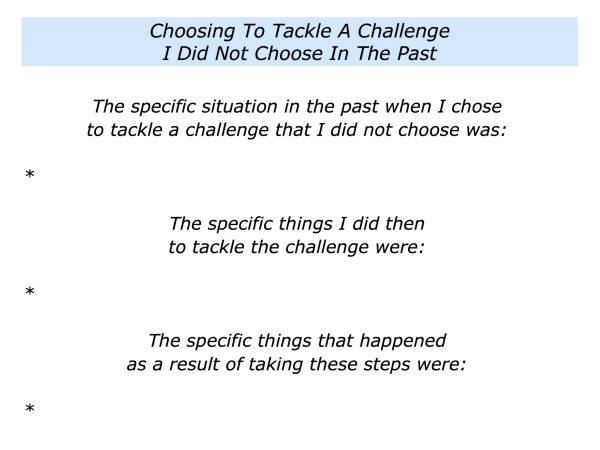
Looking back, what did you do then to choose to tackle the situation you did not choose? What happened as a result of taking these steps? If you wish, try tackling the exercise on this theme. This invites you to complete the following sentences.
Different people choose to tackle such situations in different ways. Some then focus on taking the next step.
They choose to do their best when
tackling the challenge they did not choose
People who take this approach aim to do their best when tackling a challenge they did not choose. Much depends, of course, on the specific situation. Bearing this in mind, some people take the following steps.
They clarify what they can control in the situation and set what they believe to be specific achievable goals.
They clarify the strategies than can follow to give themselves the greatest chance of achieving these goals.
They clarify how they can translate these strategies into action and follow certain disciplines to do their best to work towards achieving these goals.
Different people will do their best in different ways. Joshua Rands, for example, explained how he followed a certain rhythm when having treatment for a rare form of cancer.
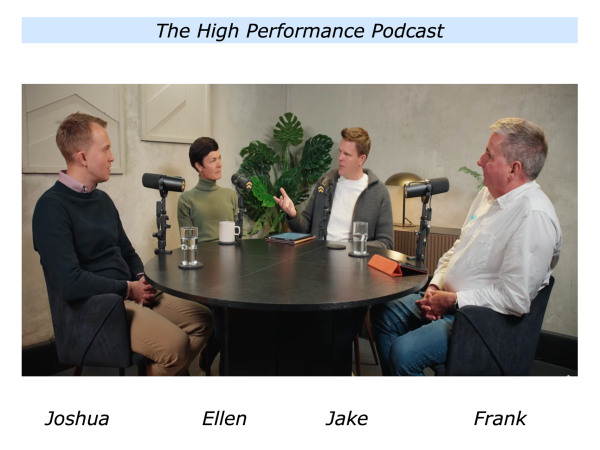
He described his journey when speaking with Jake Humphry on the High Performance podcast which highlighted the work of the Ellen MacArthur Cancer Trust. This provides sailing and outdoor development opportunities for young people who have experienced the illness.
Joshua explained how he was a healthy teenager who suddenly got a life-threatening illness. Embarking on the treatment, he often aimed:
To follow a certain daily rhythm … To do his best one day at a time … To be kind to other people because they also needed support.
Here is excerpt from a Linked In post in which Joshua explained aspects of his journey and some reflections on doing his best.
Privileged to have joined Jake Humphrey on the High Performance Podcast to discuss what it truly means to perform at the highest level — not just in business, but in life.
Alongside Dame Ellen MacArthur and Frank Fletcher, CEO of the Ellen MacArthur Cancer Trust, we spoke about the extraordinary work of the Trust — a charity helping young people rebuild confidence and independence after cancer treatment through sailing and outdoor adventure.
I don’t often speak publicly about my own cancer journey, but this conversation felt like the right moment.
Cancer tested my resilience, but it also shaped how I lead, how I show up, and what matters most to me.
For me, high performance comes down to two things:
Being purpose-driven — knowing your “why” and aligning decisions to it.Being ruthlessly kind — having the courage to be direct, honest, and compassionate in equal measure.
Kindness isn’t weakness. It’s a strategic choice. It means lifting others up while still maintaining the standards that drive excellence.
That’s why supporting the Ellen MacArthur Cancer Trust matters so much to me. If you’re facing your own battle right now — whatever form it takes — I hope this conversation reminds you that resilience isn’t about bouncing back. It’s about moving forward stronger.
Huge thanks to Jake Humphrey, Ellen and Frank Fletcher for such an honest conversation, and to everyone supporting this vital mission.
Different people will aim to do their best in different ways in different situations. Sometimes this can lead to them experiencing the next stage.
They choose to keep developing when
tackling the challenge they did not choose
Some people say that they actually develop through the process of tackling such a challenge. Al Siebert highlighted this approach in his books The Survivor Personality and The Resiliency Advantage.
Al studied people from all walks of life who had been through traumatic situations. Certainly some people continued to have challenges, but many said that they had learned from the experiences. These included:
They had learned to refocus on what was really important in life. They had developed their creativity and resilience. They had added to their repertoire of tools for managing challenges.
Babette Rothschild describes something similar in her book Safe Trauma Therapy. She says that many people have the strength to manage some traumas successfully. She explains this in the following way.
There a prevailing belief in the trauma recovery world that all traumas need to be resolved by the memories being processed.
This may be a useful approach for some people, but this is not always the case. At lectures I ask people:
How many of you have had a trauma in your history that you have not worked on but nonetheless function fairly well in spite of?
Normally two thirds of the people raise their hands.
Babette also enables people to add to their inner resources. She provides them with practical tools that they can use to manage tough challenges in the future.
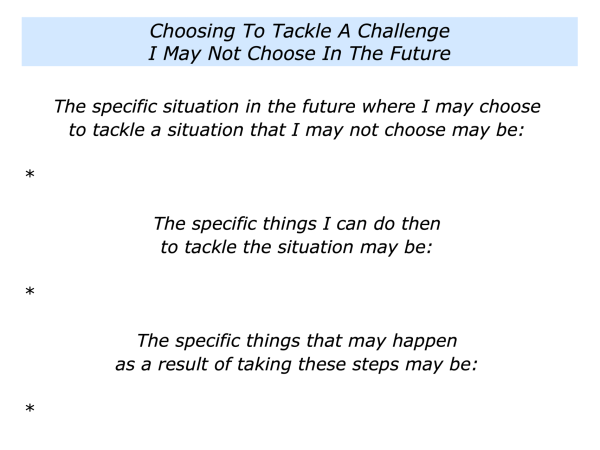
Let’s return to your own life and work. Can you think of a situation in the future when you may choose to tackle a challenge that is not of your choosing? This could be in your personal or professional life.
Much depends on the kind of situation, of course, but what do you think you could do to tackle the challenge? How could you translate your strategy into action? What may happen as a result of taking these steps?
If you wish, try tackling the exercise on this theme. This invites you to complete the following sentences.

Leave a Reply