



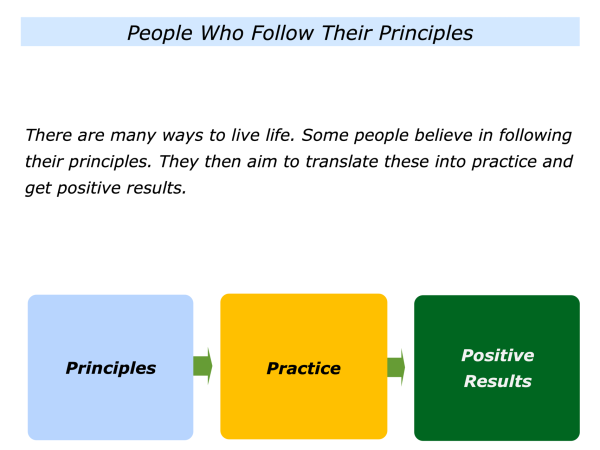
There are many ways to live life. Some people believe in following their principles. They then aim to translate these into practice and do their best to get positive results.
Some people follow this approach when following a spiritual faith, a philosophy or a moral compass. Some do it when following a vocation, a mission or when working to achieve a picture of success.
Such people aim to follow their principles and, in this way, they get a win every day. Whichever route they take, however, they often focus on the following themes.
They Clarify Their Principles
People who take this approach start by clarifying the principles they want to follow. Different people may do this at different stages of their life.
Some people grow up in a family where they learn to follow certain principles. They may have parents who encourage them to be kind, help other people and be the best they can be.
Some people learn principles from being in a school, sports team, drama group or other community. Some may learn them from significant people who helped them grow, manage challenges or achieve success.
Some people learn to follow certain principles when being in a team, organisation or other work place. Some may learn them from leaders or other people they admire.
Some people choose to follow certain principles after experiencing a potentially life-changing event. They clarify what is really important and aim to focus on these things in their personal or professional lives.
Some people take this approach after a period of reflection. They may aim to see things in perspective by going on a retreat or by exploring how to shape their future. They may focus on:
The principles they want to follow in their life;
The practical things they can do to translate these principles into action in their life;
The positive mantra they want follow to remind themselves to keep following these principles in their life.
Such people may start by brainstorming the principles they want to follow. They may then settle on, for example, the three key principles they want to follow. Here are some of the things that people write when exploring these themes.
My Principles
I want to encourage people in my life and work … I want to continue to have a sense of gratitude … I want to care for my loved ones
I want to use my strengths to help people to succeed … I want to pass on knowledge that people can use to shape a positive future.
I want to do my best during my time on the planet … I want to give people positive memories for life … I want to die feeling at peace.
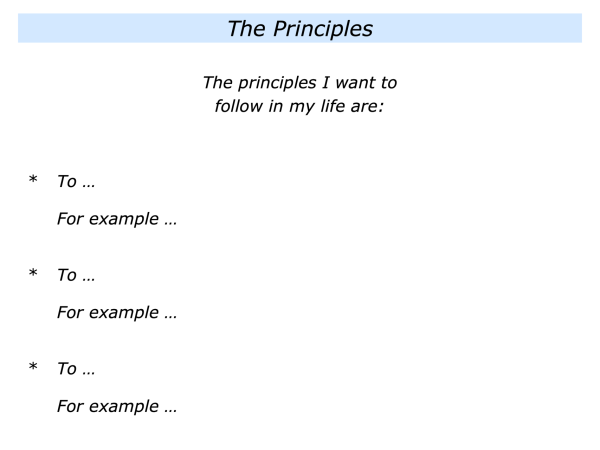
If you wish, try tackling the exercise on this theme. This invites you to complete the following sentences. If possible, try to bring each principle to life by giving an example of how you can translate it into action.
They Clarify How They Can Translate
Their Principles Into Practice
People who take this approach aim to go beyond to simply clarifying their principles. They aim to translate these into practice. Some people do this by taking the following approach.
They clarify how they can follow their
principles in their daily lives and work
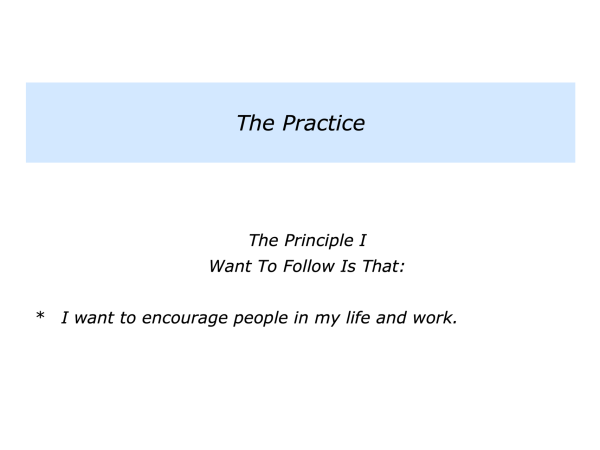
Imagine that a person has said that one of the principles they want to follow is to encourage people. They can clarify how they want to translate this into practice.
One approach is for them to do the following exercise. They can, of course, add more detail regarding how they would actually translate each of their principles into action.
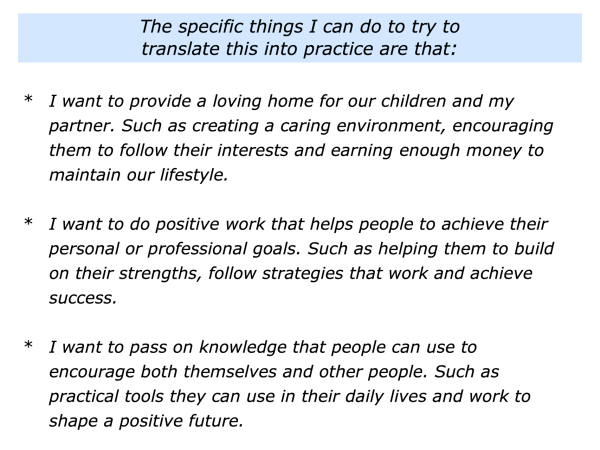
Let’s assume that a person has explored how they can translate each of their principles into practice. They may then move on to the next stage.
They clarify how they can follow
their principles in a particular
situation and get positive results
People who take this approach move from the concept to the concrete. They focus on how they can follow their principles in particular situations and do their best to get positive results.
Different people will do this in different ways. Whatever the situation, however, they often focus on the following themes.
They clarify the particular situation they may
be going into and the desired positive results
A person who follows this approach will look ahead to the particular situation. They may be aiming to encourage a person, do a piece of work, lead a team, manage a challenge or achieve a picture of success.
Such a person will prepare properly before going into the situation. Looking ahead, they may use their imagination to explore the following questions.
What is the situation I am going into? Who may be the people involved? Will it be one person or a group of people? What is the background to the situation? What is actually happening in the situation?
What are the things I can control in the situation? What are the results I would like to achieve? What are results the other people would like to achieve? Looking at the situation, what may be the desired positive results?
Such a person will use their imagination clarify the desired picture of success. They may then move on to the next stage.
They clarify how they can follow their principles in
the situation and get the desired positive results
A person who follows this approach will clarify how they can follow their principles in situation. Bearing in mind what they can control, they will focus on the desired positive results.
Such a person may then do lots of mental rehearsal in order to prepare properly. Different people will do this in different ways. Some people go through the following steps.
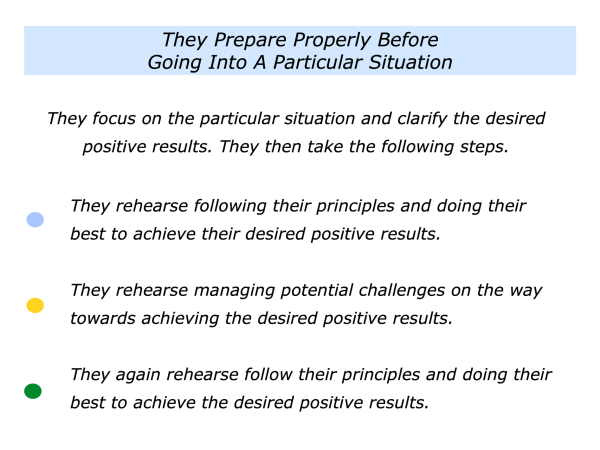
Imagine that a person has taken these steps. They may then follow their ritual for moving into action. Going into the situation, they will aim to be fully present and follow their principles.
Sometimes this may work. Sometimes there may be occasions, however, when they need to explore the following theme.
They clarify how they can sometimes follow
their principles in a pragmatic way and do
their best to get the desired positive results
Such a person will keep following their principles because these may be the only constants in a changing world. They may sometimes need to apply these in a pragmatic way, however, to get the desired positive results.
They may need to keep reading reality to see what is actually happening. Sometimes this calls for them being agile and, when appropriate, being pragmatic. There are many definitions for being pragmatic. One definition is:
To do things in a practical and realistic way that works.
Depending in the situation, different people will take this step in different ways. One approach is for them to explore the following questions.
What are the positive results I want to achieve in this situation?
What are the things that work in this kind of situation?
How can I follow my principles in a way that is most likely to work and achieve the desired positive results?
Such a person will continue to follow their principles. There may be times, however, when they need to apply these in a pragmatic way to achieve the desired positive results.
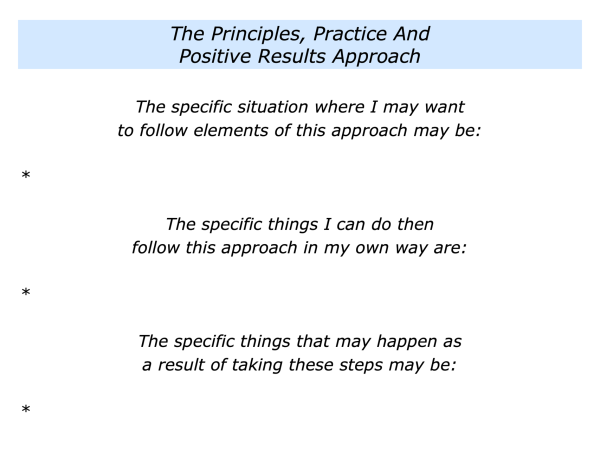
Let’s return to your own life. Looking ahead, can you think of a situation where you may want to follow elements of this approach? How can you do this in your own way?
What are the principles you want to follow in your life? What may be the situation where you want to translate these into practice? How can you then do your best to get positive results?
If you wish, try tackling the exercise on this theme. This invites you to complete the following sentences.

Leave a Reply