



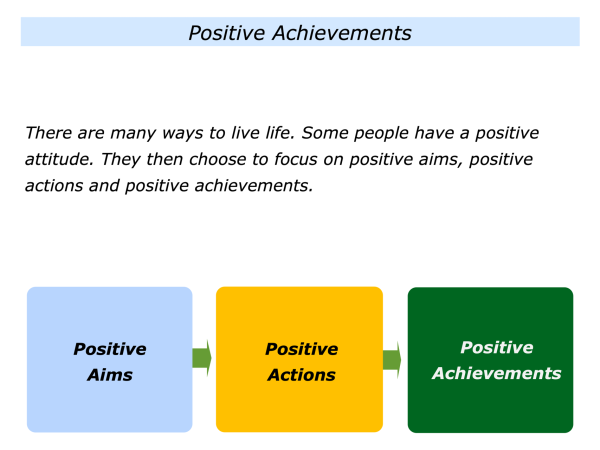
There are many ways to live life. Some people have a positive attitude. They then choose to focus on positive aims, positive actions and positive achievements.
Some people follow this approach by doing small but positive things in their daily lives. Some follow it by aiming to work towards achieving bigger goals in their personal or professional lives.
Different people follow this approach in different ways. As mentioned earlier, however, they start by having a positive attitude. They then choose to focus on the following themes.
Positive Aims
Some people aim to do simple but positive things. They may aim to encourage a person, cook nutritious food, care for their garden, solve a practical problem or do another activity.
Some people aim to follow their principles. They aim to show kindness, create beauty, do good quality work or do something practical to help people or the planet.
Some people may focus on their top priorities in life. They may aim to be proactive and take practical steps towards achieving their personal or professional goals. This leads to the next theme.
Positive Actions
Some people believe in go beyond writing their goals. They aim: a) to focus on their key priorities in life; b) to translate these into action; c) to do their best to get positive results.
Some focus on their life goals and do something towards these early in the day. One of the most influential books on this theme was Alan Lakein’s 1970 How To Get Control Of Your Time And Your Life. Here are some ideas from the book.
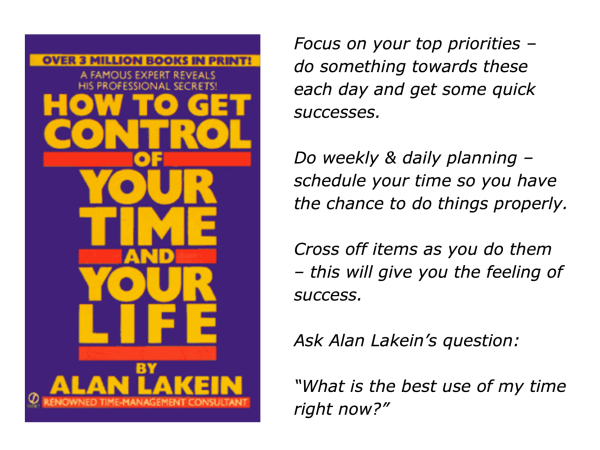
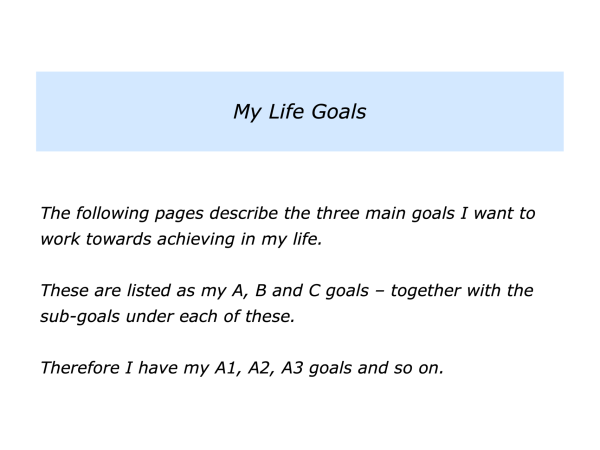
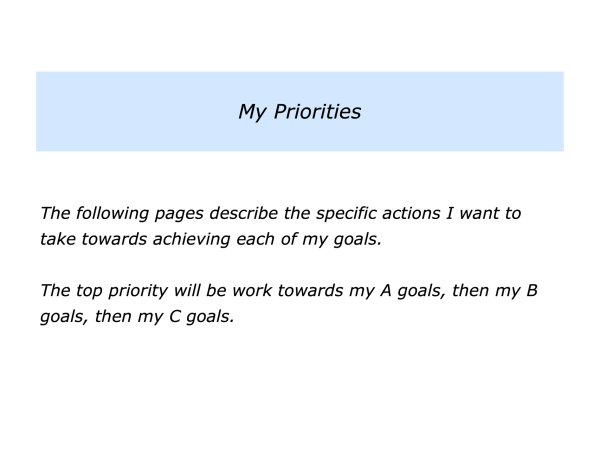
The following pages show one way that a person can apply Alan’s approach. This can also help with their priority management. A person can then aim:
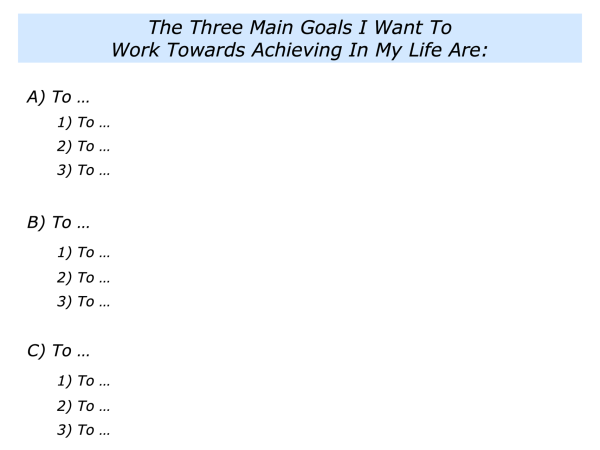
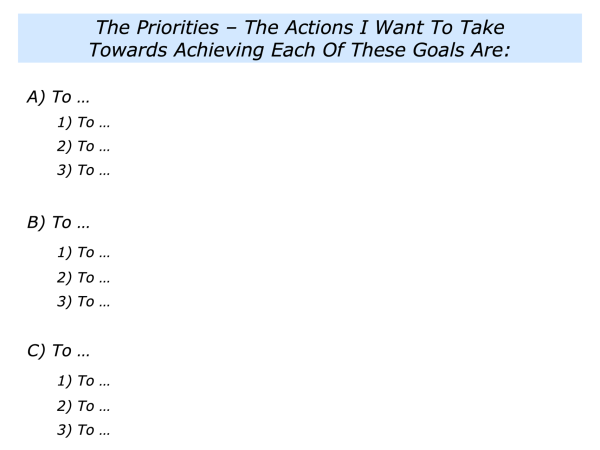
To focus on their life goals – such as clarifying their A, B and C goals together with the sub-goals under each category;
To focus on their priorities – such as what they want to do to work towards achieving their A, B and C goals;
To focus on translating these ideas into action – such as actually doing something towards achieving their A, B and C goals.
Different people apply Alan’s ideas in different way. The next pages describe one framework that people use to focus on their priorities.
Positive Achievements
Many people achieve lots of things in their lives and work. They may not recognise some of these things, however, because they see them as simply getting on with life.
Sometimes it can be useful for a person to consider their past achievements. Here are some of the things that different people may mention when focusing on this theme.
Positive Achievements In The Past
The positive things that I have done or
achieved in the past include the following. I have:
Recovered from a tough illness in my childhood … Raised two happy children … Encouraged my partner over the years … Helped my parents to buy their house.
Learned to use my skills as a dyslexic … Set up and run a successful business … Helped former addicts to stay healthy … Cared for hundreds of people in my work as a medic.
Helped young athletes to aim to do their personal best … Led hundreds of workshops that helped people to develop … Passed on knowledge that people can use to shape a positive future.
Some people may then turn to focusing on the things they want to achieve in the future. This involves them exploring the following theme.
Positive Achievements In The Future
The positive things that I want to do or achieve
in the future include the following. I want to:
*
*
*
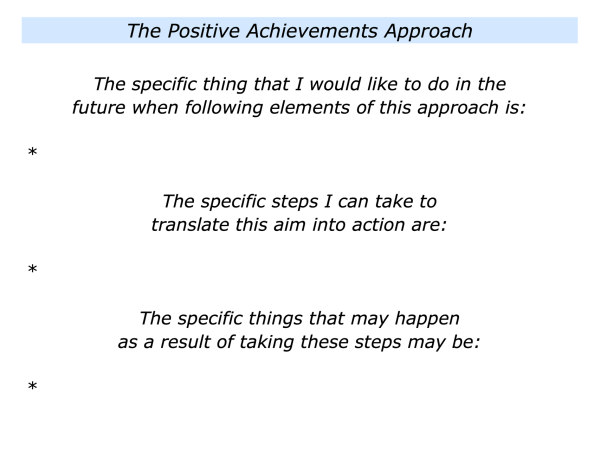
Imagine that you want to follow elements on this approach in your own way. Looking ahead, what may be some of the things that you want to do or achieve in your life or work? If you wish, try tackling the exercise on this theme.
This invites you: a) to describe one specific thing you would like to do in the future; b) to describe the specific steps you can take to translate this aim into action; c) to describe the specific things that may happen as a result of taking these steps.
If appropriate, you can then aim to take these steps and continue to achieve positive things in your life and work.

Leave a Reply