


Imagine that you are in a professional role that sometimes involves helping people to manage challenges. This may often involve helping people to build on their strengths, set specific goals and achieve success.
There may be times, however, when a person wants to make changes in their behaviour. There are many models for helping them to take this step. The following section explores one approach.
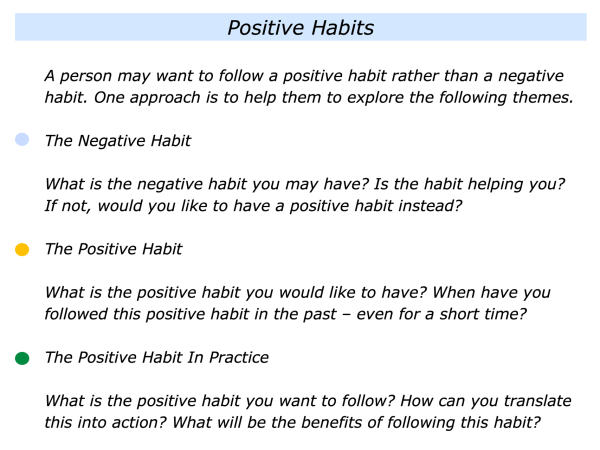
Imagine that a person wants to follow a positive habit rather than a negative habit. If appropriate, you can help the person to explore the following themes.
The Negative Habit
Let’s assume that you have created an environment where a person feels at ease. There may come a point when they want to explore how to follow a positive habit rather than a negative habit.
Different people may want to stop following different negative habits. Here are some of the topics that individuals may mention when exploring this theme.
The Negative Habit That I
Want To Stop Following Is:
Getting angry in certain situations … Having negative self-talk … Comparing myself to other people … Procrastinating and putting things off … Being addicted to following bad news about the planet.
Worrying about things I can’t control … Being addicted to harmful substances … Rewarding myself by drinking too much … Binge eating comfort food.
Trying to fix people … Helping people who don’t want to be helped … Putting myself into situations where I may feel like a victim … Focusing on negative things rather than positive things.
Let’s assume that a person has expressed the desire to follow a positive habit rather than a negative habit. If appropriate, you can ask them the following question.
What is the negative habit you may have?
Imagine that a person has described the negative habit they may have in their life or work. You may ask them to give examples of how they sometimes follow this habit.
If appropriate, you can ask them about the possible circumstances – the trigger situations – that sometimes spark them into following the habit. This is a topic we will return to later because it will be important to help them to learn how to avoid or manage situations.
Let’s assume that the person has described the negative habit. If appropriate, you can them the following question.
Is the habit helping you?
This may seem like an odd question. But it can be important to ask in order to help a person to recognise the consequences of following a certain habit. You may then want to ask the following question.
If the negative is not helping you, would you like to have a positive habit instead?
The person will probably say they do want to follow a positive habit but, at this point, may not yet be sure of what they want to do. If so, you may then move on to the next stage.
The Positive Habit
People often have more success by aiming to achieve a positive goal rather than by trying to achieve negative goal. Bearing in mind the old rule that ‘what we focus on, we become’, this means that:
People can aim to start to follow a positive habit
rather than try to stop following a negative habit.
Imagine that a person has described the negative habit they would like to stop following. If appropriate, you can ask them the follow question.
What is the positive habit you would like to have instead of the negative habit?
Some people may find this can be hard to answer. Some may simply repeat what they want to stop doing. Some may begin to describe how they would prefer to behave in certain situations.
Bearing this in mind, and only if appropriate, you may want to help them to explore the positive habits they could follow. Much depends, of course, on the person and their situation.
Imagine that you have begun to explore this theme with the person. Here are some of the answers that individuals may consider when focusing on their chosen positive way forwards.
The Positive Habit That I Would
Like To Follow Would Be To:
Stay calm rather than get angry … Be positive towards myself rather than having negative self-talk … Be happy with who I am rather than comparing myself to others … Be proactive rather than put things off.
Focus on the things I can control in situations rather than those I can’t … Be healthy rather than be addicted to harmful substances … Reward myself in positive ways rather than by drinking too much.
Be encouraging to people but stop trying to fix them … Put myself into positive situations rather than those where I can sometimes feel like a victim.
Imagine that a person has begun to describe the positive habit they would like to follow. Bearing this in mind, one approach is to ask the person the following questions.
When have you followed this positive habit in the past – even for a short time? What did you do then to translate it into action?
This is a development approach that encourages a person to build on the successful pattern they already have within them. It is also an approach that has a track record of delivering success.
The development approach invites people to learn from their positive history. Everybody has overcome challenges and worked to achieve certain goals. They can follow similar principles in the future to achieve their aims. Here is an overview of this approach.
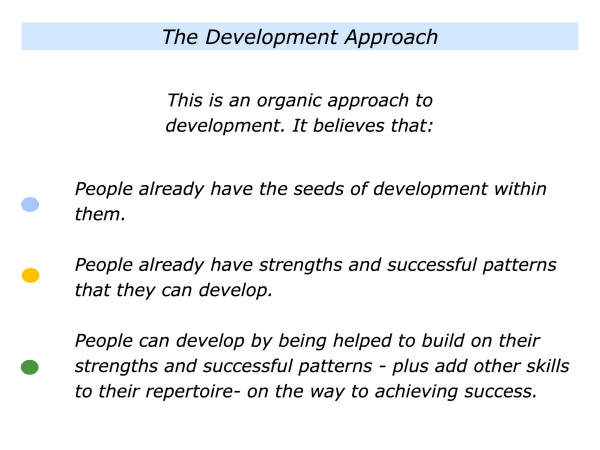
People often find it more affirming to follow the development approach rather than the change approach. Paradoxically, if a person develops then other people may see changes in the way the person behave.
Bearing in mind the positive habit that a person wants to follow, it can therefore be useful to encourage them to explore:
When have they followed that positive habit in the past – even if only for a short time?
What did they do right then? What were the principles they followed? How did they translate those into action?
What happened as a result of them follow those positive habits?
Imagine that the person has described the positive habit they followed in the past. One of the keys is for them to also describe how they actually translated this into action.
This can help them: a) to believe in themselves; b) to believe that they can follow elements of the positive habit in the future; c) to believe they have a chance of achieving success.
There may be some occasions, however, when a person cannot recall such a positive habit. It can then be important to help a person to build an action plan that they believe in. This involves helping them:
To clarify the positive habit they believe in and want to follow in a specific situation.
Imagine that a person has clarified the positive habit – rather than the negative habit – they want to follow. This could be one that they have followed in the past or a potentially new habit.
The next step will be to focus on how to translate this into action in specific situations. Let’s explore this theme.
The Positive
Habit In Practice
Imagine that the person has clarified the positive habit that they want to follow. Bearing this in mind, here are some of the themes you can explore with the person. Later will we consider how to make these happen.
What is the positive habit you want to follow? How can you translate this into action? What will be the benefits of following this positive habit?
Many people make plans to behave in certain ways in situations. The key, however, is to translate these into action. If appropriate, you can help them to take the following steps.
They can describe the positive habit
they want to follow in a specific situation
This step involves a person describing the positive habit they want to follow in a specific situation. Different people will, of course, describe different habits. Let’s look at some examples.
A recovering alcoholic may aim to follow a certain routine each day. They may aim stay sober one day at a time. They will therefore avoid putting themselves into situations where they are tempted by alcohol.
A person who aims to stay calm will put themselves into positive rather than negative situations. They will follow a ritual for buying time – such as counting to ten – if they feel tempted to respond angrily in situations.
A person who has an addictive personality will aim to follow positive addictions rather than negative addictions. They may follow a personal fitness programme, for example, rather than taking substances.
Imagine that a person has described the positive habit they want to follow. This can lead to helping them to take the next step.
They can describe the specific things they
can do – in behaviour terms – to
translate the positive habit into action
People who develop positive habits often do so by describing the specific actions they will take. They will then actually do these things in their daily lives and work. Different people follow this approach in different ways.
Some individuals wake up each day and focus on their life goals. They then do something early that day to work towards these aims. They find this can help them to feel in charge and bring meaning to each day.
Some individuals write the daily disciplines they aim to follow. They then religiously follow these habits and, in some cases, get a dopamine fix from doing these things.
Some individuals write a positive mantra they want to follow. One person wrote: Be positive … Be kind … Be somebody who does their best. They keep looking at this mantra and aimed to follow it each day.
Imagine that a person has described the positive habit they want to follow in, for example, a specific situation. They have also described how they can translate this into action. If appropriate, they may wish to remind themselves of these by doing the following exercise.
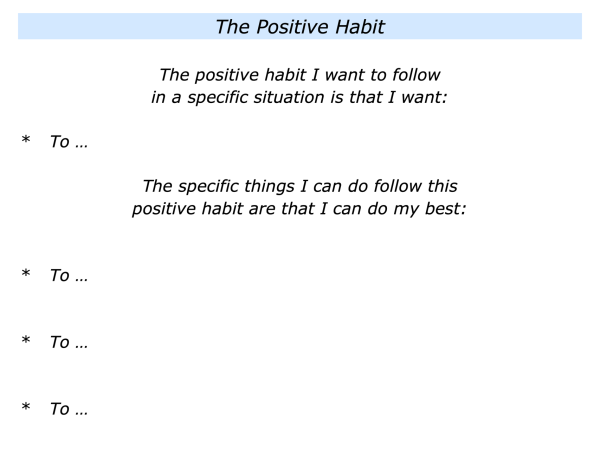
Imagine that a person has worked through these stages. If appropriate, this can lead to helping them to take the next step.
They can describe the positive
benefits of following the positive habit
People are often more motivated to do something if they can see the benefits. They may choose to follow a positive habit, for example, if they believe that they or other people will benefit. Let’s look at some examples.
A person may experience a health warning and then choose to develop a healthier lifestyle. They may do so because they want to feel better, live longer and see their children grow up.
A parent may realise that focusing on negative things in life is not helping them or their loved ones. They may therefore choose to develop a sense of gratitude, focus on positive things in life and encourage other people.
A founder of a business may realise that micromanaging may not scale the business. They may then choose to learn how to manage by outcomes – rather than by tasks – and find ways to get the best from their staff.
Let’s assume that a person is aiming to follow a positive habit. They can keep focusing on the benefits of following this approach. This can help to motivate them to follow the habit in their daily life or work.
Imagine that a person has worked through these steps. They may sometimes encounter potentially challenging situations. If appropriate, you can encourage them to explore the following theme.
They can focus on how to
manage trigger situations
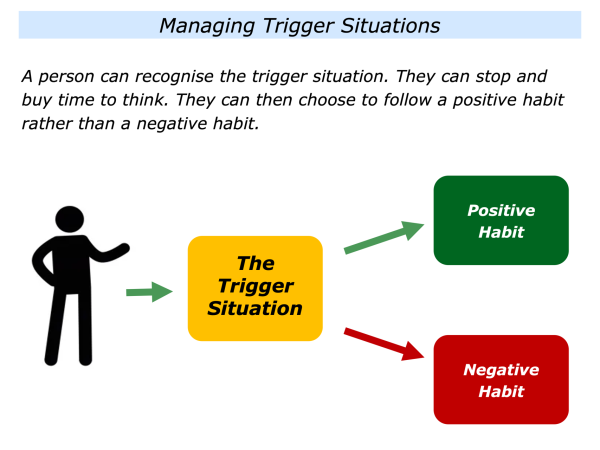
Different people have different triggers that can lead to them behaving in ways that cause difficulties. Sometimes they may manage such situations successfully. Sometimes they may fall into a downward spiral.
A recovering alcoholic may find it difficult to pass a crowded pub on a warm summer night. A person who frequently gets angry can be overcome by the rising red mist.
A footballer can make a mistake and punish themselves with negative self-talk. A normally positive person can fall into depression when hearing distressing news on the radio.
A drug user may respond to feeling anxious by searching for a quick fix. A couple may get into domestic arguments when one of them says something that hurts their partner.
Imagine that the person you are helping is aware of the potential trigger situation that can tempt them to follow a negative habit. It can therefore be important for them to do the following things.
To recognise the potential trigger situation;
To avoid putting themselves into the potential trigger situations;
To, if this is not possible, learn how to manage the trigger situation.
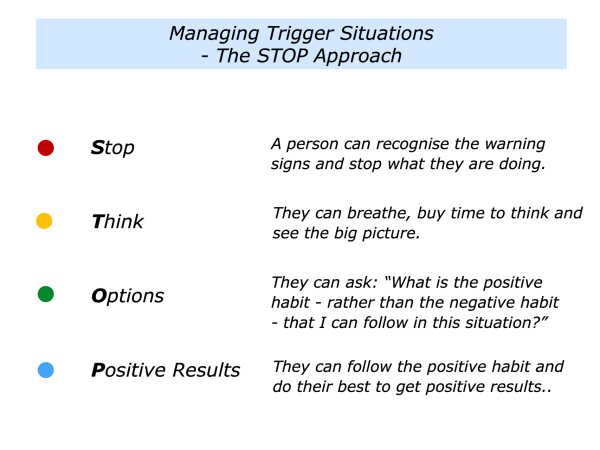
There are many techniques for following positive rather than negative habits in trigger situations. One model is for the a person to follow the STOP approach.
This invites the person to: a) Stop what they are doing; b) to buy time to Think; c) to consider their Options and choose to follow the positive habit; d) to then do their best to get Positive Results.
Different will follow this elements of this approach in their own ways in different situations. Here is an overview the approach.
Let’s return to the situation where you may be helping a person to follow a positive habit rather than a negative habit. If appropriate, you can encourage them:
To rehearse following the positive habit in their daily life;
To rehearse following the positive habit when encountering a trigger situation;
To again rehearse following the positive habit in their daily life.
The person may then be more likely to keep following the positive habit and, as a by-product, get the benefits. This can help them to continue to shape a positive future.
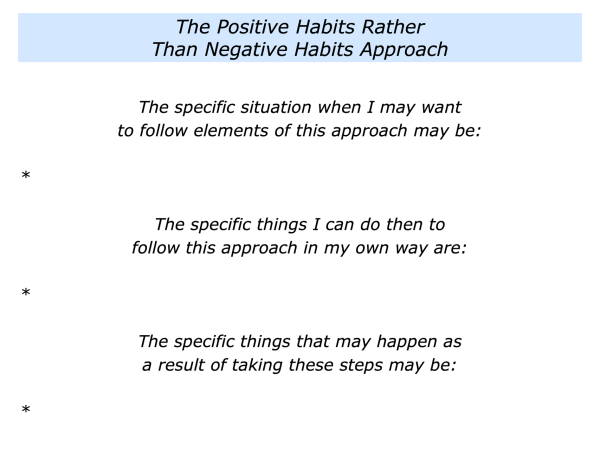
Let’s return to your own life and work. Looking ahead, can you think of a situation where you may want to follow elements of this approach? How could you do this in your own way?
If you wish, try tackling the exercise on this theme. This invites you to complete the following sentences.

Leave a Reply