



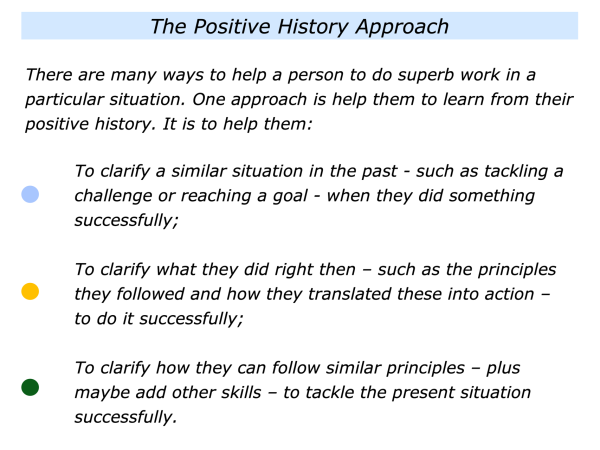
There are many ways to help people to develop. One approach is to help them to learn from their positive history. It is to help them to see they have strengths and successful patterns that they can apply in the future.
Everybody has overcome challenges, done superb work or reached specific goals. A person can clarify what they did right then and how they can follow those principles – plus add other skills – to achieve success.
Everybody has a positive history. Bearing this in mind, many educators, coaches and mentors encourage people to build on these inner resources and apply them to tackle specific situations in the future.
The following pages explore how it is possible to translate this approach into action. You will, of course, apply the ideas in your own way.
The Channelling Your Champ
Rather Than Your Chimp Approach
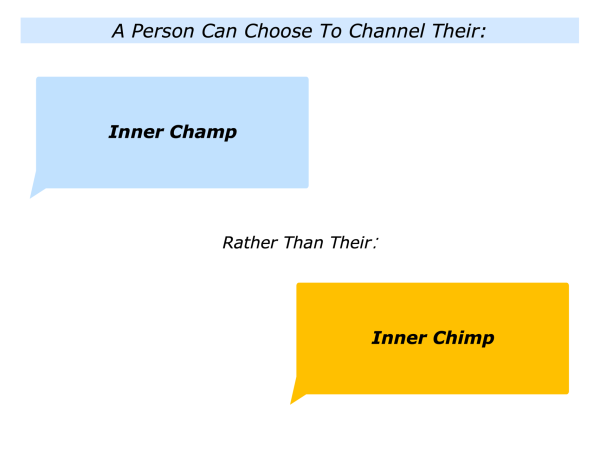
Positive people often aim to channel their inner champ rather than their inner chimp. What does this mean?
Steve Peters, who wrote The Chimp Paradox, has helped many athletes to manage their chimp. Their chimp can take many forms. It can be self-doubt, irrational emotion and negative self-talk.
Steve helps them to manage these impulses. He also encourages athletes to make specific plans for performing at their best. He uses his own terms to describe this pursuit of excellence and become the best they can be.
One way of looking at it, however, is that he helps people to channel their champ, whilst managing their chimp. Let’s explore how people can produce their equivalent of championship performances.
Clarifying Your Champ
Everybody has a history of success. So it can be useful for a person to explore when they have performed brilliantly, even if this was only for a few minutes. They may have been encouraging another person, managing a crisis, completing a piece of work or whatever.
Different coaches and educators use different questions to help people learn from such experiences. Whatever words they use, however, they often help people to explore their strengths and successful style.
They encourage the person to build from within, which is the organic approach. If appropriate, they also help them to add other skills to reach their goals. They may begin by asking the person some of the following questions.
When have you performed brilliantly? What were you doing right then? What were the principles you were following? How can you follow these principles – plus maybe add other skills – to perform brilliantly in the future?
Peak performers follow a similar route. They constantly recall their best performances. They know that following similar principles can ensure they do the basics and achieve 8+/10.
Such people then aim to add the brilliance and achieve 10/10. They build on their champ rather than get distracted by their chimp.
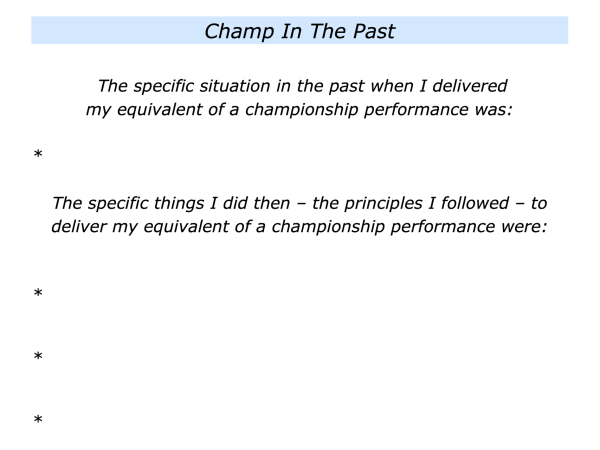
If you wish, try tackling the exercise on this theme. This invites you to do the following things.
Describe the specific situation in the past when you delivered your equivalent of a championship performance.
Describe the specific things you did right then – the principles you followed – to deliver your equivalent of a championship performance.
Channelling Your
Champ In The Future
Good teams also use this approach to keep developing. One football team used it, for example, to improve the way they finished games.
The team’s manager was concerned that, on several occasions, the players had failed to close out games when they were leading by the odd goal. They had drawn or lost games where, with ten minutes to play, they were leading 1-0 or 2-1.
The players forgot to do the basics. They became paralysed and kept watching the clock, hoping for the game to end. This led to the other team scoring and taking over the game.
The manager had a choice. One option was to rip into them for forgetting to do the basics. Taking this route, however, may have increased their sense of fear. So he chose another route.
The manager invited the team to build on its strengths. The team recalled the matches when they had led by one goal with ten minutes to go and went on to win.
The players recalled what they had done right to keep playing, rather than become paralysed, and win the game. They then focused on how to follow these guidelines in the future. It worked. The team learned how to stay calm and go on to win the games.
People sometimes want to deliver their equivalent of championship performances. Singers want to do this, for example, when making a record or performing at a particular concert. Recently when working with such people, we have recalled their best performances.
Looking back, they prepared properly. Before going on stage, they breathed deeply and then clicked into gear. They walked on stage and served the song, rather than worry about the audience reaction.
Looking ahead, we explored how to do these things in the future. The aim was to build organically. They knew what worked, so we built on these beliefs. They settled on the specific things they could do to deliver their equivalent of championship performance.
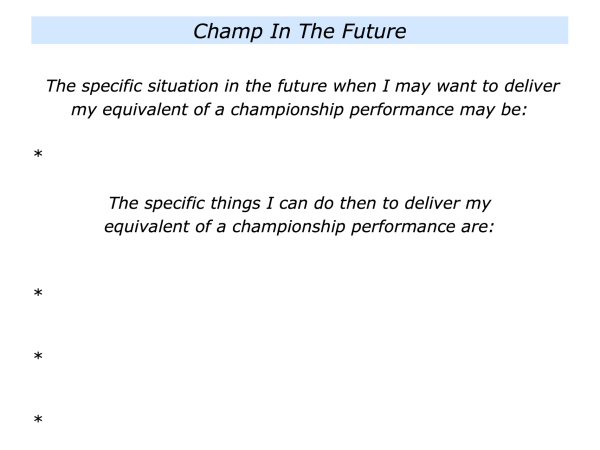
If you wish, try tackling the exercise on this theme. This invites you to do the following things.
Describe a specific situation in the future when you want to deliver your equivalent of a championship performance.
Describe the specific things you can do then to do your best to deliver your equivalent of a championship performance.
The Serving The Song Approach
Several years ago I worked with a singer who wanted to feel at ease when performing live in front of audiences. She explained this in the following way.
“My career took off but then it stalled. I became preoccupied with being loved by everybody. It got to the point where I froze if I spotted a person in the audience who was not being appreciative.
“There is now an opportunity coming up, however, where I have the chance to sing live. I would love to take it, providing I can deal with my version of stage fright. I want to enjoy singing and also give people great experiences.”
I invited the singer to recall her most satisfying performance. Looking back, she said her best performances came when she served the song. She described one particular experience when she sang one of her favourite songs.
“I rehearsed in my room and in my mind for many weeks. Then came the day of the performance. Getting to the theatre, I went through my usual rituals for centring, which included deep breathing.
“Moving from the dressing room, I snapped into action and strode onto the stage. Forgetting myself, I sank deeply into the music and aimed to serve the song.
“Before I knew it, the song was over and the audience gave rapturous applause. I am not exactly sure what happened, but people said it was the best performance I had ever given.”
Looking deeper, we began to explore what she had done right on that occasion. We then looked at other times when she had given fine performances. Could we see any recurring patterns?
Eventually we began to clarify the key principles and how she could follow these in the future. Looking ahead, she felt it would be useful to pursue the following themes.
To play to my strengths when choosing a song … To forget myself and serve the song … To perform superbly and, when appropriate, to add something special.
We focused on the specific steps she could take to translate these principles into action. This resulted in her feeling more at ease when giving performances.
The Channelling Your Personality Rather
Than Changing Your Personality Approach
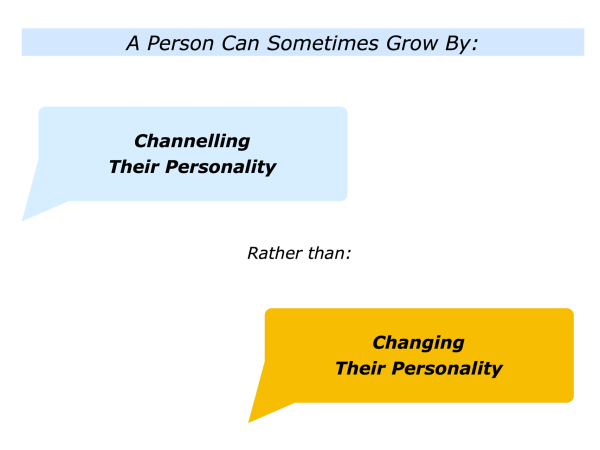
There are many models for helping a person to develop. One approach focuses on helping them to grow by channelling their personality rather than changing their personality.
People develop, they seldom change. Bearing this in mind, it can be useful to help them:
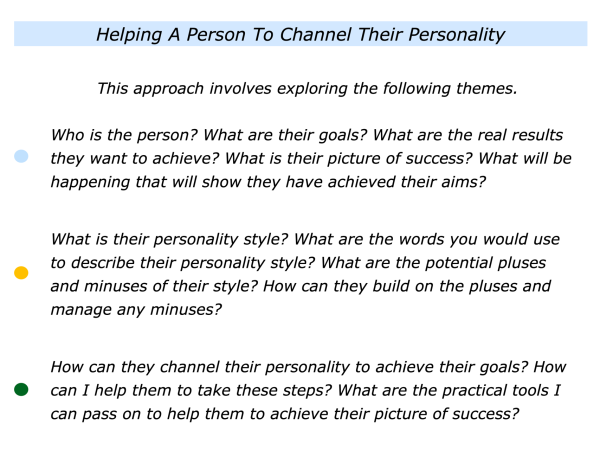
To clarify the real results they want to achieve in a situation – their picture of success;
To clarify their personality style – including both the potential pluses and minuses of their style;
To channel their personality style in ways that help them to achieve their picture of success.
This is an approach I have found useful when working with people who demonstrate certain characteristics. Here is one example.
Max is an energetic and highly driven leader. Being positive and results focused, he can be inspirational and has a track record of building pacesetting teams.
He also loves with working with certain kinds of leading edge clients. He helps them to develop strategies that enable them to stay ahead in their field.
The pluses of his style include the following. He generates positive energy and gives people a compelling picture of the future. He is also good at helping certain kinds of clients to solve problems and achieve success.
The potential minuses of his style include the following. He gives lots of ideas and can overload people with information. He only works best with self-motivated achievers and can be impatient with other kinds of people.
Max explained one piece of advice that he had been given.
“I have been told to slow down in order to take my people with me. Whilst I understand part of that logic, I find it difficult to follow.
“My mind keeps focusing on how to solve both the present and future challenges. Plus I get lots of ideas about how to create products that will help our customers to achieve success.
“The problem is that I can sometimes dive into the daily running of our business. If I see something that could be done better, I immediately try to fix it. Maybe I should try to be patient, but I am not sure that will work. Have you any suggestions?”
Max and I looked at how he could channel his personality rather than change his personality. His brain would continue to be in over-drive. Bearing this in mind, it was important for him to spend most of his time with pacesetting customers.
Max could help them to solve challenges and build prototypes that enabled them to achieve future success. This could create wins for them and also wins for his company.
At the same time, I suggested that Max follow the rule of three when sharing ideas with people. This involved him crafting his messages so that, when appropriate, he could aim:
To give the big picture – the context – and to describe the three outcomes to achieve;
To give the reasons for achieving these outcomes;
To check with people whether: a) they understood the outcomes to achieve; b) they would be happy to contribute toward achieving these; c) they had the support required to achieve the outcomes.
Max then moved on to the next stage. How to channel his personality in a way that delivered positive results? After some discussion he chose to take the following steps.
First, Max appointed a managing director who had the ability to run the business. This was somebody who Max had worked with in the past. They had the ability:
To keep focusing on the company’s principles and translate these into action;
To build a positive environment in which motivated people could flourish and deliver good results;
To manage Max’s interventions and integrate his ideas into continuing to build a successful business.
Second, Max applied his strengths to working with certain customers and also aiming to become a thought leader in his chosen field. This involved him taking the following steps. He chose:
To work with three leading edge customers and do superb work that enabled them to stay ahead of the game;
To produce success stories about this work which helped to build their reputations and also that of his own company;
To produce a series of short videos in which Max described pacesetting ideas that companies could implement to achieve future success.
Third, Max continued to share inspiring ideas with the people in his business but he did this through certain channels. He and the managing director ran sessions every two months where they aimed:
To give Max the opportunity to share his latest thinking and, when appropriate, how people could add some of these ideas to their present way of running the business;
To learn from what some of the company’s leading edge customers were doing well and how to adapt these ideas when working with some of their other customers;
To focus on how the company could continue to following its principles, translate these into action and deliver positive results.
Max, the managing director and I continued to work on these themes over the next years. This helped to create an environment in which people applied strengths to help the company to achieve ongoing success.
Every person is different but many can learn how to channel their personalities rather than change their personalities. When working with introverts, for example, it is possible to help them:
To build on their ability to reflect, make sense of ideas and make their best contributions to a client, team or organisation;
To rehearse what they want to do or say and then share their knowledge in ways that increase the likelihood of them getting heard;
To be true to themselves and learn how to take a positive role in situations they find challenging – such as meetings, brainstorming sessions or social events.
There are many ways to help a person to channel their personality. Here are some guidelines that it can be helpful to bear in mind. You will, of course, apply these in your own way.
The Counselling Approach
Good counsellors sometimes follow the positive history approach when working with individuals who are experiencing difficulties.
Whilst acknowledging the person’s feelings, they invite them to recall when they have dealt with challenges successfully. They may say something like the following.
Looking back, when have you encountered a similar challenge and come through it successfully?
What did you do right then? What were the principles you followed to tackle the challenge successfully?
You already have the strength and successful patterns within you. So let’s explore how you might follow these principles – plus maybe add other skills – to tackle the present challenge.
A person may have recovered from illness, made a difficult transition or managed a trauma. They may be able to follow some of these principles to tackle a present challenge.
Babette Rothschild follows elements of this approach. She has helped many people to deal with traumas. Her work combines kindness, wisdom and practical tools.
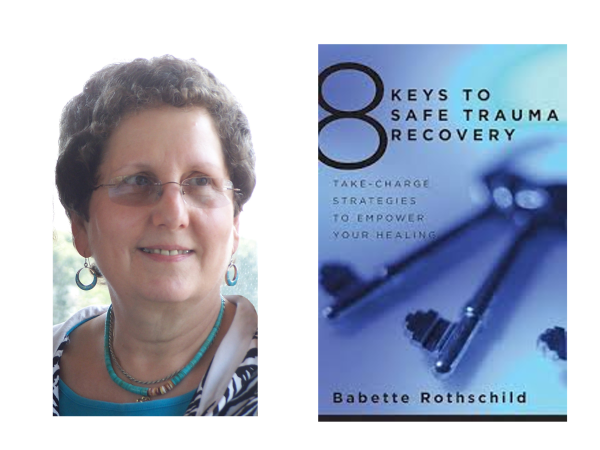
Babette creates a safe environment in which a person feels at ease. She says:
“The first goal of trauma recovery should and must be to improve your quality of life on a daily basis.”
She then, if appropriate, provides practical tools that they can use:
To manage flashbacks and traumatic feelings;
To build on their inner strengths and successful patterns for dealing with challenges;
To add further skills they can use to improve the quality of their lives.
Babette is considered an expert in her field, but she also believes that people often resolve many issues without requiring professional help. She explains this in the following way.
“The vast majority of humans who experience traumatic events resolve them on their own, relying on internal resources, the family, the community, the environment, spiritual beliefs and so forth.”
When people do seek Babette’s professional help, she often begins by helping them to learn how to manage flashbacks. She explains this in the following way.
Applying the brakes
The client should learn how to apply the brakes to stop the process or take control of flashbacks or other symptoms. They will then feel more confident in being able to proceed with the therapy.
Babette underlines the importance of building on the client’s strengths. She describes this in the following way.
Building on inner resources
“When the focus is on trauma, it is easy to forget the accompanying mechanisms that have helped people to survive and carry on, even when they have PTSD.
“Resources of both the past and the present are important allies; they mediate the negative effects of trauma. Resources are partners that make survival and life after trauma possible.
“Wise therapists will listen as carefully for coping mechanisms as they do for possible trauma.”
Babette believes it is vital to help a client to build on their resources. This will make it easier to proceed with the trauma therapy.
Different people use different questions to help people to learn from their positive history. Whatever words they use, however, they often help people to explore their strengths and successful style.
They encourage the person to build from within, which is the organic approach. They may begin by asking the person some of the following questions.
When have you performed successfully? What were you doing right then? What were the principles you were following? How can you follow these principles – plus maybe add other skills – to perform successfully in the future?
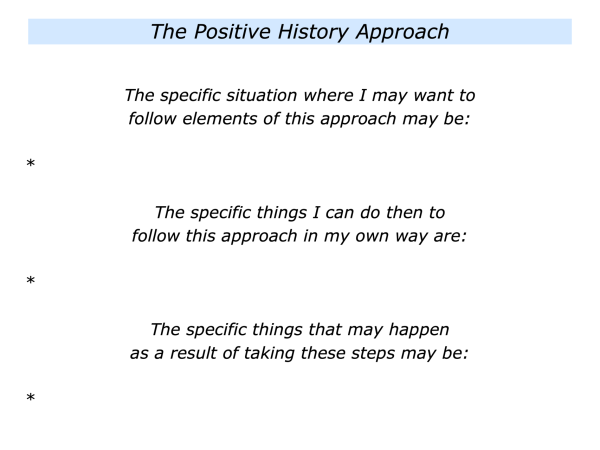
Let’s return to your own life and work. Looking ahead, can you think of a situation where you may want to follow elements of this approach? How can you follow this in your own way?
If you wish, try tackling the exercise on this theme. This invites you to complete the following sentences.

Leave a Reply