


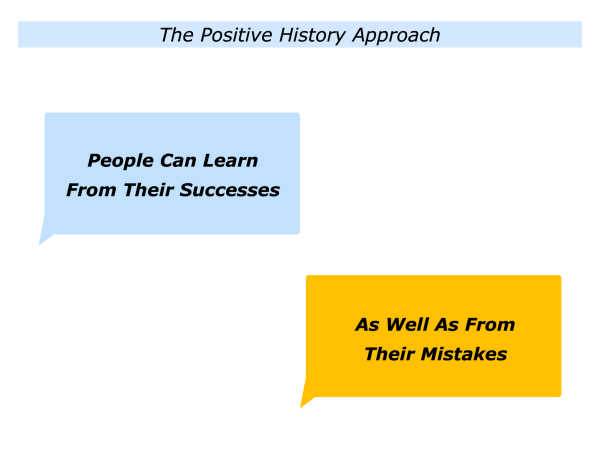
Some people quote the view that you learn more from your mistakes than from your successes. That sound reasonable, but there is another view. This involves people learning from their positive history. When done properly:
People can learn as much – if not more – from their successes.
Everybody has a positive history. Everybody has done superb work or overcome challenges. They can clarify what they did right then and how they can follow similar principles – plus maybe add other skills – in the future.
Bearing this in mind, many educators, coaches and mentors encourage people to build on these inner resources. They then help them to apply these to tackle specific situations in their lives and work.
People like the positive history approach. It is an organic approach that develops inner belief. The following illustration provides an introduction to the approach. You will, of course, apply the ideas in your own way.
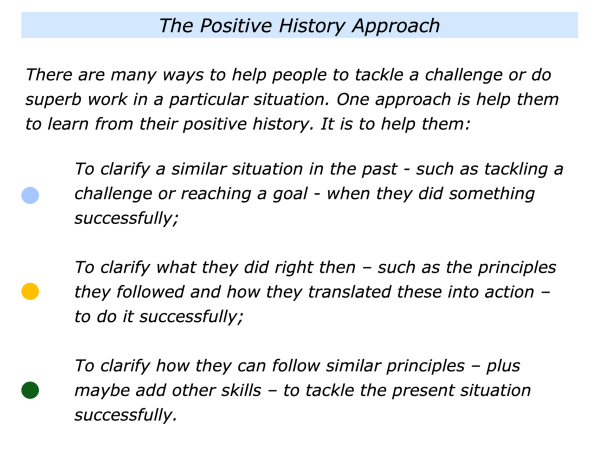
The following pages explore how it is possible to apply this approach in different situations.
Performing Superbly
This approach is often used in sports psychology. The aim is to help athletes to focus on when they have performed superbly in the past. They then explore how they can follow similar principles in the future.
The athlete will then do lots of physical and psychological rehearsal. This includes rehearsing: a) how to follow their chosen strategies; b) how to build on successes; c) how to bounce back from setbacks.
There are many other models that follow elements of the positive history approach. The following section explores one of these approaches.
The Appreciative Inquiry Approach
There are many models for helping people, teams and organisations to develop. Appreciative Inquiry is one of the most effective and is based on what works.
This involves studying humanity at its best. Bearing in mind the challenge that people want to explore, they are invited to learn from their positive history. Here is an introduction to this approach.
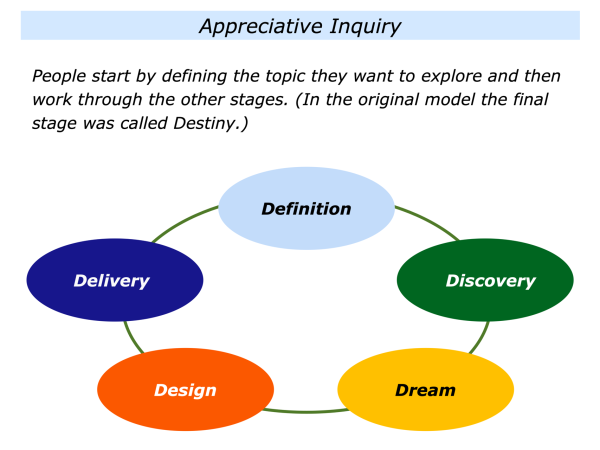
Definition
The approach starts by people defining the question to explore. It is also important to frame this in a positive way. For example:
How can we do superb work? How can we improve customer service? How can we improve morale? How can we collaborate better across departments? How can we build on our strengths and achieve future success?
Discovery
This involves people discovering when they have performed superbly in this area. When did they tackle a similar challenge successfully? What were the principles we followed? How did they translate these into action?
Dream
This involves people following these principles and translating them into setting a desirable goal. It is important that the goal is stimulating, stretching and will help them to achieve success.
Design
This involves people designing the strategies for achieving the goal. It is important for them to use their strengths, follow these chosen principles and do what is necessary to increase the likelihood of achieving success.
Delivery
This involves people following their chosen strategies, performing superb work and continually improving. They encourage each other on the journey and do their best to deliver the desirable goal.
People like Appreciative Inquiry. It builds on what works and, providing people then do the work, it works. People can keep building on their strengths, following strategies that work and delivering success.
As mentioned earlier, the positive history approach can be used in many situations. Let’s explore where it can be used in another scenario.
Problem Solving
The positive history approach is one that I have used when helping people to tackle certain challenges in their lives. The first aim is to create an encouraging environment in which a person feels able to explore.
The next step is to invite them to describe the challenge. It can be useful to get more information about the issue and, if appropriate, what else may be happening in their personal or professional lives.
Sometimes it make sense to immediately invite them to focus on the future. It is then to provide them with practical tools they can use to manage the challenge and work towards their picture of success.
Sometimes it can also be useful to help them to learn from their positive history. Whilst acknowledging the person’s feelings, it is to invite them to recall when they have dealt with challenges successfully. It is to say something along the following lines.
Looking back, when have you encountered a similar challenge and come through it successfully? This could have been something in your personal or professional life.
What did you do right then? What were the principles you followed to tackle the challenge successfully? How did you translate these into action? What happened as a result?
Bearing this in mind, you already have the strength and successful patterns within you. So let’s explore how you might follow these principles – plus maybe add other skills – to tackle the present challenge.
A person may have recovered from illness, made a difficult transition or managed a trauma. They may be able to follow some of these principles to tackle a present challenge.
Babette Rothschild follows elements of this approach in her work with safe trauma therapy. Her help combines kindness, wisdom and practical tools. Let’s explore this approach.
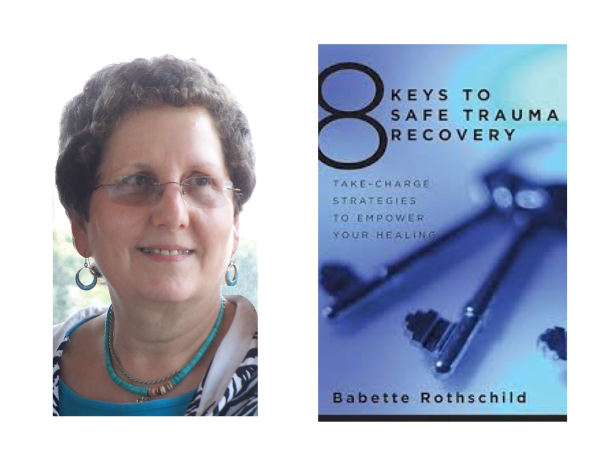
Babette creates a safe environment in which a person feels at ease. She says:
“The first goal of trauma recovery should and must be to improve your quality of life on a daily basis.”
She then, if appropriate, provides practical tools that they can use:
To manage flashbacks and traumatic feelings;
To build on their inner strengths and successful patterns for dealing with challenges;
To add further skills they can use to improve the quality of their lives.
Babette is considered an expert in her field, but she also believes that people often resolve many issues without requiring professional help. She explains this in the following way.
“The vast majority of humans who experience traumatic events resolve them on their own, relying on internal resources, the family, the community, the environment, spiritual beliefs and so forth.”
When people do seek Babette’s professional help, she often begins by helping them to learn how to manage flashbacks. She explains this in the following way.
Applying the brakes
The client should learn how to apply the brakes to stop the process or take control of flashbacks or other symptoms. They will then feel more confident in being able to proceed with the therapy.
Babette underlines the importance of building on the client’s strengths. She describes this in the following way.
Building on inner resources
“When the focus is on trauma, it is easy to forget the accompanying mechanisms that have helped people to survive and carry on, even when they have PTSD.
“Resources of both the past and the present are important allies; they mediate the negative effects of trauma. Resources are partners that make survival and life after trauma possible.
“Wise therapists will listen as carefully for coping mechanisms as they do for possible trauma.”
Babette believes it is vital to help a client to build on their resources. This will make it easier to proceed with the trauma therapy. Let’s explore another approach to shaping a positive future.
Positive Future
There are many ways to do your best to achieve positive results in the future. One approach builds on the idea of channelling your champ rather than your chimp. Let’s explore this theme.
The Channelling Your Champ
Rather Than Your Chimp Approach
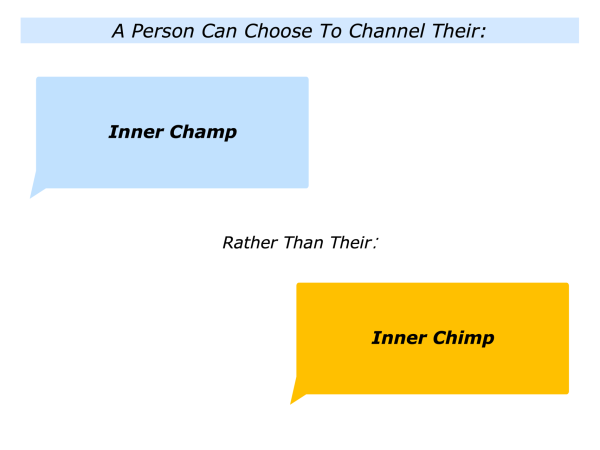
Positive people often aim to channel their inner champ rather than their inner chimp. What does this mean?
Steve Peters, who wrote The Chimp Paradox, has helped many athletes to manage their chimp. Their chimp can take many forms. It can be self-doubt, irrational emotion and negative self-talk.
Steve helps them to manage these impulses. He also encourages athletes to make specific plans for performing at their best. He uses his own terms to describe this pursuit of excellence and become the best they can be.
One way of looking at it, however, is that he helps people to channel their champ, whilst managing their chimp. Let’s explore how people can produce their equivalent of championship performances.
Clarifying Your Champ
As mentioned earlier, everybody has a history of success. So it can be useful for a person to explore when they have performed brilliantly, even if only for a few minutes. They may have been encouraging another person, managing a crisis, completing a piece of work or whatever.
Different coaches and educators use different questions to help people learn from such experiences. Whatever words they use, however, they often help people to explore their strengths and successful style.
They encourage the person to build from within, which is the organic approach. If appropriate, they also help them to add other skills to reach their goals. They may begin by asking the person some of the following questions.
When have you performed brilliantly? What were you doing right then? What were the principles you were following? How can you follow these principles – plus maybe add other skills – to perform brilliantly in the future?
Peak performers follow a similar route. They constantly recall their best performances. They know that following similar principles can ensure they do the basics and achieve 8+/10.
Such people then aim to add the brilliance and achieve 10/10. They build on their champ rather than get distracted by their chimp.
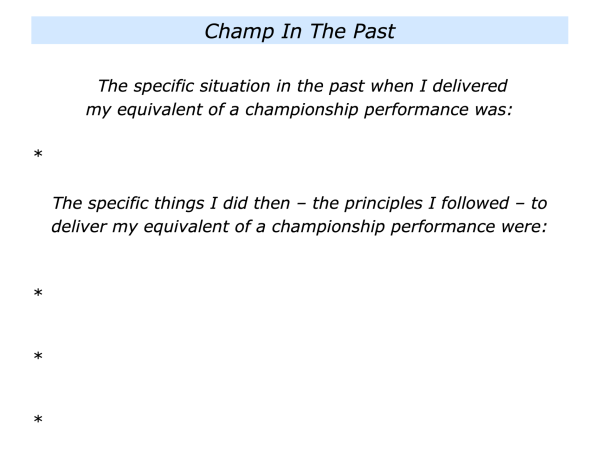
If you wish, try tackling the exercise on this theme. This invites you to do the following things.
Describe the specific situation in the past when you delivered your equivalent of a championship performance.
Describe the specific things you did right then – the principles you followed – to deliver your equivalent of a championship performance.
Channelling Your
Champ In The Future
Good teams also use this approach to keep developing. One football team used it, for example, to improve the way they finished games.
The team’s manager was concerned that, on several occasions, the players had failed to close out games when they were leading by the odd goal. They had drawn or lost games where, with ten minutes to play, they were leading 1-0 or 2-1.
The players forgot to do the basics. They became paralysed and kept watching the clock, hoping for the game to end. This led to the other team scoring and taking over the game.
The manager had a choice. One option was to rip into them for forgetting to do the basics. Taking this route, however, may have increased their sense of fear. So he chose another route.
The manager invited the team to build on its strengths. The team recalled the matches when they had led by one goal with ten minutes to go and went on to win.
The players recalled what they had done right to keep playing, rather than become paralysed, and win the game. They then focused on how to follow these guidelines in the future. It worked. The team learned how to stay calm and go on to win the games.
People sometimes want to deliver their equivalent of championship performances. Singers want to do this, for example, when making a record or performing at a particular concert. Recently when working with such people, we have recalled their best performances.
Looking back, they prepared properly. Before going on stage, they breathed deeply and then clicked into gear. They walked on stage and served the song, rather than worry about the audience reaction.
Looking ahead, we explored how to do these things in the future. The aim was to build organically. They knew what worked, so we built on these beliefs. They settled on the specific things they could do to deliver their equivalent of championship performance.
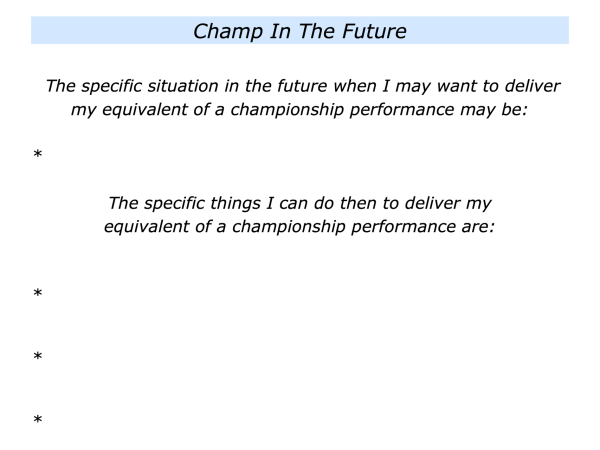
If you wish, try tackling the exercise on this theme. This invites you to do the following things.
Describe a specific situation in the future when you want to deliver your equivalent of a championship performance.
Describe the specific things you can do then to do your best to deliver your equivalent of a championship performance.
There are many ways to live life. One approach is for people to learn from their positive history to shape a positive future. They can follow this approach in both their personal and professional lives.
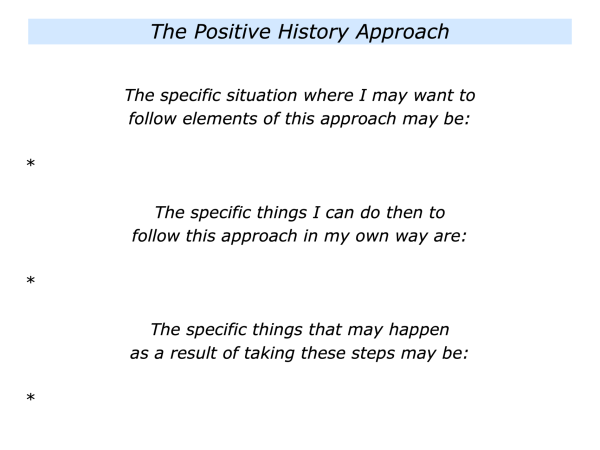
Let’s return to your own life and work. Can you think of a situation where you may want to follow elements of this approach? You may want to do this to develop in your own life or when aiming to help another person.
Looking ahead, how could you follow this approach in your own way? How could you translate it into action? What may happen as a result of taking these steps?
If you wish, try tackling the final exercise on this theme. This invites you to complete the following sentences.

Leave a Reply