



Many people use mantras to remind themselves of the principles they want to follow in their lives. They may repeat these to themselves to focus their efforts when tackling a particular challenge or task.
Different people use different mantras when focusing on different situations. Some may say to themselves things like:
Be positive … Be kind … Be the best you can be.
An athlete competing in an event may use a certain mantra to stay calm, focus and aim to achieve peak performance.
A recovering alcoholic may follow a certain mantra to help them to stay sober one day at a time.
A person may also use mantras to remind themselves to follow certain spiritual beliefs.
People who follow the mantra approach often develop a positive script they want to follow in their lives. They then aim to translate this into action in their daily lives and work.
Different people create their personal mantra in different ways. Some start by focusing on the principles they want to follow in their life and do the following exercise.
They describe the specific things they do want to do in their life.
They describe the specific things they don’t want to do in their life.
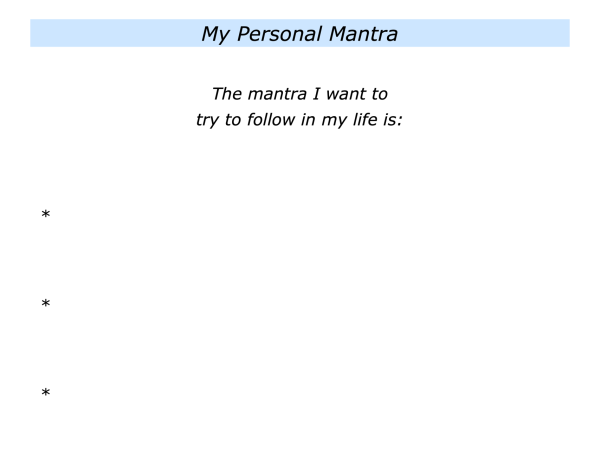
They translate some of these dos into a personal mantra they want to try to follow in their life.
People who work in organisations may also follow certain mantras. These act as rallying calls or reminders to encourage people to channel their energies to follow certain principles.
Different organisations create these mantras in different ways. Some follow the organic approach and focus on people’s positive history. This involves taking the following steps.
They clarify the specific situations in the past when people have performed brilliantly.
They clarify what people did right then – the principles they followed and how they translated these into action – to perform brilliantly.
They clarify the things that people can do to follow these principles – plus maybe add other skills – in the future to perform brilliantly.
Some organisations then summarise these principles and translate them into a mantra that people can aim to follow in their work. One organisation took this approach and produced the following
The Organisation’s Mantra – We
encourage people to do their best by aiming:
To Be Positive … To Be Professional … To Deliver Peak Performances
One football manager took this approach by gathering the whole squad together during their pre-season training camp. They players were then invited:
To recall a time when they and their teammates had done positive work in either their present team or another team;
To brainstorm and then agree on three phrases they wanted to have as their positive mantra;
To focus on how they could translate this positive mantra into action in different situations.
The entire squad brainstormed the possible phrases. These included: Be together, Be resilient, Be relentless, Be supportive, Be classy and Be excellent. They then voted on these to produce the top three phrases.
People formed small groups to clarify how they as players and staff could translate each of these phrases into action. They then focused on how they could follow these in challenging situations.
The squad settled on their final mantra which comprised of three phrases. They put this in their dressing room and around the training ground. It replaced the old cut-and-paste motivational slogans.
People felt ownership of their mantra. Simple and memorable, it provided a guide they could follow when things got tough during the season.
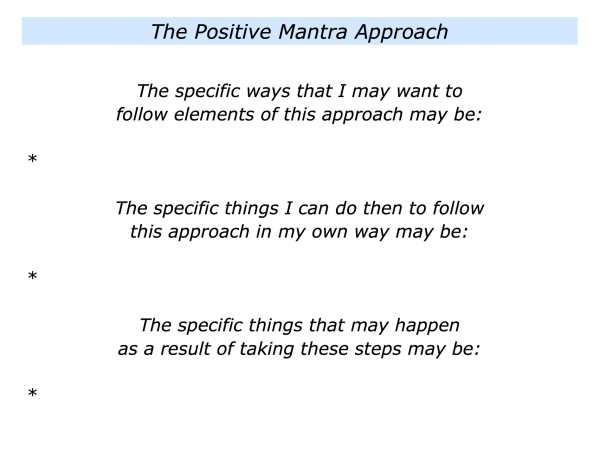
Let’s return to your own life and work. Imagine that you want to follow elements of the positive mantra approach. How can you do this in your own way?
If you wish, try tackling the exercise on this theme. This invites you to complete the following sentences.

Leave a Reply