



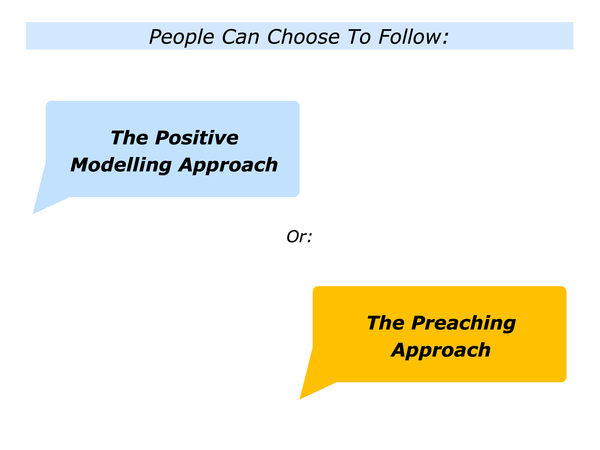
There are many ways to live life. Some people aim to follow the positive modelling approach. They believe in following certain principles in their personal or professional lives.
Such people may follow a certain moral code and maintain high standards. They know that others will watch what they actually do rather than just what they say.
They recognise it is vital to follow their principles in both positive and challenging times. They believe it is important to show – rather than just tell – and behave in certain ways when under pressure.
Some people follow the preaching approach and keep telling others how they should live. Such people may or may not follow such standards in their own lives or work.
The Positive
Modelling Approach
Different people may be positive models in different situations. They may do so in the family, school, work place, community or other situations. Let’s consider how they may do this in their personal or professional lives.
People Can Act
As Positive Models
Many parents aim to be positive and predictable. They aim to do the maintenance by providing a good home and the materials for living a healthy life. They also encourage their loved ones to grow and to have positive memories for life.
Many educators aim to act as positive models. They aim to create an inspiring environment in which people want to learn. They then aim to pass on knowledge that the students can use to shape a successful future.
Many people aim to do their best and live positive lives. They aim to follow their life principles, be kind and help people to succeed. They aim to encourage both present and future generations during their time on the planet.
Professionals Can
Act As Positive Models
Many professionals act as positive models for others. They maintain high professional standards because they realise that they are always ‘on stage’. People are watching what they do, not just what they say.
Different professionals take this approach in different fields. They may be working in education, medicine, the law, therapy, science or another activity. A person may be working as a coach, manager, leader or in another professional role.
Let’s return to your own life and work. Looking back, can you think of a professional who acted as a positive model in your chosen field? What did they do then to act as such a model?
What was their personal attitude? What were the professional standards they demonstrated? How did they treat other people? What were the key things you learned from them?
Places Can Act
As Positive Models
Many places can act as positive models. These may be communities, groups, teams, organisations or other places that show a positive way of living, learning or working.
Hospices often proved a caring and compassionate environment for people nearing the end of life. Some hotels aim to provide their guests with a home from home.
Some teams create a positive environment in which motivated people can perform superb work. They encourage people to focus in a clear purpose, follow certain principles and do their best to achieve the picture of success.
Some societies encourage people to tackle particular crises or achieve certain goals. They then help people to coordinate their strengths, follow strategies that work and achieve success.
Places that follow the positive modelling approach show humanity at its best. They show how human beings can set a specific goal, combine their strengths and do superb work that helps people or the planet.
The Preaching Approach
Some people aim to preach to others. They want to tell people that there is a certain way to live, work or do other things. They may do this when acting as leaders, politicians, campaigners or in other roles.
Some do this by using powerful means that aim to control people. Some do it in a pious or patronising way. Sometimes such people do behave in the ways they advocate. Sometimes they say one thing and do another.
Let’s return to the positive modelling approach. People who take this approach often follow certain eternal principles. They may express these in modern ways, however, in their daily lives or work.
Such people aim to show what can work rather than moralise to others. They recognise that people are more likely to believe what they see rather than what they are told. They therefore aim to do their best:
To show rather than tell … To demonstrate success … To show positive ways forward.
Some pioneers follow this approach. They may do this when showing possible ways forward in education, medicine, sport, business and other fields. They recognise that people buy success rather than the theory of success.
They therefore aim to pass on positive models and practical tools that work. They may do this by producing articles, films or using other media in ways that resonates with people.
Such people aim to communicate this knowledge in a humble way and show respect for others. People can then take the ideas they like and use these in their own way to achieve positive results.
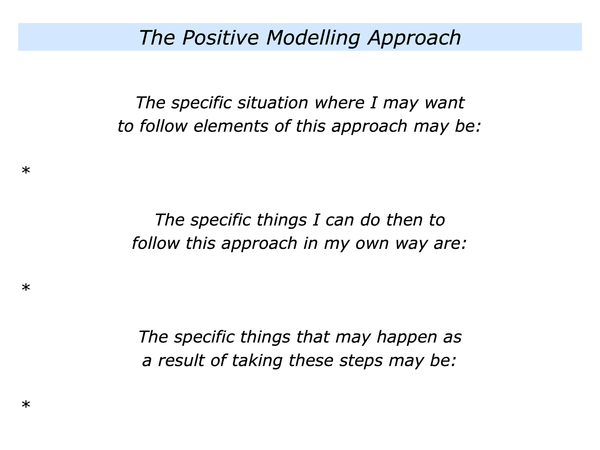
Let’s return to your own life and work. Looking ahead, can you think of a situation where you may want to follow elements of the positive modelling approach? How can you do this in your own way?
If you wish, try tackling the exercise on this theme. This invites you to complete the following sentences.

Leave a Reply