



This is an approach that can be followed in situations where you may or may not be able to make a positive contribution. It involves recognising the following things:
You can recognise that you are only in control of aiming to make a positive contribution;
You can try to increase the chances of the contribution landing in a positive way;
You are not ultimately in control, however, of whether or not the contribution is accepted or used in a certain way.
This is an approach that people can use in both personal and professional situations. It sometimes involves a person finding or creating a new role. It can work, for example:
For a senior person who has to some extent been moved aside as the company grows and evolves in a changing world;
For a person who wants to pass on their knowledge and help other people to succeed;
For a person who wants to make a positive contribution during their time on the planet.
Different people follow this approach in different ways. As mentioned earlier, it can be important for them to recognise they are only in control of aiming to make a positive contribution.
This can be challenging on many levels. Bearing this in mind, the following section describes the path that one person took after losing their job.
Making A Positive Contribution
One person I worked with was laid off by a charity after fifteen years of service. At the age of 50, they found this difficult because:
They had risen through the ranks of the charity and eventually become part of the C-Suite;
They had become quite institutionalised and used to working in a relatively predictable structure;
They had done much of their work focusing on internal processes rather than helping to provide solutions for external customers.
The person began applying for full-time jobs but seldom got to the interview stage. This led to them beginning to lose confidence and not knowing how to take the next step in a changing job market.
We began working on another approach. This involved helping the person to consider doing contract work. Whilst reluctant at first, they recognised that it may be difficult to get a full-time job.
They began by clarifying their strengths. This proved difficult at first because they saw themselves as a generalist. After some exploration, however, it emerged that:
They were good at helping people in organisations to run successful projects.
Bearing this in mind, we focused on how they could build on their strengths and help people to succeed. We took this approach rather than the person trying to sell themselves. We therefore aimed:
To clarify the positive contribution the person could make to a potential employer – such as helping people to run successful projects.
To clarify the people they knew in their network who may be involved in overseeing or running projects;
To clarify how to approach these people and share knowledge about ways to run successful projects.
When doing this, it was vital: a) to do lots of research about the challenges facing the people in their network; b) to share knowledge – particularly around projects – that could help them to achieve their goals.
The person also needed to recognise a realistic but challenging reality. At this point:
They were only in control of sharing their potential contribution in a way that may be attractive to potential employers.
They could do their best: a) to be customer focused; b) to share ways that could help the potential customer to achieve success. But there was no guarantee of a positive outcome.
The approach took time but eventually bore fruit and produced two assignments. These involved the person doing work that occupied them four days a week.
One organisation hired them to do a hands-on and coaching role with a team that was struggling to deliver an internal project.
Another organisation hired them to work alongside a person who was having difficulties implementing a project with a challenging client.
One year after losing their full-time role they managed to earn two-thirds of their previous regular income. This was challenging but they found ways to maintain a healthy lifestyle.
They continued to focus on helping people to deliver successful projects. They also set up their own website that provided practical tips that people could take to follow this approach.
The person still partly hankered to have a full-time job which might give them the feeling of security. They also realised, however, that such positions might no longer exist. There would, however, always be projects.
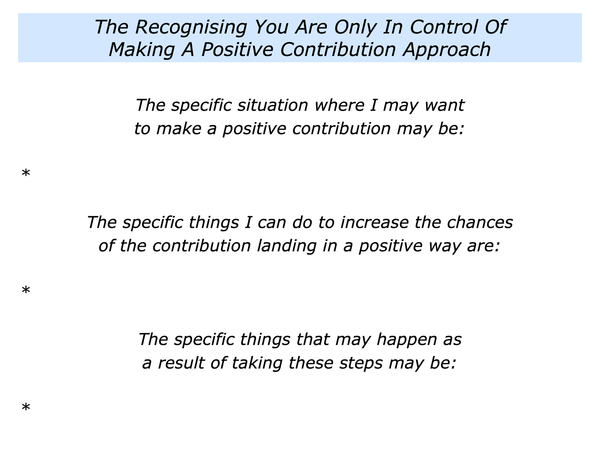
Let’s return to your own life and work. Can you think of a situation where you are only in control of aiming to make a positive contribution? This could in your personal or professional life.
What may be the specific situation? How could you increase the chances of the contribution landing in a positive way? What may happen as a result of taking these steps?
If you wish, try tackling the exercise on this theme. This invites you to complete the following sentences.

Leave a Reply