



Many people repeat the quote attributed to Billie Jean King that ‘Pressure is a privilege.’ There are different kinds of pressure, however, and people respond to these in different ways.
There is positive pressure and negative pressure. Let’s explore these themes.
Positive Pressure
People who see things as positive pressure often have certain characteristics. They have a positive attitude and see things as opportunities.
They often have a sense of gratitude. They count their blessings rather than their burdens. They may also have a good quality of life and a track record of achieving some successes.
Such people aim to build on their strengths and become the best they can be. They aim to follow their principles and do their best to achieve their chosen picture of success.
Negative Pressure
People who experience things as negative pressure may have a certain attitude. They may be facing difficult situations, however, such as not having the basic materials for life.
Such people may not have enough money to feed their family, have poor living conditions or be surrounded by difficult people. Such conditions can trigger negative emotions.
Some people may have a reasonable quality of life but also have a negative attitude towards certain challenges. They often focus on what can go wrong in a situation or what they can lose. Let’s consider another approach.
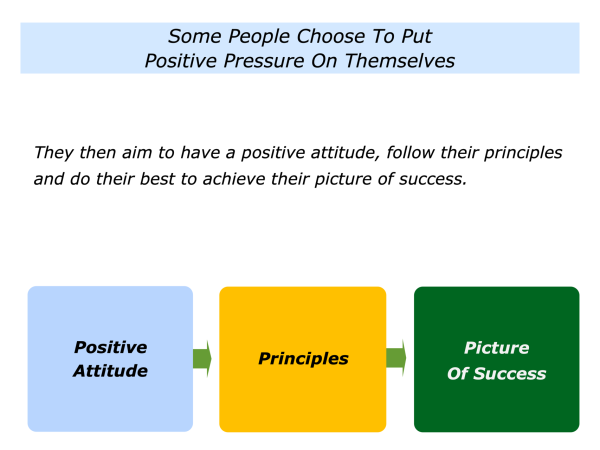
Some people choose to put positive pressure on themselves. They then aim to have a positive attitude, follow their principles and work towards achieving their picture of success. Let’s explore these themes.
Positive Attitude
A writer may have a positive attitude towards finishing a book. They may set a date for completing a manuscript and tell their publisher they will send it by that date. They may then follow a certain rhythm to finish the book.
A person may plan to be a certain weight on their wedding day. They may then follow a specific diet to make sure they can get into the clothes they have ordered for the big day.
A leadership team may choose to clarify the principles they want to follow in a company. They may then focus on how they can live these principles in their daily work.
Different people have different motives for putting positive pressure on themselves. Whatever their reasons, some may then move on to the next stage.
Principles
Great workers, teams and organisations believe in following their principles. This can be relatively easy when things are calm. The hard part is following them in stormy weather. It can therefore be useful to test how to follow the principles in challenging situations.
One company I worked with took this approach. The senior team began by involving key people across the business in agreeing on the principles to follow in the future. These included the following:
Take Responsibility … Be Professional … Help People Succeed … Deliver Great Results
The company held employee workshops where people explored how to translate these principles into action. It included this exercise.
The Principles Challenge
Choose a situation where it may be challenging to follow the principles.
Clarify the possible options for tackling the challenge together with the pluses and minuses of each option.
Clarify which of these possible options is the one where we can – as far as possible – follow our principles and translate these into action.
The employees threw themselves into the exercise and produced plans for tackling most scenarios. They did not consider one scenario, however, that soon presented the leader with a dilemma.
The Actual Challenge
One month after the workshop two senior staff members behaved in a way that violated the professional guidelines that had been communicated to staff.
The story about their behaviour spread across the company. People began to wonder if the company was serious about following the stated principles. The CEO had several options in the situation. Each option had pluses and minuses.
They could ignore the errant behaviour;
They could give the senior staff members a warning and hope it was a one-off;
They could show they were serious about following the principles and replace the senior staff members.
The CEO chose the third option. This surprised many people and created some short-term shocks, but it was beneficial in the medium to long-term. It showed they were serious about building and maintaining a positive and professional company.
Picture Of Success
Imagine that a person has followed their chosen principles. They may then aim to do their best to achieve their picture of success. Some people follow the approach described by Robert Kriegel and Marilyn Harris Kriegel in their book The C Zone: Peak Performance Under Pressure.
People who take this route aim to be calm, controlled and centred. They then commit themselves to pursuing their chosen strategy to achieve their goals.
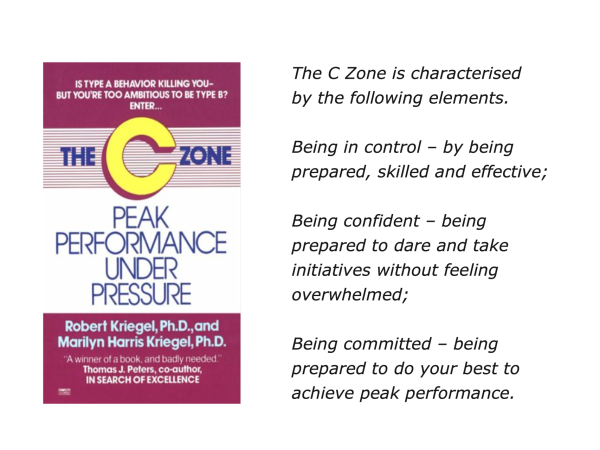
Some people have added their own C words to this approach. They aim to stay calm and focus on the following steps.
Control
They have a positive attitude but are also good at reading reality. They clarify what they can control in the situation. They then aim to build on what they can control and manage what they can’t.
Clarity
They clarify the What – the real results they want to achieve. They clarify the How – the key strategies they can follow to achieve the results. They clarify the When – the action plan they will follow to achieve the results.
Concrete Results
They move into action. They pursue their chosen strategies but also keep reading reality. They build on what is working and tackle areas for improvement. They then do their best to achieve the desired results.
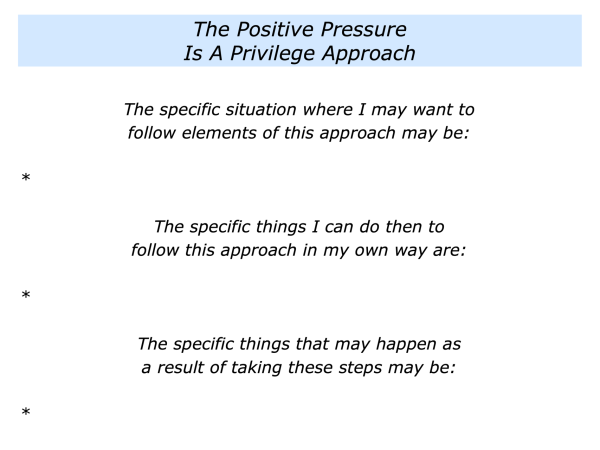
Let’s return to your own life and work. Can you think of a specific situation where you may want to see positive pressure as a privilege? How can you follow this in your own way?
If you wish, try tackling the exercise on this theme. This invites you to complete the following sentences.

Leave a Reply