


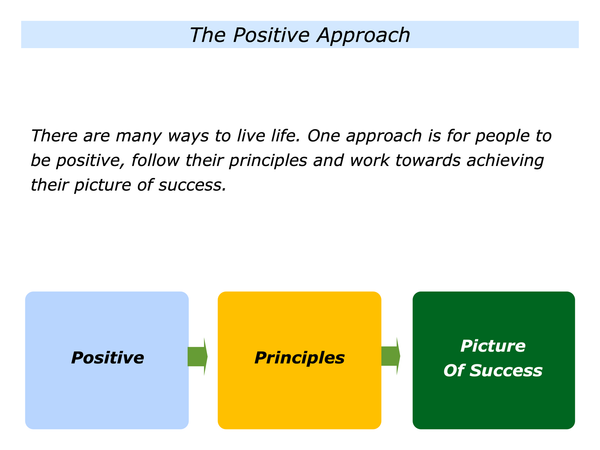
There are many ways to live life. One approach is for people to be positive, follow their principles and work towards achieving their picture of success.
Different people follow this approach in different ways. They may follow it when working as individuals, teams or organisations. They then aim to do their best to achieve their picture of success.
Imagine that you want to follow elements of this approach in your personal or professional life. Bearing that in mind, we will focus on how you can do this as an individual.
As mentioned earlier, however, it is also possible to follow this approach when leading a team or organisation. People can then aim to be positive, follow certain principles and work to achieve the picture of success.
Let’s assume that you aim to follow this approach as an individual. This often involves focusing on the following themes.
Picture Of Success
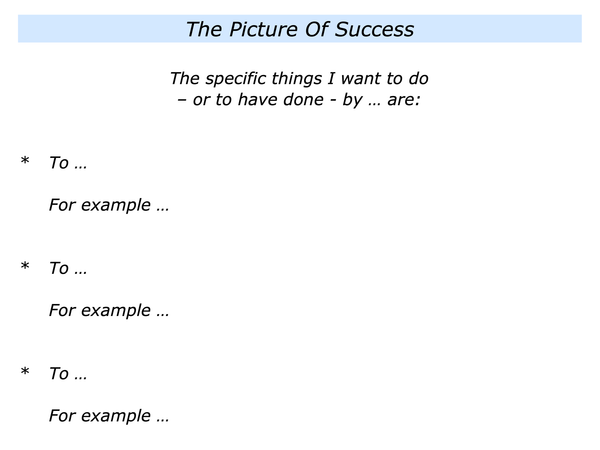
The first step is to clarify your picture of success. Bearing in mind what you can control, one approach is to clarify the specific things you want to do – or to have done – by a certain time.
Some people focus on what they want to achieve in the next day, month, year or other time frame. Some clarify their long-term life goals. They may do this by, for example, focusing on the following themes.
Positive Relationships
A person may describe how they want to be remembered as a parent, partner or friend. A person may say, for example:
I want my partner and I to have given our children the opportunity to enjoy a happy childhood.
For example, I want them to say things like:
“Our parents were always there for us. They encouraged us, helped us to develop our talents and learn how to make good decisions.”
Positive Contribution
People often talk about wanting to use their strengths to do satisfying work that help other people. They may also want make a positive contribution during their time on the planet.
This may involve them following their vocation or doing something that improves life for other people. So a person may write something like:
I want to have built my strengths and done positive work that has helped people or the planet.
For example, I want to have …
Positive Experiences
A person may focus on how they want to enjoy life, pursue experiences and have no regrets. A person may say something like:
I want to have lived fully and also helped to have given people positive memories for life.
For example, I want to have …
If you wish, try tackling the exercise on this theme. This invites you to describe what you want to do – or to have done – by a certain time. These could be things in your personal or professional life.
Imagine that you have clarified your aims. As mentioned earlier, one approach is to be positive, follow your principles and work towards your picture of success.
Different people follow these themes in different ways. Let’s explore how some people may translate these into action.
Positive
People who take this approach are often positive realists. They have a positive attitude but are also good at reading reality. Bearing this in mind, they often choose:
To be positive rather than negative;
To take responsibility rather than avoid responsibility;
To be creators rather than complainers.
They aim to build on their strengths rather than their shortcomings. They focus on what they can control rather than what they can’t control. They aim to do their best during their time on the planet.
They are good at seeing patterns in the areas where they excel. They then aim: a) to build on the successful patterns; b) to stop or manage any unsuccessful patterns; c) to follow the strategies most likely to achieve success.
Positive realists are good at seeing possibilities. They have a history of studying success and clarifying what works in certain situations. Bearing this in mind, they often enjoy finding creative solutions to challenges.
Such people are good at positive reframing. They reframe situations to focus on: a) the positive possibilities; b) the possible ways forward; c) the practical things they can to do achieve their picture of success.
Some people take this approach even when facing daunting challenges. Here is an example of one person who chose to have a positive attitude in their life and work.
Alice Herz-Sommer – Choosing
To Have A Positive Attitude
Alice Herz-Sommer was somebody who chose to have a positive attitude to life. A pianist and survivor of Nazi concentration camps, she continued to be optimistic well past the age of 100.
Her view of life reached a wider audience after an interview she gave to the BBC became popular on the web. “Life is beautiful,” said Alice, and explained this in the following way.
“I have lived through many wars and have lost everything many times – including my husband, my mother and my beloved son.”
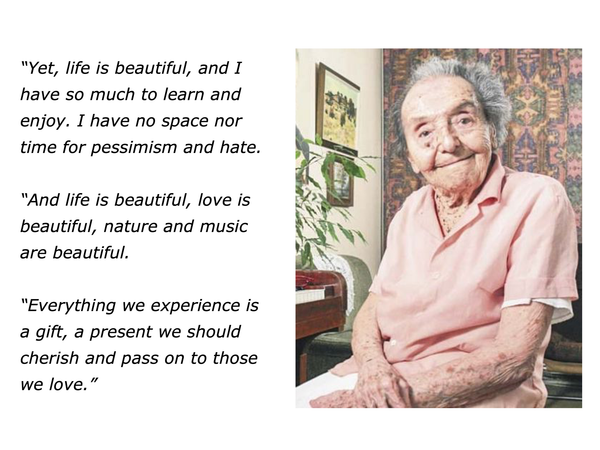
Life brings pain and beauty, said Alice, but she believed the secret of happiness was to focus on what is really important. She focused on gratitude, kindness, nature, music and the joyful things in life.
Caroline Stoessinger gave an insight to Alice’s approach in her book A Century of Wisdom: Lessons from the Life of Alice Herz-Sommer. She provided a series of quotes in which Alice explained her philosophy.
“Gratitude is essential for happiness … Only when we are old do we realise the beauty of life … Music is a dream … It takes you to paradise … I am richer than the world’s richest people, because I am a musician … Music saved my life … Music is God.
“Every day is a miracle. No matter how bad my circumstances, I have the freedom to choose my attitude to life, even to find joy. Evil is not new. It is up to us how we deal with both good and bad. No one can take this power away from us.
“My optimism has helped me through my darkest days. It helps me now.
“The more I read, think and speak with people, the more I realise just how happy I am.
“When I die I can have a good feeling that I have done my best. That I believe I lived my life the right way.”
People who take this approach do what they enjoy because this gives them strength to give to others. Alice did this through playing music and reflecting on the beautiful things in life.
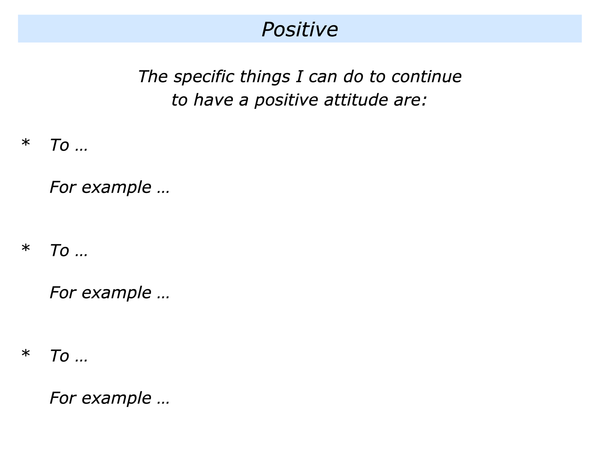
Let’s return to your own life. Imagine that you want to continue to have a positive attitude. How can you continue to count your blessings? How can you focus on what you can control?
How can you do things that give you positive energy? How can you encourage other people? When appropriate, how can you help them to shape a positive future?
If you wish, try tackling the exercise on this theme. This invites you to complete the following sentence.
Principles
People who take the positive approach often follow their chosen principles and aim to translate these into action. Doing what they believe in gives them strength.
Such a person may follow certain moral principles, a spiritual faith or another belief system. They keep referring to this inner compass when making decisions in their daily lives.
What are the principles that you want to follow in your life or work? Different people give different answers to this question. Here are some of the themes they mention.
My Principles – The principles
I want to follow in my life are:
To encourage people … To be kind … To maintain a sense of gratitude … To care for my loved ones … To give people positive memories for life … To use my strengths to help people to succeed.
To do my best during my time on the planet … To build pioneering things that show people a better way … To pass on knowledge that people can use to shape a positive future … To die feeling at peace.
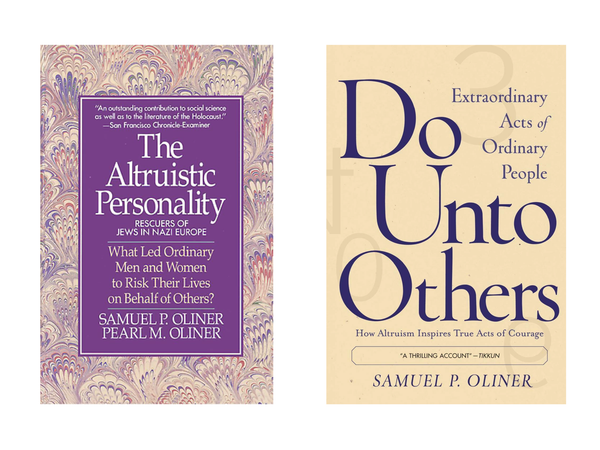
Different people follow their principles in different ways. Samual and Pearl Oliner have studied when people follow their principles in extremely challenging times. Their books include The Altruistic Personality and Do Unto Others.
The Altruistic Personality chronicles the activities of people who protected Jews during the Holocaust. Up to 500,000 non-Jews risked their own lives to rescue the victims of Nazi persecution.
These were ordinary people, say Pearl and Samuel. They were farmers, teachers, entrepreneurs, factory workers, rich and poor, parents and single people, Protestants and Catholics.
Different people helped the Jews in different ways. Some offered them shelter, some helped them escape from prison and some smuggled them out of the country.
The rescuers committed themselves to helping Jews, knowing that capture would mean death for their families. Why? Many said, “It was the right thing to do.” Individuals also said things like:
“I was always filled with love for everyone, for every creature, for things. I am fused into every object. For me everything is alive.”
“I sensed I had in front of me human beings that were hunted down like wild animals. This aroused a feeling of brotherhood and a desire to help.”
“We had to help these people in order to save them, not because they were Jews, but because they were persecuted human beings who needed help.”
Samuel illustrates the moral of the book by describing his own experiences. As a 12-year-old Jewish boy in Poland, he fled the Nazis after his parents were captured. Knocking on the door of a family he hardly knew, he was taken in by the mother, Balwina.
Protecting him from the Nazis, she gave her instructions. Change his name to Jusek; go to church every Sunday; learn the Catholic Catechism; get a job and ensure nobody saw him undressed.
Balwina protected him for a while, but then the situation became too dangerous. He trekked across the country with other refugees and finally found safety.
Samuel wrote another book on the theme of helping other people called Do Unto Others. In it he focuses on heroic, moral and philanthropic individuals who translated these values into action.
In addition to well-known names, he describes the activities of hidden heroines and heroes in many countries. Here is the introduction from the page on Amazon.
A passing motorist stops to help the passengers of a car that has crashed into an embankment. A hospice volunteer begins her shift in hospital ward caring for people with AIDS.
A Vietnam chopper pilot stops the brutal execution of innocent civilians at Mylai by American soldiers. A firefighter responds to a routine call.
All of these people are considered heroes, but what motivates such brave and altruistic acts, whether by trained professionals or just ordinary people?
In Do Unto Others, Holocaust survivor and sociologist Samuel Oliner explores what gives an individual a sense of social responsibility, what leads to the development of care and compassion, and what it means to put the welfare of others ahead of one’s own.
Weaving together moving personal testimony and years of observation, Oliner makes sense of the factors that elicit altruistic behavior – exceptional acts by ordinary people in ordinary times.
Samuel discovered that many such people had learned optimism and concern for others from their parents, teachers, peer groups and communities. They then chose to translate this moral code into action in challenging circumstances.
The Oliners have shown what we can learn from humanity at its best. We can choose to follow these principles in our own ways to show kindness and help other people.
Let’s return to your own life. If appropriate, you may want to consider how you can follow your principles. Let’s explore this theme.
You Can Follow Your Principles
There many ways to take this step. One approach is to start by brainstorming the principles you want to follow in your life. You can then settle on, for example, the three key principles you want to follow.
Many people who take this approach start by describing lots of principles. As mentioned earlier:
Some may focus on building positive relationships – such as to be grateful, to be kind and to encourage people in their life and work.
Some may focus making a positive contribution – such as to build on their strengths, to do superb work and to achieve their view of success.
Some may focus on having positive experiences – such as to do their best, to create positive memories and to enjoy a sense of peace.
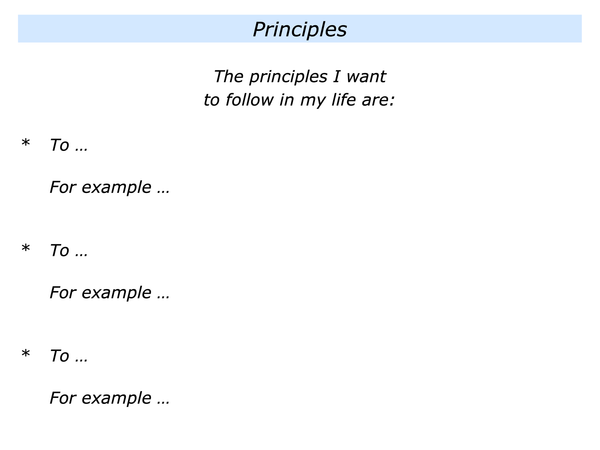
If you wish, try tackling the exercise on this theme. This invites you to do the following things.
First, you can brainstorm the principles you want to follow in life. Don’t worry if these sound too generic.
Second, you can aim to settle on the three key principles you want to follow in your life.
Third, you can try to give an example of how you may want to translate each of these principles into action.
Sometimes it can take time before you settle on the principles. It can also be the case that, as you evolve, you may change some of the wording.
But it can be useful to keep focusing on these because, as mentioned earlier, this can provide an internal compass you can follow in many situations. Here is the exercise on this theme.
You Can Clarify How You Can Follow
Your Principles In Specific Situations
Let’s assume that you have settled on the principles you want to follow. You may then aim to pursue these in different situations.
These situations are like different boxes you go into during your daily life. You may be aiming to encourage a person, help a customer, lead a team, tackle a challenge or do another activity.
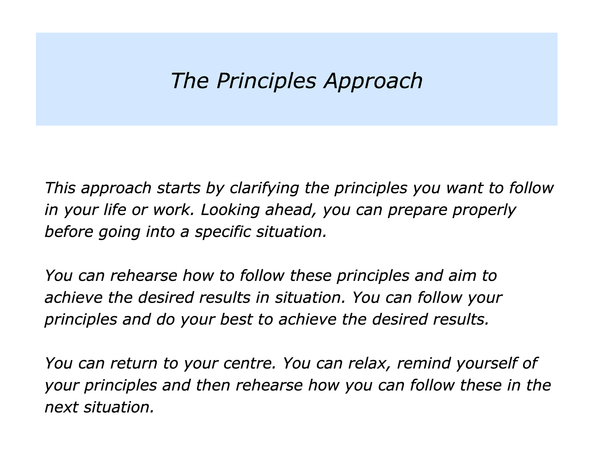
Imagine that you will be going into a specific situation. You can start by going to your centre and reminding yourself of the principles you want to follow in your life. You can then aim:
To clarify the real results that both you and the other parties – such as a person or group of people – want to achieve in the specific situation;
To rehearse how you follow your principles and also, at the same time, do your best to achieve the desired results in the situation;
To go into the situation, be agile and, if appropriate. follow your principles in a pragmatic way to achieve the desired results in the situation.
You can then return to your centre, relax and, when appropriate, rehearse going into the next situation in your life or work.
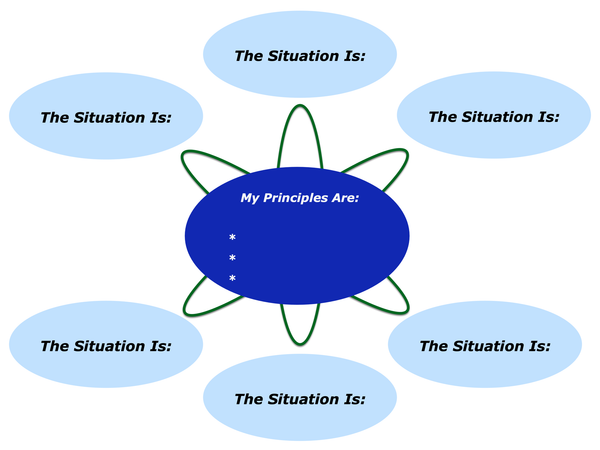
There is one key point that it can be useful to bear in mind. You may find it helpful to clarify your expectations about what you can and can’t expect to happen in the situation.
You will always do your best but there will be some situations where you can expect certain responses. Sometimes these may be positive, neutral or other responses. So it can be useful to explore:
The positive things that could happen in the situation … The neutral, negative or other things that could happen in the situation.
Let’s look at one example. Imagine you are about to embark on doing some work for a particular organisation. Bearing in mind the culture, there may be both pluses and minuses involved when working with the organisation.
Looking at the situation from your side, you will aim: a) to focus on what you can control; b) to rehearse properly; c) to do your best in the situation.
Looking at the situation in perspective, however, there may be things that are beyond your control. It is important to bear these factors in mind when judging how things went in the situation.
Imagine that you have rehearsed what you want to do. You can click into action and be fully present. You can then aim to follow your principles and do your best to achieve the desired positive results.
People who follow their life principles keep returning to their inner compass. They are then more likely to live in what the existentialists call good faith and feel a sense of peace.
There are, of course, both pluses and minuses involved in following your principles. These include the following.
The Pluses Are:
You may find the principles provide an internal compass you can refer to when making decisions;
You may feel at ease by doing what you believe in and following principles that serve you well in many situations;
You may find following the principles produces tangible benefits – such as feeling you have done your best and delivering success.
The Potential Minuses Are:
You may find following the principles can mean making tough decisions and sometimes losing out on short-term gains;
You may find other people criticise you or reject your efforts for following these principles;
You may sometimes fail to follow your principles and feel you have been untrue to yourself.
Let’s assume that you are aiming to be positive and follow your principles in your life and work. If appropriate, sometimes this may lead to focusing on the next theme.
Picture Of Success
People who have a positive attitude often aim to follow their principles and express these by working towards a certain picture of success.
As mentioned earlier, they often start by focusing on what they want to do in their lives or work. Let’s look at some examples.
They may aim to encourage people in their daily lives. They may aim to build a happy family. They may aim to help people to do satisfying work, provide medical care or do another activity that enables people to achieve their goals.
They may aim to build on their strengths and do superb work. They may aim to create an inspiring school, run a sports academy, lead a pioneering team or create a culture in which people can thrive.
They may aim to find solutions to challenges. They may aim to work as a mediator, use technology to improve people’s lives or pass on knowledge that helps people to shape a positive future.
People who take this approach clarify the real results they want to achieve. They then aim to follow their principles and do their best to achieve their picture of success. Let’s look at one example.
Kate Griggs And Her
Work With Dyslexia
Kate Griggs is somebody who has translated her vision into action and delivered success. She has used her experience of dyslexia to educate people about its strengths.
She has been offering a positive view of dyslexia since 2004. She has also written two books called This Is Dyslexia and Extraordinary People.

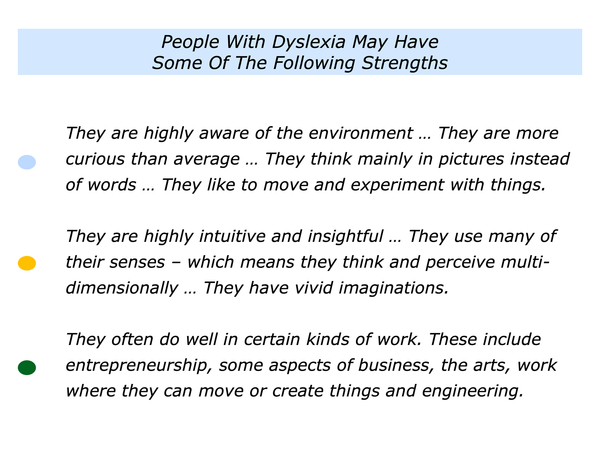
Kate created the website Made By Dyslexia which acts as a positive resource for children, parents and teachers. Here is an excerpt from its website.
Made By Dyslexia
We are here to empower Dyslexic Thinking. We are a global charity led by successful dyslexics. We are the world’s largest community of dyslexic people and their allies.
Our mission is to teach the world the brilliance of Dyslexic Thinking. It is to empower it in every home, every workplace and every school.
Our bold campaigns, game-changing partnerships and impactful resources are redefining dyslexia, informing, teaching and inspiring a global movement for change.
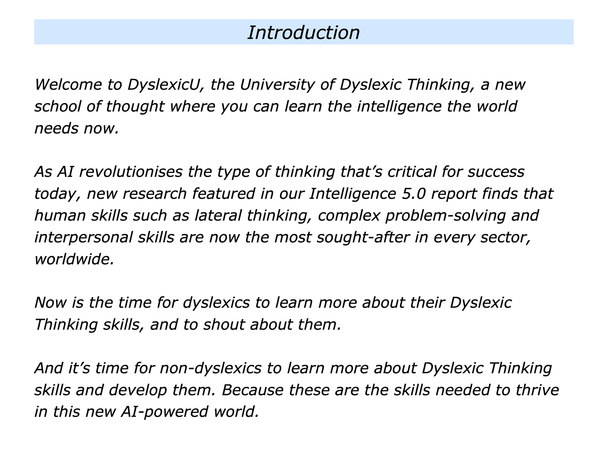
Kate also co-founded the University of Dyslexic Thinking. This shows how the skills demonstrated by dyslexics can help to produce superb work in an AI World.

You Can Work Towards
Achieving Your Picture Of Success
There are many ways to live life. This piece has looked at how some people aim to be positive, follow their principles and work towards a picture of success.
Different people do this in different ways. Some people take the following steps.
They choose to have a positive attitude, focus on what they can control and clarify the real results they want to achieve. They translate these into a clear picture of success.
They clarify the principles they want to follow in the situation. They then focus on the strategies they can follow to give themselves the greatest chance of achieving the picture of success.
They clarify their action plan, prepare properly and rehearse what they are going to do. They then aim to perform superb work, keep improving and do their best to achieve the picture of success.
Let’s return to your own situation. Imagine that you want to follow elements of this approach in your own way. This could be in your personal or professional life.
How can you continue to have a positive attitude? How can you follow your principles? How can you then do your best to achieve your picture of success? What may happen as a result of taking these steps?
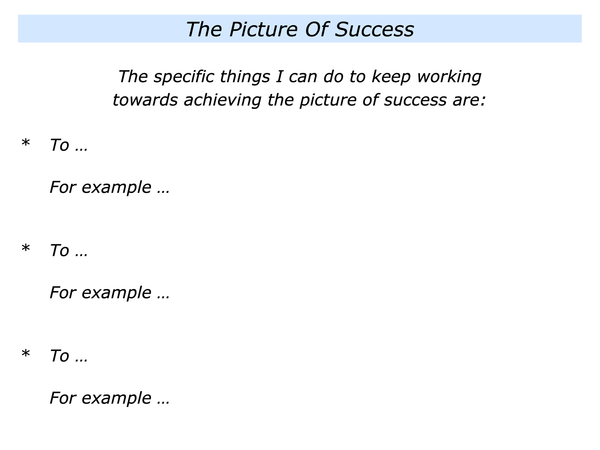
If you wish, try tackling the final exercise on this theme. This invites you to describe how you can continue to work towards achieving the picture of success.

Leave a Reply