



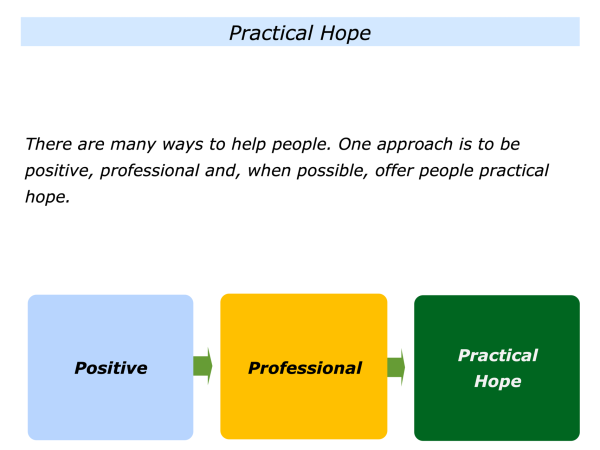
There are many ways to help people. One approach is to be positive, professional and, when possible, offer people practical hope.
This is an approach that is followed by many educators, trusted advisors, leaders and other people. They aim to pass on practical things that people can use to shape a positive future.
Different people take these steps in different ways. This often involves them focusing on the following themes.
They Are Positive
People who follow this approach often have a positive attitude towards life. They often have a sense of gratitude and count their blessings rather than their burdens. They enjoy being generous and giving to people.
They also have a positive approach in their chosen field. They may believe in the power of education, coaching, health care, science, technology or other work to help people to achieve their goals.
Good educators, for example, often follow the adage that the learner learns what the learner wants to learn. They clarify people’s goals and then pass on knowledge that enables people to achieve success.
Imagine that you want to have a positive approach in your work. You may aim to do this when working in education, medicine, therapy, the arts, sports, technology or another field.
How can you have a positive approach in your work? How can you translate this into action? What may happen as a result of taking these steps? If you wish, try tackling the exercise on this theme. This invites you to complete the following sentence.
Let’s assume you are taking this approach. If appropriate, you can focus on the next step taken by people who aim to offer others practical hope.
They Are Professional
Great workers aim to be super professional. They follow this approach whether working as artists, athletes, carers, carpenters, chefs, medics, mediators or in another role.
Imagine that somebody is aiming to help a person to achieve their goals. One approach will be for them to take the following steps.
They prepare properly and clarify th
person’s potential picture of success
Great workers prepare properly. They aim to clarify: a) the real results to achieve; b) the strategies they can follow to achieve these results; c) the action plan for achieving these results.
Different workers will do this in different ways. Good mentors, for example, often use their imagination to work through the following steps when preparing to meet a mentee.
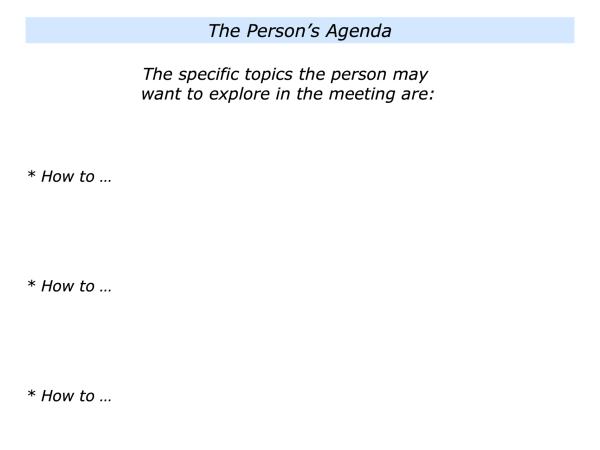
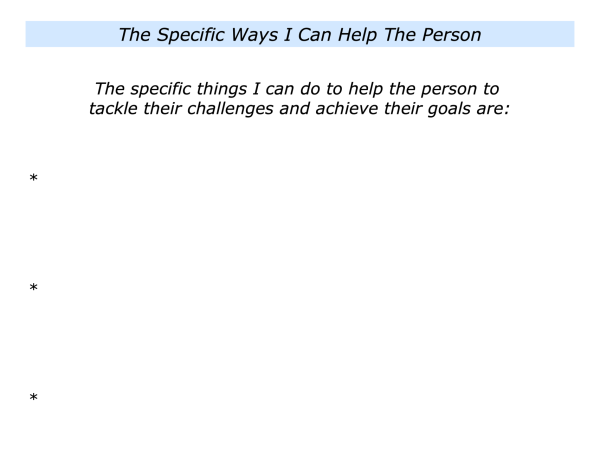
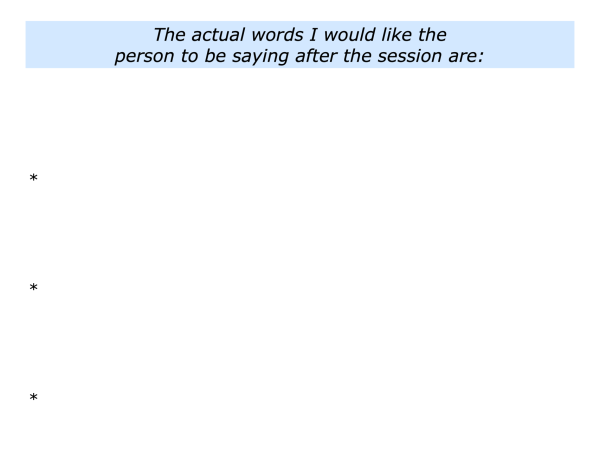
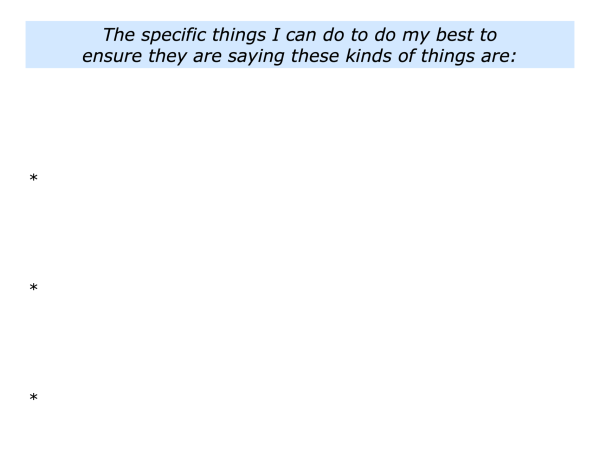
Imagine that you have prepared properly before meeting a person. If appropriate, you may then move on to the next step taken by people who want to offer others practical hope.
They create a positive environment and
clarify the person’s picture of success
Good mentors, for example, aim to create a stimulating sanctuary in which a person feels at ease. They then invite the person to describe the topics they want to discuss.
Focusing on the first topic, they aim to get more information about what is actually happening. Bearing in mind what the person can control in the situation, they then take the following steps:
They clarify the real results the person wants to achieve – the picture of success;
They clarify the benefits – for the person and, if appropriate, maybe for other people – of achieving the picture of success;
They clarify what will be happening that will show the person has achieved the picture of success.
Good mentors take this approach. It is also one that, when appropriate, is followed by other professionals. Depending on the situation, they will follow elements of it in their own way. They then move on to the next stage.
They follow high professional standards
and do their best to help the person
to achieve their picture of success
Great workers aim to follow high professional standards that help others. Again, much depends on the situation. When appropriate, however, they take some of the following steps.
They make clear contracts with the person about the goals they want to achieve – the picture of success;
They aim to be positive, professional and follow their chosen principles on the way towards helping the person to achieve their picture of success;
They aim to perform superb work, find solutions to challenges and do their best to help the person to achieve their picture of success.
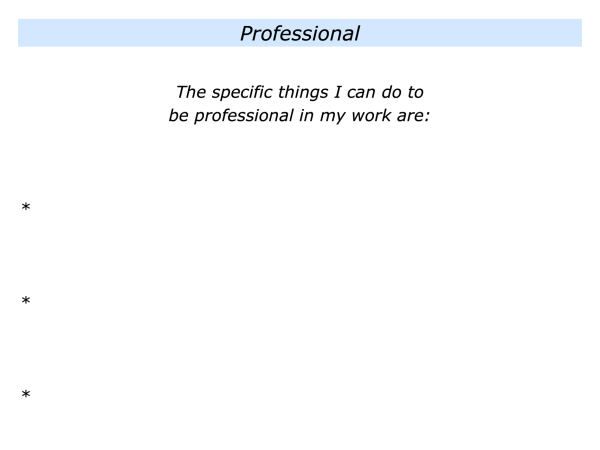
Let’s return to your own life and work. Imagine that you are helping a person to achieve their goals. How can you do this in your own way? How can you be professional in your work and deliver high standards?
If you wish, try tackling the exercise on this theme. This invites you to complete the following sentence.
Imagine that a person has aimed to be professional when helping somebody to achieve their goals. Sometimes this may also mean focusing on the following theme.
They Offer People Practical Hope
Good mentors, for example, often pass on knowledge that people can use in their daily lives. They also recognise, however, that sometimes people need practical things they can use to achieve their goals.
Much depends on a person’s situation, of course, but there are many ways to offer people practical hope. Sometimes this can involve providing them with the basic materials for life – food, shelter and enough money to live.
Sometimes it can involve providing practical tools a person can use to manage challenging situations. Sometimes it involves passing on strategies that work. People can then apply these in their own way to shape a positive future.
There are many ways to pass on this knowledge. One approach is to help people to increase their way power. This involves adding to their repertoire of options for reaching their goals. Let’s explore this theme.
Helping People To
Expand Their Way Power
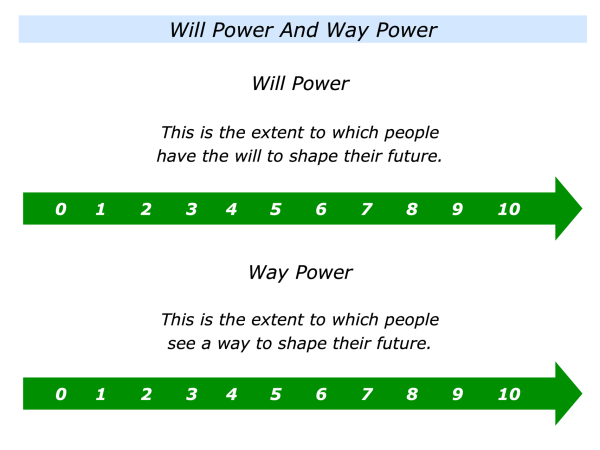
Rick Snyder described this approach in his book The Psychology Of Hope. Here is one of the key messages he gave in the book.
People feel more able to shape their futures when they score highly on both will power and way power.
Let’s explore what this means in practice. Imagine that a person is facing a difficult challenge. They will have a strong sense of hope if, for example:
They score 8+/10 in terms of their will to solve the challenge;
They score 8+/10 in terms of seeing a way to solve the challenge.
The person will then feel confident about how to achieve their picture of success. This is because they score highly on both will power and way power.
This model also explains why a normally positive person can be confused if they feel depressed when facing a particular challenge. Their will power to solve the problem is 9+/10 but their present ability to see a way to solve it is perhaps 3/10.
Once the person sees a way to solve the problem, however, the cloud evaporates. Their way power goes up to 8+/10. Their sense of hope returns and they feel reinvigorated to tackle the challenge.
Here are some of the key messages in The Psychology Of Hope.
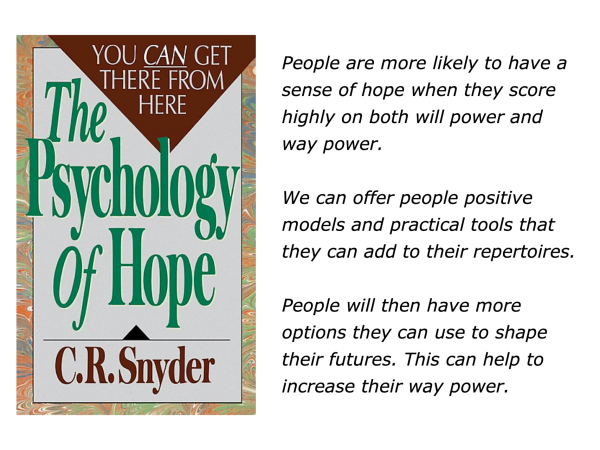
Many people use this approach to encourage, educate and enable people in their daily lives and work. They pass on knowledge that helps others to increase their way power.
Good educators, for example, believe that education is the ultimate democratic activity. It offers people more choices – and therefore more freedom – to shape their future lives.
Good speakers also bring things to life by moving from the concept to the concrete. They give lots of examples that resonate with people. They also describe practical ways forward that can give people practical hope.
We are often told that: “Where there’s a will, there’s a way.” But this phrase can be turned around to say: “Where there’s a way, there’s a will.” If a person sees a way forward, they are more likely to develop the will to make it happen.
There are many ways to help people. One approach is to be positive, professional and, when possible, offer people practical hope. The person may then be more able to shape a positive future.
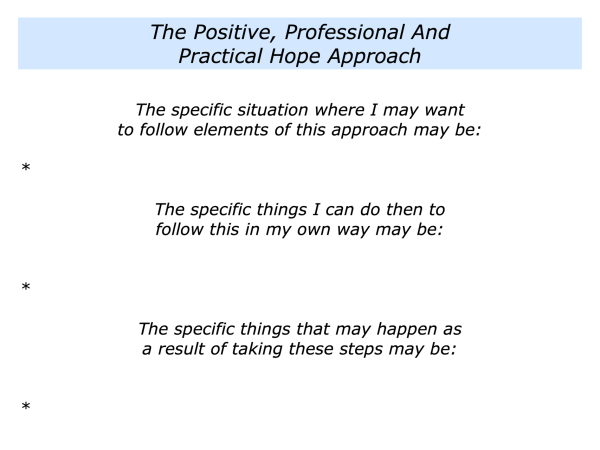
Let’s return to your own work. Can you think of a situation where you may want to follow elements of this approach? How can you do this in your own way? What may happen as a result of taking these steps?
If you wish, try tackling the exercise on this theme. This invites you to complete the following sentences.

Leave a Reply