



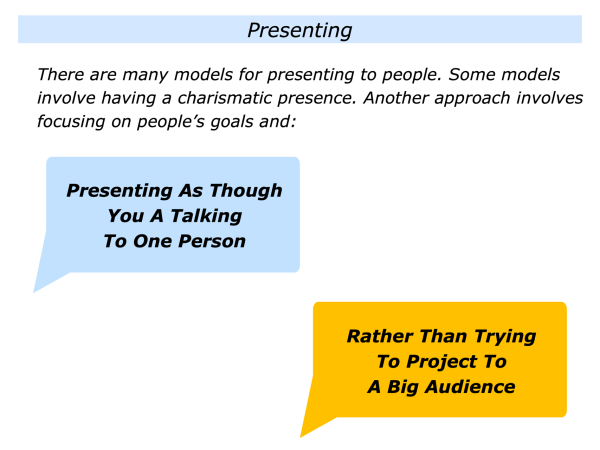
There are many models for making presentations to people face to face or over the web. Some models involve having a charismatic presence and inspiring people.
The following piece explores another approach. This involves presenting as though talking to one person. It is also important to make the session compelling, however, and cover themes that resonate with many people in the group.
This approach involves aiming to connect with people’s agenda and also provide concrete ideas that work. It involves taking the following steps:
To prepare properly by doing lots of research to clarify people’s situation – such as what is happening in their world together with their challenges and goals;
To put together a positive presentation that resonates with people – bringing it to life with lots of relevant examples – and sharing these in a way that helps people to achieve their goals;
To make the presentation as though talking to one person – rather than trying to project to a big audience – and providing lots of practical tools that can help people to achieve their goals.
Different people follow this approach in different ways. When doing so, however, they often focus on the following themes.
They can do lots of prework before the
session to understand people’s goals
Imagine that a person is going to make a presentation to a group of people. Much will depend, of course, on the context and whether it will be a face to face or virtual session.
Bearing this in mind, they may begin by doing lots of research. They can use their imagination to consider the people who will be in the audience. They can focus on:
The specific things that may be happening in people’s world;
The specific challenges that people may face and their personal or professional goals;
The specific knowledge that they can pass on that can help people to achieve their goals.
Imagine that a person has explored these themes. If appropriate, they may also need to make clear contracts with the key stakeholders – such as the leader of the group – about the following things.
The specific outcomes they want to achieve from the session.
The specific themes they want covered in the session.
The specific things they would like people to be doing – and the actual words they would like them to be saying – as a result of the session.
Let’s assume that the person is clear on the goals to achieve from the presentation. They may then move to the next stage.
They can put together a presentation
that will help people to achieve their goals
The person will then aim to put together a presentation that will help people to achieve their goals. Much depends, of course, on people’s situation and the challenges they may face.
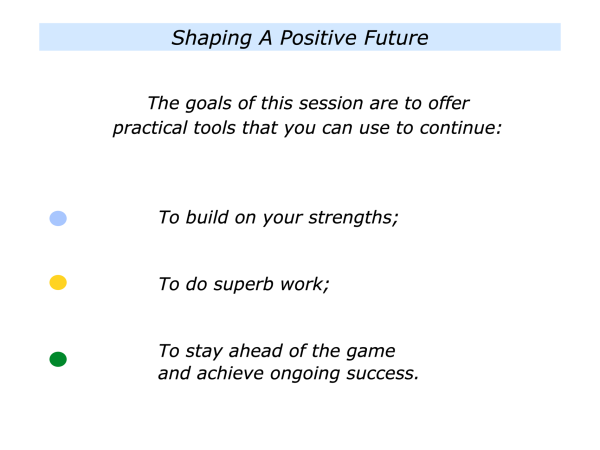
Here is the first slide I used, for example, to introduce the aims for a session I did with one organisation. The aims were to provide people with practical tools that would help them to shape a positive future.
Imagine that somebody is clear on the topics to cover during the presentation. They will also set aside time to prepare properly. A mentioned earlier, they will then aim:
To put together a positive presentation that covers the key themes and helps people to achieve their goals;
To pass on knowledge and practical tools that can help people to achieve their goals;
To practice bringing the presentation to life by giving examples that resonate with people and can help them to achieve their goals.
Let’s assume the person has taken these steps. The next stage will be to move into action and, when appropriate, make the presentation. This can involve focusing on the following theme.
They can aim to present as if they are talking
with one person and also provide practical
tools that people can use to achieve their goals
As mentioned earlier, there are many ways to make a presentation. Whichever route is chosen, however, there are several points that can be worth bearing in mind.
Good communicators are often like good educators. They build on their strengths and aim to communicate in a compelling way. They also recognise that the situation is not about them. It is about aiming:
To focus on the people involved and
helping them to achieve their goals.
Different presenters will present in different ways. Some will use lots of visuals to bring the ideas to life. Some will talk a lot and use fewer visuals. Some will stand up, be energetic and move around a lot when presenting.
Some people will sit down when they present as if they are running a traditional tutorial. They will then aim to share ideas in a clear and compelling way.
Imagine that a person is following this latter approach in an encouraging and enthusiastic way. They may aim to this by taking the following steps.
They may present the ideas as if they talking with one person but they also cover the themes that are relevant to many of the people;
They may pass on knowledge and practical tools that people can use to achieve their goals;
They may bring these ideas to life by moving from the concept to the concrete.
This final point is crucial. It can be vital to bring the ideas to life in a way that resonates with people.
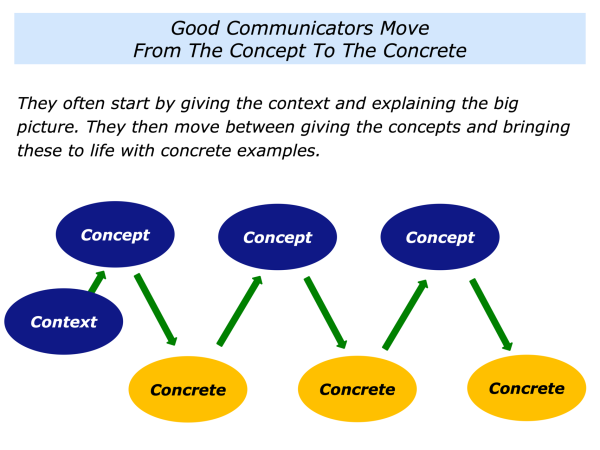
Good communicators keep moving from the concepts to the concrete and give examples that resonate with people. Some do this by taking the following approach.
They start by giving the context – the bigger picture. This can give people the background and the reasons for working to achieve certain goals.
They may then introduce a concept. This may be a strategy, for example. that people can follow to work towards achieving their goals.
They move between the concept and the concrete. They give concrete examples that can help people to work towards achieving their goals.
Different people move from the concept to the concrete in different ways. Some follow each idea they introduce by saying:
“For example: …
This forces them to bring the idea to life and give an example that rolls off the tongue. They then aim to communicate this in a way that resonates with people.
There are many models for making presentations. One approach is to make a presentation as though talking with one person. It is also to cover the themes that are relevant for many people in the group.
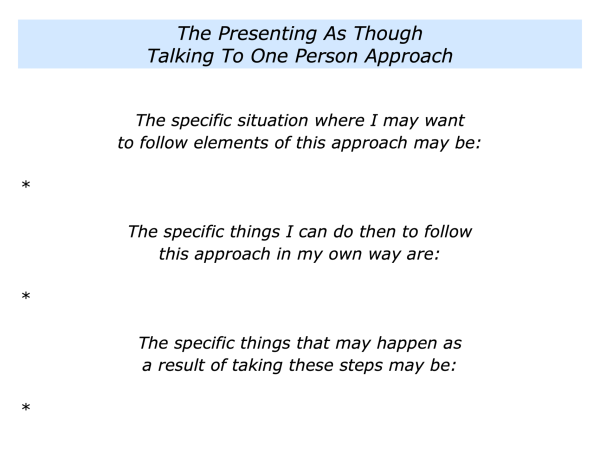
Let’s return to your own work. Looking ahead, can you think of a situation where you may want to follow elements of this approach? How can you do this in your own way?
What may be the specific situation? What may be the messages you want to give to people? How can you bring these to life? How can you pass on knowledge and practical tools that can help people to achieve their goals?
If you wish, try tackling the exercise on this theme. This invites you to complete the following sentences.

Leave a Reply