



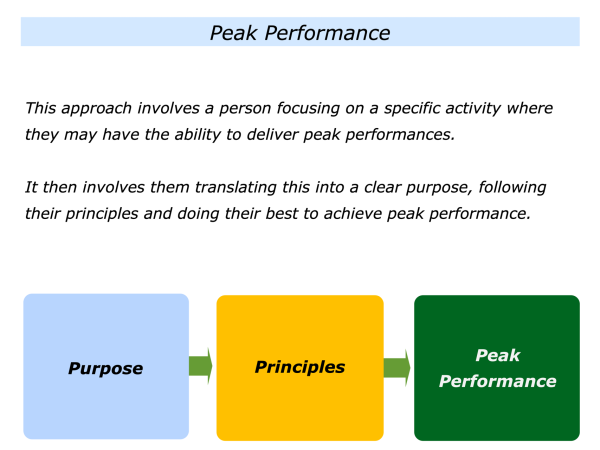
There are many ways to do fine work. This approach involves a person starting by focusing on a specific activity where they may have the ability to deliver peak performances.
The approach then involves them aiming: a) to translate this into a clear purpose; b) to follow their chosen principles; c) to do their best to achieve peak performance.
Imagine that a person wants to follow elements of this approach. This can involve them focusing on the following themes.
Peak Performance
The first step is to clarify a specific activity where they can become the best they can be and achieve peak performance. One approach is for them to explore the following questions.
What are the activities where I may have the ability to deliver peak performances? What are those where I deliver As rather than Bs or Cs? What are those where I am in my element – at ease and able to excel?
What are the activities that give me positive energy? What are those where I see the destination quickly – I go ‘A, B … then leap to Z’? What are those where I have a track record of delivering Z?
What are the activities where I quickly see patterns? Where do I have good personal radar and know what will happen before it happens? Where do I also have the repertoire to deliver the desired results?
What are the specific activities where I build on my strengths and follow strategies that work? What are those where I also have a track record of delivering success?
A person may take these steps when teaching a class, playing a sport, performing on stage or doing another activity. They may do so when working as a coach, medic, designer, crisis manager, leader or in another role.
Imagine that you want to follow elements of this approach in your own way. This could involve taking the following steps. You could aim:
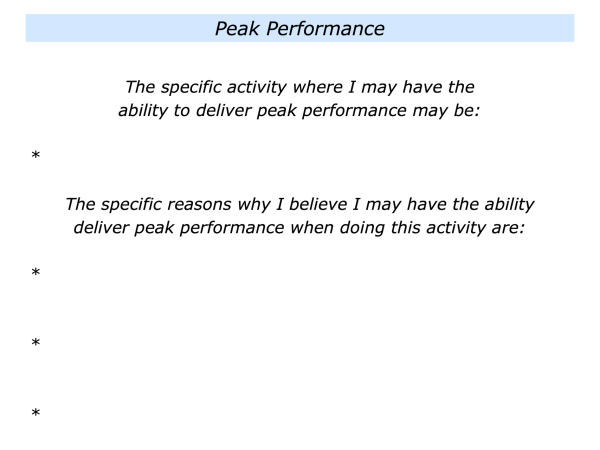
To clarify the specific activity where you may have the ability to deliver peak performances;
To clarify the specific reasons why you believe you may have the ability to deliver peak performances in this activity.
If you wish, try tackling the exercise on this theme. This invites you to complete the following sentences.
Purpose
Imagine that a person has clarified the specific activity where they may have the ability to deliver peak performances. They may then translate this into focusing on a specific purpose.
People love to have a sense of purpose. They love to wake up each morning and focus on something that has meaning. Different people do this in different ways.
Some people focus on a long-term purpose. They may aim to follow a spiritual faith, a vocation or a sense of mission. They may aim to do something each day to work towards achieving their life goals.
Some people focus on a short-term purpose. They may aim to write an article, climb a mountain, finish a marathon, teach an inspiring course, lead a team to success or achieve another goal.
Different people describe different things regarding their purpose. Here are some they may mention.
My Purpose – The specific
thing I want to do is:
I want to encourage people … I want build a happy family … I want to help dyslexic people to build on their strengths … I want to write articles that inspire people … I want to create enriching environments that enable people to grow.
I want to help to find a specific medical cure … I want to create technology that simplifies people’s lives … I want to give people practical hope … I want to pass on knowledge that helps people to shape a positive future.
Imagine that a person wants to build on a specific activity and translate this into clear purpose. One approach is to do a specific piece of work and aim to achieve a picture of success. When doing so, they may explore some of the classic questions.
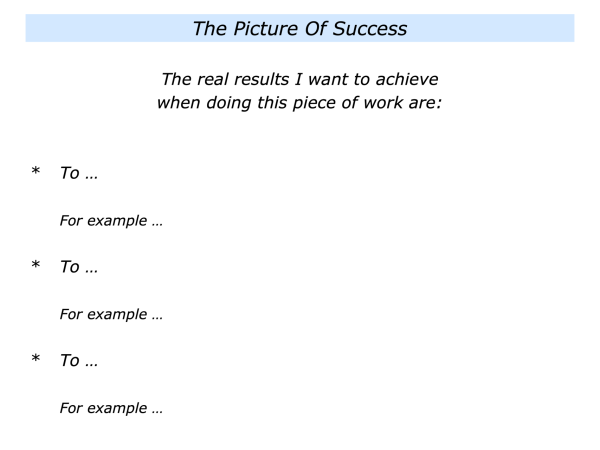
What is the specific piece of work I want to do? What are the real results I want to achieve? What is the picture of success? What will be happening that will show I have achieved the goal?
What will be the benefits of achieving the goal? What will be the pluses and minuses involved in working to achieve the goal? How can I build on the pluses and manage the minuses?
Bearing in mind what is involved, on a scale 0-10 how high would I rate my motivation to do the work? How can I maintain or improve the rating? Make sure the rating is at least 8+/10.
Imagine that you have explored some of these questions. If you wish, try tackling the exercise on this theme. This invites you to complete the following sentences.
Principles
Imagine that a person has clarified their purpose. The next step can be to clarify how they can do their best to achieve the picture of success. One approach is to focus on the principles they want to follow.
Much depends on their chosen activity. They may be aiming to do work as an educator, medic, specialist, leader or in another role. Here are some of the principles that people mention when focusing on their chosen activity.
My Principles – The principles I want
to follow when doing the work are:
To be caring in my work in the hospice … To be a good educator who enables people to shape their futures … To help people to build on their strengths, follow strategies that work and achieve success.
To make TV programmes that encourage people to take care of the planet … To create a positive culture in which people can flourish … To create wins for our company, customers and colleagues.
Some people then focus on how to translate their principles into action. They do this by exploring the following questions.
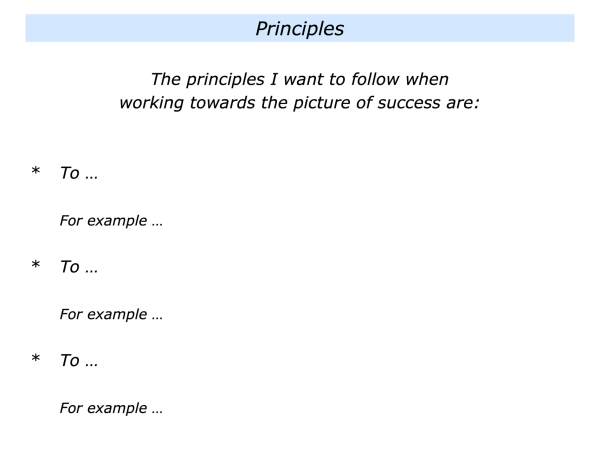
What is the specific goal I want to achieve? What are the principles I want to follow when working towards the picture of success? What are the reasons why I believe in following these principles?
How can I translate these principles into action? What are the key strategies I can follow to increase the chances of achieving success? How can encourage myself and other people on the journey?
Such people aim to deliver consistently high standards when following their principles They do this whether they are counselling people, coaching a sports team, leading a business or doing other kinds of work.
They may also aim to act as positive models and encourage other people – especially when times get tough. They often take the following steps when focusing on how to follow their principles.
They prepare properly. They look ahead, clarify the results to achieve and rehearse following their chosen strategies to achieve the goal. They then click into action. They are super professional and encourage other people.
They aim to get some early wins, perform superb work and provide great service. They focus on continuous improvement. They keep doing reality checks to clarify what is working, what they can do better and how. They then implement these ideas to keep improving.
Imagine that you want to follow this approach. If you wish, try tackling the exercise on this theme. This invites you to clarify the principles you want to follow when working towards the picture of success.
Peak Performance
Imagine that a person is following their principles and continuing to deliver high standards. They may then do their best to achieve the picture of success.
Sometimes this can be enough to reach the goals. But there may be other times when they need to raise their game, however, and be good at problem solving.
People who take this approach may then achieve peak performance. Some may then go further and pass on knowledge to other people. Sometimes this can lead to a sense of peace. Let’s explore these themes.
Problem Solving
Great workers find solutions to challenges. Some even use setbacks as a springboard to success. You will do this in your own way, but it can be useful to ask some of the following questions.
Looking ahead, what may be some of the difficulties I may face on the journey? What can I do to prevent some of these difficulties happening? How can I manage these difficulties if, despite my best efforts, they do happen?
What can I do to stay calm during a crisis? How can I buy time to think and explore the options for going forwards? How can I find creative solutions to challenges? How can then pursue my chosen option and do my best to achieve success?
Peak Performance
Great workers often rise to the occasion and, when appropriate, deliver peak performances. They may do this when performing a song, conducting an operation, tackling a challenge or doing another activity.
They use their radar to gather information, see patterns and predict what may happen. Reaching into their repertoire of skills, they then apply their knowledge to deliver the desired results.
Such workers seem to go into another dimension. They seem to act slowly but swiftly. They then do something special to deliver peak performances and achieve the picture of success.
Different people do this in different ways. Some find it useful to explore the following themes.
How can I be a good finisher? Looking back, what is my successful pattern for finishing? How can I follow those principles in this situation? How can I flow, focus and finish?
How can I keep doing the basics and, when appropriate, add the brilliance? How can I add that touch of class? How can I do my best to achieve peak performance?
Imagine that a person has completed the piece of work. They may simply want to rest, reflect and re-energise themselves. At some point they may also wish to consider the following theme.
Passing On Knowledge
Great workers sometimes want to go beyond doing fine work. They want to share what they have learned with other people. Some find it useful to start by focusing on the What, Why, Who, How and When.
The What
What is the knowledge they want to pass on? This may depend on the project or other activity they have been pursuing. They may have learned lessons from gardening, counselling, building houses, managing crises, coding, leading teams, solving particular problems or whatever.
The Why
Why would they like to pass on this knowledge? What would be the benefits for people? What are the practical tools people could take away and use in their daily lives and work? How could these things help them to succeed?
The Who
Who would they like to reach with the knowledge? Would they be young people, those with learning difficulties, budding entrepreneurs, athletes, leaders, scientists, social entrepreneurs, therapists or other people?
What would be the characteristics of these people? Would they be motivated and wanting to learn? What other qualities would they like to see in their ideal students?
The How
How would they like to share their knowledge with people? Different people prefer different methods for sharing know how. They may prefer, for example:
To act a positive model and show what good looks like on a daily basis by, for example, running a business;
To act as a mentor, coach, trusted advisor or to run teaching sessions, seminars, workshops or other forms of education;
To write articles, create websites, write blogs, produce learning materials, make videos, make television programmes or whatever.
The When
When do they want to share the ideas with people? What would be their preferred setting? Would they like to run a seminar, produce a blog, run a coaching session or whatever?
Peace
Great workers love to do their best. This can lead to them enjoying a sense of peace. A person who is adrenaline-driven may enjoy stretching themselves and reaching a specific goal. This may be followed by a rush of satisfaction and feeling high.
Such a person may then enjoy a sense of peace but this may only last for a short while. They will then move on to planning the next mountain they want to climb.
Another person may pause and feel content. They may take time to reflect, recentre and re-energise themselves. They may then begin to explore the next thing they want to do to make a positive contribution.
There are many models for doing fine work. One approach is to focus on a specific activity where this may be possible. It is to translate this into a clear purpose, follow certain principles and achieve peak performance.
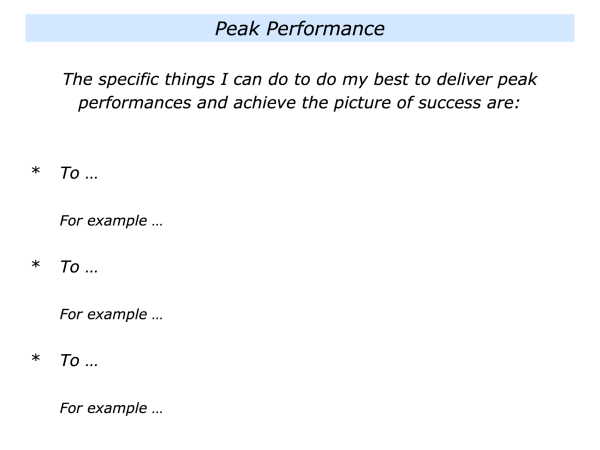
Let’s return to your own life. Imagine that you have already followed some elements of this approach. How can you then do your best to deliver peak performance and achieve the picture of success?
If you wish, try tackling the final exercise on this theme. This invites you to complete the following sentences.

Leave a Reply