



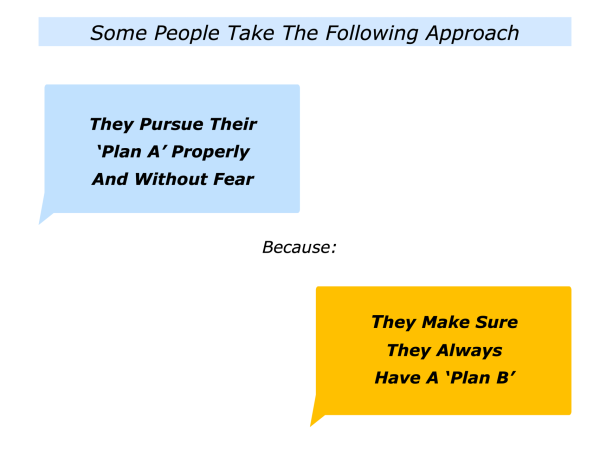
There are many ways to do fine work. One approach is to pursue your ‘Plan A’ properly – and to do this without fear – because you will always aim to have a ‘Plan B’. Different people follow this approach in different situations.
A person who is doing satisfying work in an organisation, for example, will continue to follow their ‘Plan A’ and do their best to deliver success. At the same time, however, they may ask themselves some of the following questions.
What would I do if the organisation was taken over and I was forced to leave? What would I do if it is put out of business by new technology or changes in the market?
What is my Plan B? What are my strengths? How could I use these to help other people – customers or employers – to achieve success? How could I create a potential back up plan?
A person who takes this approach may, paradoxically, feel freer and more able to make their best contribution to an organisation. They follow the old saying that:
Security is to always have an alternative.
Paul McGinley, who captained a winning European Ryder Cup Team, followed this approach when advising talented young golfers. He believed it was important for golfers to flow rather than fear.
He encouraged young golfers to pursue their ‘Plan A’ – to earn their living playing golf – but also to develop a ‘Plan B’. He believed that having a back-up plan could help them to play without fear.
Paul recognised that is was vital for players to be committed to making the best use of their talent. This involved them being focused and doing their best.
At the same time, however, he had seen many young players become crippled by fear. Some had come from families where their parents had remortgaged their house in order to finance the young golfer.
Today many sporting academies help young athletes to take the following steps. First, to do their best to pursue their ‘Plan A’. Second, to – bearing in mind their strengths – develop a potential ‘Plan B’.
The young athletes are encouraged to follow high professional standards in their chosen field. At the same time, they are also given practical help to be able to use their transferable skills in another potential profession.
Great organisations take a similar approach. Bearing in mind their strengths and what they can control in a situation, they often take the following steps.
They clarify the real results they want to achieve and the key strategies they can follow to give themselves the greatest chance of achieving the picture success.
They rehearse following these strategies – plus dealing with any potential challenges and having backup plans – on the way towards achieving the picture of success.
They follow the strategies and focus on continuous improvement – by building on what is working plus finding solutions to challenges – on the way towards achieving the picture of success.
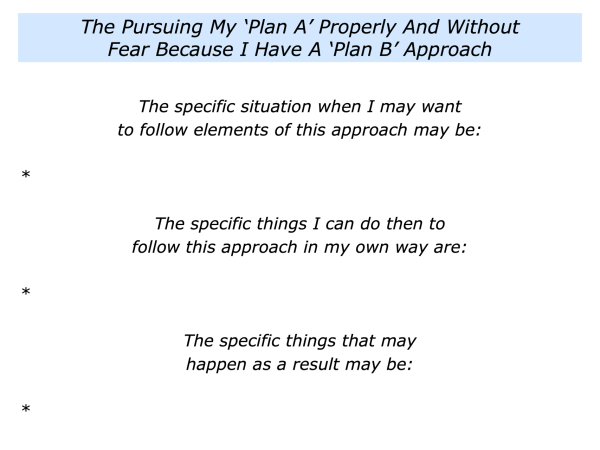
Let’s return to your own life and work. Can you think of a situation where you may want to pursue a ‘Plan A’ without fear because you have a ‘Plan B’? How can you do this in your own way?
If you wish, try tackling the exercise on this theme. This invites you to complete the following sentences.

Leave a Reply