



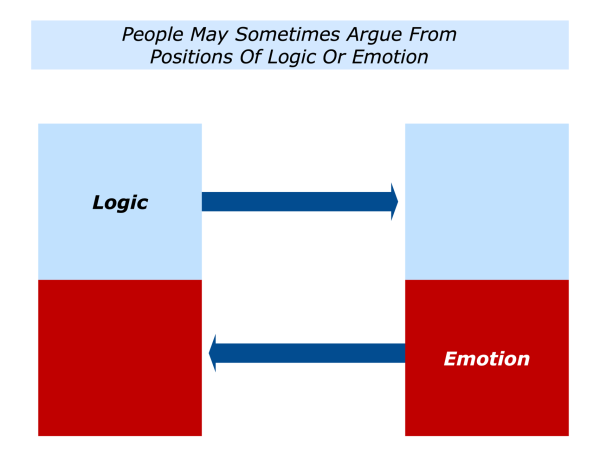
There are many ways to understand how people express their views. One approach is to recognise that some people may argue from a position of logic or emotion.
This can explain why some people may find it difficult to communicate in a way that resonates with others. There are, however, several ways to manage such situations.
Bearing this in mind, let’s explore the various ways that people may express their views.
Recognising that some people
argue from a position of logic
Some people argue from a position of logic – though this may be their view of logic. Such people sometimes believe that, for example:
The best way to convince others is to describe what they see as a logical case for doing something.
Sometimes this can work. But there may be other times when – what they see as logical – falls on stony ground. This can be because the person they are trying to communicate with has a different way of seeing events.
Sometimes it can be for another reason. The person they are aiming to communicate with is experiencing and expressing things in a different way. Let’s explore this approach.
Recognising that some people
argue from a position of emotion
Some people take an emotional stand towards situations and then express their views from that position. There are many reasons why they may take this approach.
A person may have strong feelings about a situation. They may then aim to communicate these in order to express their emotion or explain why they feel this way. They may believe that:
The best way to convince others is to describe the feeling they have about something.
Sometimes this can work. But there may be other times when their emotion is met by the other person again responding with what they see as a logical case.
People who argue from a position of emotion may also sometimes follow their own version of logic by looking for confirmation bias. They look for specific examples – or their view of logical facts – that boost their case.
Bearing all these things in mind, however, it is sometimes possible for people to communicate in ways that help others to reconsider their position. Let’s explore one approach.
Recognising that some people will only
shift their position if they see the benefits
One approach to bear in mind is the adage that people buy benefits. Good communicators sometimes follow this approach when describing an idea or a potential way forward. They recognise that:
Some people may only change their views – or their approach to life – if they feel that another approach may benefit them.
An alcoholic, for example, may only choose to stay sober if they really want to stay alive for longer or want other benefits.
A person who is negative will only change to being more positive if they believe it will help them – and maybe their loved ones – to be happier.
A person who believes in giving critical feedback will only change to the feed forwards approach if they see how this can be more effective.
A micromanaging boss will only change to managing by outcomes if they see how taking this approach can help to improve people’s performance.
A company that is addicted to fossil fuels may only change if it can see how it can make more profits by switching to renewables.
Different people choose to adopt another approach – and get the benefits – for different reasons. Sometimes this can involve them taking the following steps.
They need to recognise – to see, feel and believe – that thinking or behaving in another way will bring benefits.
They need to see how to make this happen – and how they can get an early success – on the way to getting the benefits.
They need to follow certain disciplines – whilst building on the pluses and managing any minuses – and reap the rewards of getting the benefits.
Good communicators often start they by focusing on the benefits. They do this in a way that is more likely to resonate with their target audience – the person or specific group of people. They also try to bring this to life by giving specific examples.
Such communicators recognise, however, that they can only do their best. It will then be up to people to choose their particular way forward. There may, of course, also be consequence to the route they choose.
There are many ways to understand how people express their views. One approach is to recognise that some people may argue from a position of logic or emotion.
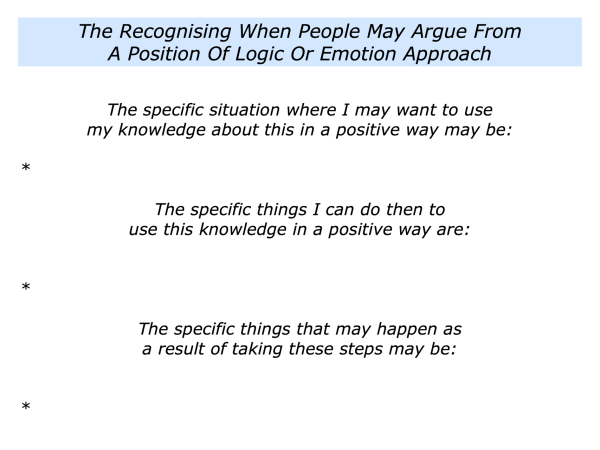
Let’s return to your own life and work. Looking ahead, can you think of a situation where you may want to use your knowledge about these different ways of communicating? How can you use this in a positive way?
If you wish, try tackling the exercise on this theme. This invites you to complete the following sentences.

Leave a Reply