



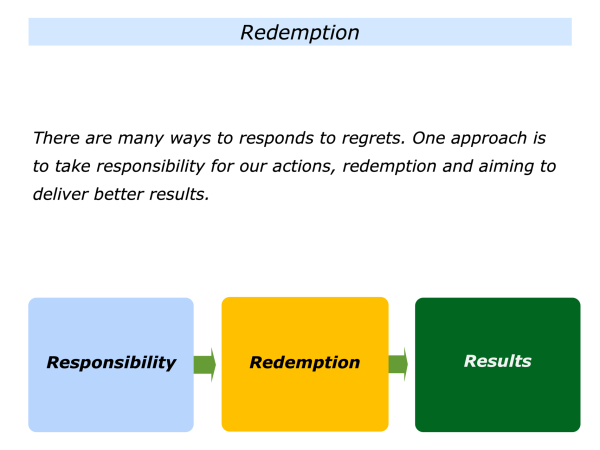
There are many ways to respond to regrets. One approach is to focus on the themes of taking responsibility for our action, redemption and aiming to deliver better results.
There are many definitions for the word redemption. These include the following:
The act of being cleansed for sins … The act of aiming to atone for guilt, a fault or a mistake … The act of redeeming a debt … The act of making something better or more acceptable.
Here are looking at the latter definition. This is aiming to atone for something we regret doing and, if possible, improving the situation. This can mean focusing on the following themes.
Responsibility
This step involves a person taking responsibility for their actions and recognising the consequences. Everybody makes mistakes in their lives. Sometimes the consequences only affect ourselves.
Sometimes we may also do things that cause pain or problems for other people. Whatever the reasons for our behaviour, we have several choices regarding how we react to what happened. We can choose:
To ignore or deny the consequences, or;
To take responsibility, recognise the consequences and act in ways that may in some way lead to atonement or redemption.
Some people refuse to take responsibility. They blame others or try to justify their behaviour. Some bullies, for example, claim that they are actually the victims.
As we know, however, the first step in any recovery programme is for a person to take responsibility for their actions. They need to say something like the following.
“I am responsible for my behaviour. Whatever the circumstances, I am responsible for how I react and how I behave in the future.”
Different people follow the redemption approach in different. Sometimes these involve our personal relationships. Sometimes these involve trying to do better in professional situations.
Many sports people, for example, take responsibility for improving their performance after experiencing a disappointment. Such athletes are often committed to personal improvement.
Looking ahead to the next event, they aim to prepare properly. Bearing in mind what they can control in the situation, they explore the following themes.
“What are the real results I want to achieve? How can I build on what I am doing right? How can I tackle areas for improvement? How can I do my best to achieve the desired results?”
Imagine that a person has chosen to take responsibility and has recognised the consequences of their behaviour. They may then move to the next stage.
Redemption
This involves a person acting in a way that aims to make things better or, if possible, repair some of the damage. Sometimes this is possible, sometimes it can be more difficult.
A person who has caused financial problems may be able to make financial recompense. A person who has caused physical damage to property may act to restore it to its original condition.
Sometimes it is harder to make recompense for causing psychological damage. Bearing this in mind, some individuals focus on aiming to be more caring and encouraging in the future.
Some people commit themselves to following a certain moral code or set of principles. They may aim to be kind, pursue a spiritual faith, follow a Twelve Step programme or take another approach.
Some individuals who have transgressed ethical standards or broken the law may confess their guilt and serve a criminal sentence. They may then aim to pursue a new life where they serve other people.
Some people aim to follow their principles but also take a pragmatic approach. They choose to take responsibility and aim:
To clarify the specific results they want to achieve and the benefits to the various stakeholders of achieving this picture of success;
To clarify the specific strategies they can follow to increase the chances of achieving the picture of success;
To clarity the specific routines they can follow to translate the strategies into action and do their best to achieve the picture of success.
People who take this approach often aim to help others or improve the situation. Such people then move into action. This often involves focusing on the following theme.
Results
Different people who follow the redemption approach may aim to achieve different goals. These could involve reparation, rehabilitation or other kinds of results.
Sometimes the reparation can involve rebuilding physical things or repaying debts. As mentioned earlier, this can sometimes be relatively straight forward in terms of delivering results.
Sometimes it can be harder to gain redemption from psychological damage. A person who has hurt others, for example, may aim to behave in a more caring way in the future.
When appropriate, such a person may also aim to make clear contracts with the other person – or the group of people – involved. They can then aim to agree on the following things.
The specific results to achieve – such as how they as a person will behave in the future or to agree with other people on more tangible results;
The specific responsibilities – such as what they and other people can aim to do when working towards achieving these results;
The specific things that will be happening that will show that they and, when appropriate, other people have achieved the desired results.
Sometimes a person who takes these steps can help to improve a situation. This does not necessarily take away some of the pain, but it can help to shape a better future.
Sometimes this can involve the person who caused the damage staying away from the situation. They may need to respect the healing process by giving other people space to get on with their lives.
Some individuals also realise that redemption may be a journey rather than a destination. They may therefore aim to do their best one day at a time during the rest of their lives.
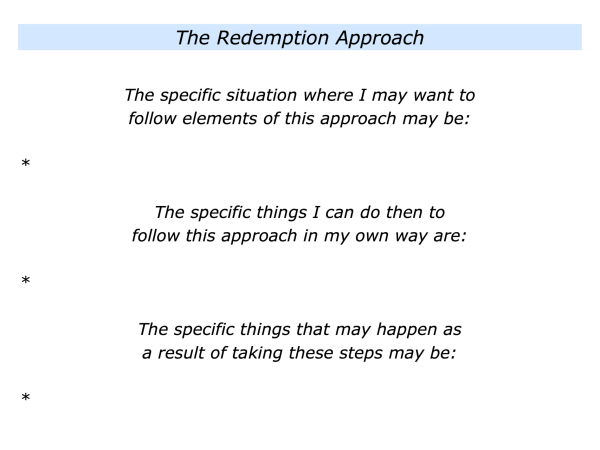
Let’s return to your own life and work. Can you think of a situation where you may want to take responsibility and follow elements of the redemption approach? How can you do this in your own way?
If you wish, try tackling the exercise on this theme. This invites you to complete the following sentences.

Leave a Reply