


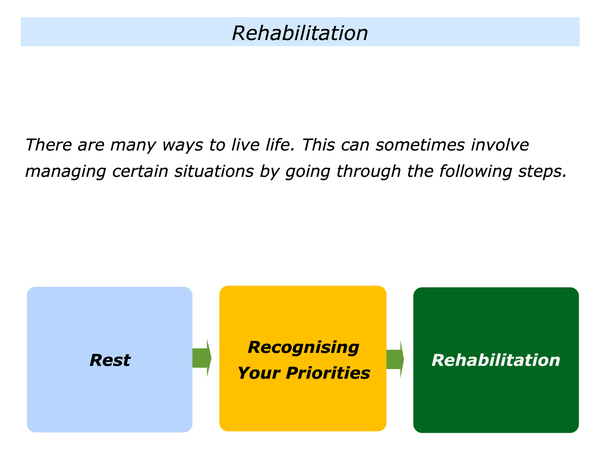
There are many ways to live life. This can sometimes involve managing certain situations by following elements of the rehabilitation approach. There are several definitions for this process. The one we are using here is:
The restoration of something to its prior
condition or sometimes making it even better.
Different people follow this process in different situations. They may be aiming to recover from a setback, give up a negative addiction or manage a specific challenge.
One approach is for them to focus on rest, recognising their priorities and rehabilitation. Let’s explore these themes.
Rest
Imagine that somebody has experienced a shock, a setback or a serious illness. The first step will be to deal with any emergencies. It will then be to stabilise things and plan the road to recovery.
Sometimes it can be vital to simply rest. This can help to heal the body or the soul. A person may do this by aiming to sleep, relax or spend time in their version of a sanctuary.
Some people use sanctuaries to rest and regain strength. Some aim to find comfort after a loss or other event. They may cry, mourn or experience other emotions. Some return to their spiritual faith or inner compass.
Different people spend time in different kinds of sanctuaries. They may sleep, listen to music or spend time in their garden. They may walk, exercise or do other things that help them to heal.
Some people may also aim to begin to make sense of their experience. Sometimes this is possible. Sometimes it can be for them to accept what has happened and learn how to manage their emotions.
Imagine that a person has spent time resting and regaining their strength. They may then move on to the next stage.
Recognising Priorities
People like to feel in control. This means that unexpected events or crises can shake their soul. They want to regain control and feel in charge of shaping their lives.
Some people start by focusing on what they can control in the situation. Bearing this in mind, they begin to plan ahead. This often involves recognising their priorities.
Different people focus on different priorities. Some may aim to take their first physical steps, being to regain their health or organise their finances. Some may focus on their top priorities in life.
Vulnerability can be a great teacher. It can help us to focus on what is important in life. Bearing this in mind, some people explore the following questions.
What are the things that I believe are important in life?
What can I do to focus on the things that I believe are important in life?
What is the positive mantra I want to follow to remind myself to keep focusing on the important things in life?
Imagine that a person has gone through these step and wants to focus on their priorities. Sometimes this can lead to the next stage.
Rehabilitation
Some people move on to making a specific plan for rehabilitation. Some may aim to return to their previous state. Some may aim to make things even better. Different people do this in different ways.
Some people follow their positive mantra. They look at this to remind themselves to keep focusing on their priorities and the important things in life.
Some people follow the one day at a time approach. This is an approach that associated with people recovering from addictions. But it can also be used by individuals who want to work towards a specific goal.
People who follow this approach may also focus on the Dos and Don’ts they want to follow in their lives. Some may aim to follow certain habits by completing the following exercise.
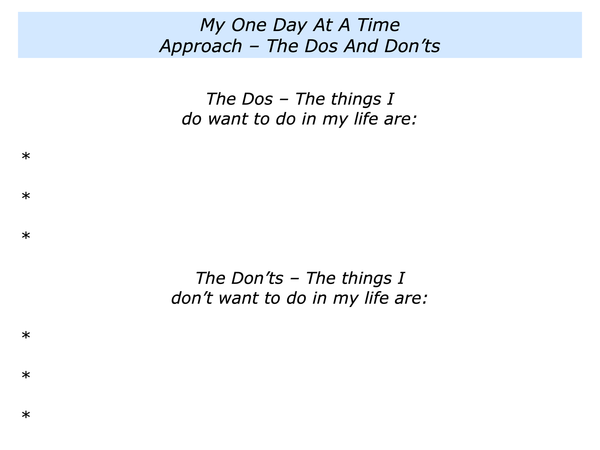
People who follow this approach sometime focus on the journey as well as reaching a certain goal. They may follow the philosophy that:
The journey is the destination and the destination is the journey.
Mihaly Csikszentmihalyi described how some people do this in his book Flow: The psychology of optimal experience. He says that such experiences are not limited to people doing creative activities.
Mihalyi describes how some people take this path when recovering from accidents. He cites a paper called Tragedies Transformed which is a study of paraplegics that was conducted by Professor Fausto Massimini.
Some said that their accident had produced both positive and negative consequences. Tragic events presented them with extremely clear goals and learning to live again was in itself a matter of pride.
People who mastered the fresh challenges experienced a clarity of purpose they had not felt before their accidents. They pursued this path on the way to rehabilitation.
Lucio had been a 20-year-old gas station attendant when a motorcycle accident paralysed him below the waist. He explained what he had done since the accident.
“When I became paraplegic, it was like being born again. I had to learn from scratch everything I used to know, but in a different way.
“I had to learn to dress myself, to use my head better. I had to become part of the environment, and use it without trying to control it. It took commitment, willpower and patience.
“As far as the future is concerned, I hope to keep improving, to keep breaking through the limitations of my handicap.
“Everybody must have a purpose. After becoming a paraplegic, these improvements have become my life goal.”
There are many ways to live life. This can sometimes involve managing certain situations by going through the stages of rest, recognising your priorities and rehabilitation.
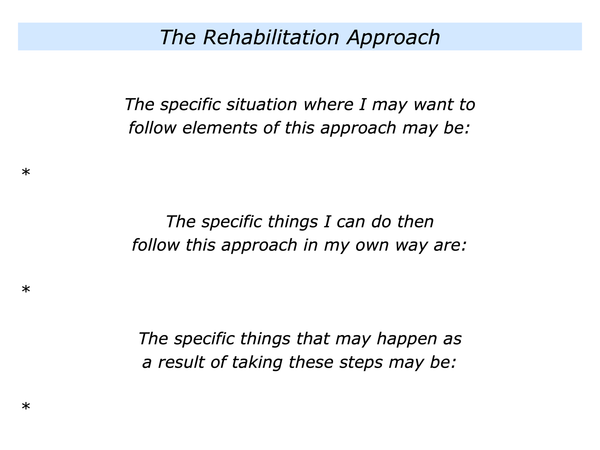
Looking ahead, can you think of a situation where you may want to follow elements of this approach? How can you do this in your own way? What may happen as a result of taking these steps?
If you wish, try tackling the exercise on this theme. This invites you to complete the following sentences.

Leave a Reply