



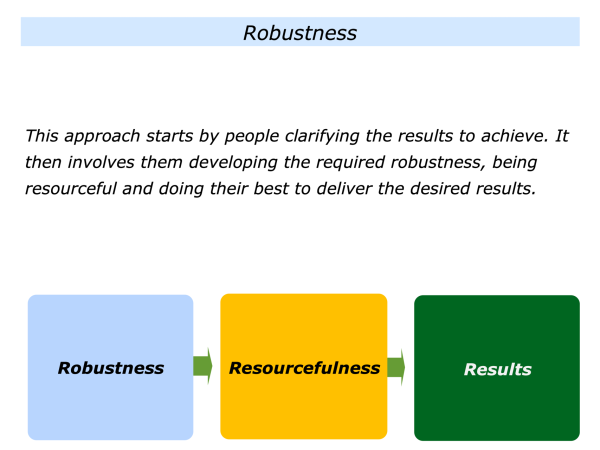
This approach starts by people clarifying the results they want to achieve. It then involves them developing the required robustness, being resourceful and doing their best to deliver the desired results.
Imagine that you lead an organisation that wants to follow elements of this approach. This can involve focusing on the following themes.
Results
The first step will be to clarify the results your organisation wants to achieve. One approach is to pick a date in the future and clarify the outcomes you want to achieve by that date.
Much depends, of course, on the kind of work the organisation is doing. A school, sports team, theatre group, startup business, commercial company or other organisation will have different goals.
Bearing this in mind, if you wish try tackling the exercise on this theme. First, pick a date in the future. Second, describe the specific results you want the organisation to deliver by that date.
Imagine that you have clarified the results to achieve. We can then focus begin focus on how people can do their best to achieve these goals. One approach is to begin by focusing on the following theme.
Robustness
Great workers often develop the robustness required to do their best to achieve the desired results. There are many definitions for this quality. Here is one view.
Robustness Is Demonstrating:
The strength and strategies required to keep functioning properly whilst dealing with different challenges on the way to achieving success.
Imagine that your organisation wants to develop this quality. One approach is to make sure it has the required resources and follows robust strategies that will help it to achieve its goals. Let’s explore these themes.
Resources
Great organisations do their best to try to get the resources required to reach the goals. The kinds of resources they need will obviously depend on the work they are doing.
Imagine that you lead an organisation. It will be important to, as far as possible, get the physical, practical and people resources required to deliver the goods. Getting these in place can provide the platform for achieving success.
Robustness
Great organisations aim to develop their robustness. They start by building on their strengths and find ways to manage the consequences of any weaknesses.
Such organisations aim to follow the strategies most likely to achieve the picture of success. They then stress test these strategies by rehearsing how to follow them in various challenging scenarios.
Imagine that you lead an organisation. How can you do your best to get the required resources? How can you help your organisation and your people to develop robustness?
If you wish, try tackling the exercise on this theme. This invites you to complete the following sentences.
Resourcefulness
Great workers continually use their radar to see what is happening and what might happen. They then use their resourcefulness to do their best to achieve the desired results. Let’s explore these themes.
Radar
Such workers sometimes seem to know what will happen before it happens. They use what is called their personal radar to keep scanning situations.
They keep reading reality and are good at seeing patterns. They are then able: a) to see what is actually happening; b) to see what may happen. They then focus on the next step.
Resourcefulness
Great workers are good at managing both present and possible future events. They have a wide repertoire of strategies and skills they can use in such situations.
Such people focus on the real results to achieve in both the short and long-term. They then apply their creativity in a resourceful way to do their best to get the desired results.
Great organisations educate their people to take similar steps. They encourage them to develop their radar to what is happening and what could happen. They then encourage people to use their resourcefulness to deliver the goods.
Imagine that you lead an organisation. How can you ensure that your organisation and people take similar steps? If you wish, try tackling the exercise on this theme.
Results
Great organisations encourage and enable their people to keep doing good work. Sometimes this involves encouraging people to revitalise themselves and then do their best to deliver the desired results. Let’s explore these themes.
Revitalisation
Great workers often follow a certain routine. They keep following their rhythm and, when appropriate, deal with random events. But there may also be times when they need to revitalise themselves.
Great organisations encourage their people to perform superb work. They also recognise, however, that it can be important to help their people to feel revitalised. Different organisations do this in different ways.
Some organisations create inspiring events where they remind people of the purpose, principles and picture of success. They then provide people with the support they need to deliver the goods.
Some organisations encourage people to find their own ways of revitalising themselves. They continue to help people to deliver their agreed contributions but also provide lots of tools that people can use to take care of their wellbeing.
Results
Great organisations build on people’s strengths. They make clear contracts with people about their best contributions. They also give them the support they need to do the job.
Then then manage by outcomes rather than by tasks. They encourage people to perform superb work, find solutions to challenges and do their best to achieve the agreed outcomes.
Such organisations keep sharing success stories. They highlight when people have demonstrated resourcefulness, for example, and how they can follow these principles to deliver future success.
Imagine that you lead an organisation. How can you encourage your people to, when appropriate, revitalise themselves? How can you then encourage them to do their best to deliver the desired results?
If you wish, try tackling the final exercise on this theme. This invites you to complete the following sentences.

Leave a Reply