



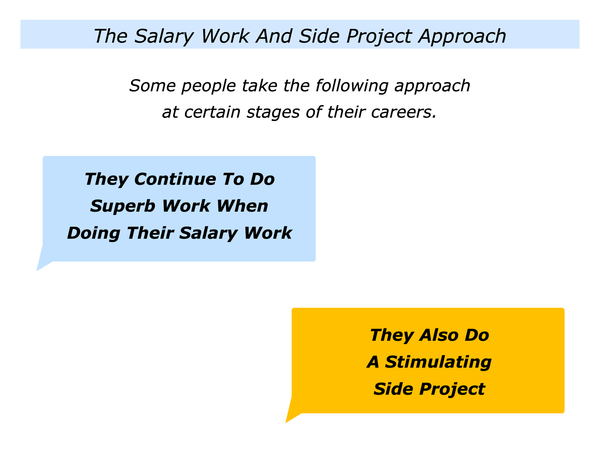
There are many ways to shape your career. One approach is for a person to continue to perform superb work in the role that earns them a salary. They may also, when appropriate, aim to do a stimulating side project.
Different people may follow this approach at different stages in their careers. Some people may do so for one or more of the following reasons.
They may be doing relatively satisfying work but be in a situation where there are limited opportunities to develop.
They may be at a stage where, as some point, they want to move on to another role inside or outside an organisation.
They may want to do a project or develop a prototype that could form the basis for the next step in their career or for building a business.
Different people take different steps when following this approach. Let’s explore how they may translate these into action.
They Continue To Do Superb
Work In Their Salary Work
Some people who take this approach continue to do superb work in the day job that earns a salary. It is important, however, that their day job involves doing some satisfy work.
Such individuals may stay in their present role for two reasons. First, they see it as a way to earn money and pay the mortgage. Second, they see it as their moral duty to do professional work to help the organisation to achieve its goals.
Some individuals may find it more challenging, however, if much of their day job involves doing soul destroying work. It can then become a matter of urgency to explore ways to move on.
There may be several reasons why a person reaches the stage where they consider doing a side project. During a mentoring session, one mentee expressed this in the following way.
“Our organisation has changed over the last few years. There was a time when we had some freedom to operate providing we delivered the goods. This also enabled us to develop.
“As the organisation has got bigger, however, there has been more micromanaging from the top. The organisation says it wants people to continue to be creative, but many feel like they are just cogs in a wheel.
“I recognise that every organisation has a Scorecard which is then passed down to each department. Whilst this is understandable, the Scorecard has become more detailed and prescriptive.
“Previously the organisation encouraged people to just focus on the ‘What’ – the outcomes to deliver. It also gave them some freedom regarding how they could use their strengths to deliver these results.
“The Scorecard has now moved to telling people ‘How’ they should deliver the results. This has also encouraged the managers to move into more of a micromanaging mode.”
The person and I looked ahead to explore their possible options going forwards. Each option had both pluses and minuses. Here are some of the routes they could consider.
Option A
The person could choose to accept that this is what often happens in organisations as they get bigger. They could decide stay in their present role, do the tasks and accept the good salary.
Option B
They could explore potential roles in other organisations. This could be challenging in the present market, however, and there was no guarantee that it would lead to more job satisfaction.
Option C
They could continue to be professional and, at the same time, explore the possibilities of doing a side project within the organisation. Such a project must obviously contribute to helping the organisation to achieve its goals.
Option D
They could make a radical career shift. They could aim to go freelance, do contracting work or set up their own business. They could then do a project that acted as a prototype for making such a career shift.
The person considered the attractiveness of each route and rated these on a scale 0-10. They decided to continue to be professional in their present role but begin to do a stimulating side project in their spare time.
Each person takes their own route when shaping their career. As mentioned above, however, some individuals to be professional when performing their salary work. They may also explore the following step.
They Do A Stimulating Side Project
Different people do different kinds of side projects. Some may already do stimulating projects in their personal lives. They may devote lots of time to their hobbies, gardening, sports, the arts or other activities.
Some people do stimulating projects that can shape their professional lives. They may gain qualifications, expand their skills, publish a blog, have a website, earn money from an extra job or do other activities.
There are certain guidelines it can be useful to bear in mind when planning to do a stimulating side project. Let’s explore these themes.
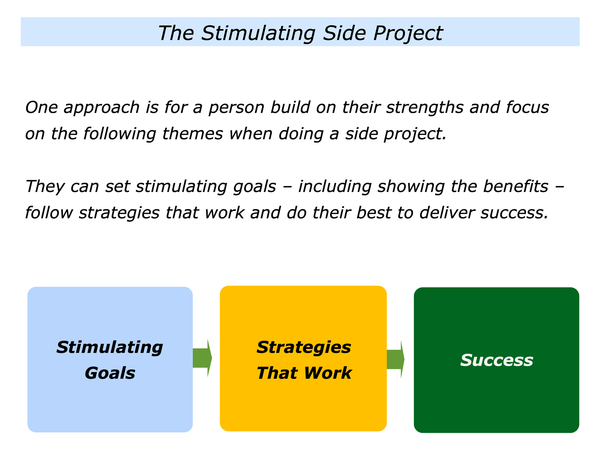
People who do such projects start by building on their strengths. They take this approach when aiming to do a project within an organisation or alongside other professional activities. They then focus on the following themes.
They Set Stimulating Goals
People who take this approach set stimulating goals. They may do this in their personal life by aiming to run a marathon, raise money for charity, climb a mountain or do a creative activity.
Some may do this in their professional life. They may aim to learn a skill, gain a qualification, start a business, turnaround a company, lead a sports team to success or reach another goal.
Some people may aim to do a side project within an organisation. They may stand a greater chance of this being given the go ahead, however, if can show how it complements the strategy. They may then need:
To describe the project’s picture of success;
To describe the positive benefits of achieving the picture of success;
To describe how it will contribute to helping the organisation to achieve its picture of success.
Imagine that a person has set stimulating goals and has clarified the positive benefits. They may then move on to the next stage.
They Follow Strategies That Work
This can be the challenging part. How to deliver the goods? Much depends, of course, on the kind of side project. Whatever it is, however, some individuals ask themselves the following questions.
What are the real results I want to achieve? What will be happening that will show I have achieved the stimulating goals? What are the key strategies I can follow to give myself the greatest chance of success?
What do we know works in these situations? Looking back, when have I or other people tackled such situations successfully? What did I or other people do right then?
What were the principles that were followed? How were these translated into action? How can I follow similar principles – plus maybe add other skills – to tackle the present situation successfully?
What are the strategies I therefore want to follow? How can I translate these into an action plan? How can I get some early wins? How can I maintain the momentum on the way to the goals?
Imagine that a person has made their action plan. They may then aim to get some early successes, follow their strategies and do superb work. This can then lead to the next stage.
They Do Their Best
To Deliver Success
People who take this approach then do their best to deliver the goods. Much depends, of course, on the kind of project they are doing. Bearing this in mind, however, some people focus on the following themes.
They keep following their chosen strategy. At the same time, they keep reading reality. They aim to build on what is working and to tackle areas for improvement.
They also buy time to think when faced by unexpected challenges. They then aim: a) to clarify the possible options going forwards; b) to follow their chosen option.
Some people may also follow their successful pattern for finishing. Looking back, they clarify when they have finished things successfully. They clarify what they did right then to deliver the goods.
They then aim to follow similar principles – plus maybe add other skills – to finish the present project successfully. Such people may then also do something special to add that touch of class.
As mentioned earlier, they are many kinds of side projects. The following section looks at two approaches the people may follow.
The Sharing Knowledge And
Shop Window Side Projects
Some people do a side project that involves creating an attractive website. Different people do this for different reasons. Whatever route they follow, however, they start by clarifying the purpose of the website. Let’s look at two examples.
The Sharing Knowledge Approach
Some people may simply aim to pass on knowledge to other people. Such individuals often come from an educational tradition. They want to share knowledge that can help other people to succeed.
They may do this when working as a teacher, therapist, coach, mentor, medic, trusted advisor or in another role. They aim to share positive models and practical tools that other people can use to reach their goals.
The Shop Window Approach
Some people have a more commercial approach. They aim to create a blog or website that shows what they can offer to potential customers. Bearing this in mind, they may describe the following things.
* The What
The specific outcomes they aim to deliver – and the benefits – to help people to achieve success.
* The How
The specific principles they follow to help people to achieve success.
* The Who
The specific kinds of people who may benefit and helped to achieve success.
Such individuals recognise that people buy success rather than the theory of success. They therefore include some success stories that bring the ideas and may resonate with the potential target group.
There are many ways to shape your career. One approach is for a person to continue to perform superb work in the role that earns them a salary. They may also, when appropriate, aim to do a stimulating side project.
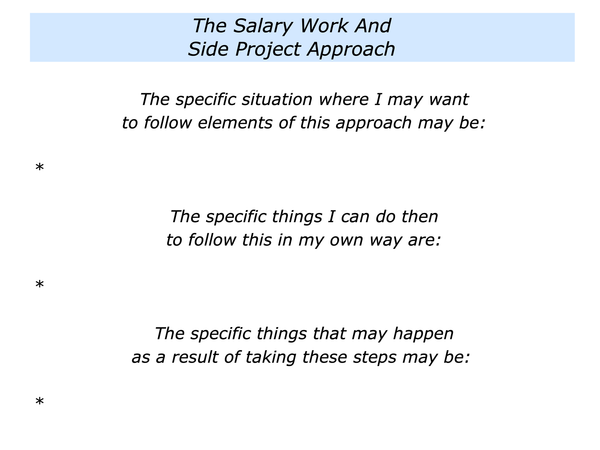
Let’s return to your own life and work. Imagine that you want to follow elements of this approach. How could you do this in your own way? What may happen as a result?
If you wish, try tackling the exercise on this theme. This invites you to complete the following sentences.

Leave a Reply