



There are many ways to live life. These can sometimes involve having serendipity experiences. Such events can lead to discovering things by chance and following new paths in life.
The Oxford Language Club website provides some excellent background about the origin of the word serendipity. Here is an excerpt from its description.
Serendipity is a word that carries a delightful sense of surprise and serendipitous discoveries. Its origins can be traced back to the mid-18th century when Horace Walpole coined it in a letter to describe unexpected findings.
Inspired by the Persian fairy tale “The Three Princes of Serendip,” Walpole used the word to encapsulate the idea of making fortunate discoveries while searching for something unrelated.
In modern usage, serendipity refers to those beautiful moments when we stumble upon something valuable or meaningful entirely by chance.
There are many examples of this leading to creative breakthroughs. One of the most cited is Alexander Fleming’s discovery of penicillin, which came about after leaving a petri dish next to an open window.
This developed a mould that killed adjacent bacteria. Fleming went on to translate this discovery into developing penicillin. Many years later he wrote:
When I woke up just after dawn on September 28, 1928, I certainly didn’t plan to revolutionize all medicine by discovering the world’s first antibiotic, or bacteria killer. But I suppose that was exactly what I did.
Many songwriters describe a chance remark or event that led to producing a song. Mark Knopler, for example, ducked into a South London pub to escape the rain.
On stage was a band that playing to a relatively uninterested audience. The band enjoyed their gig, however, and called themselves as The Sultans of Swing. This became the inspiration for his own band’s first hit.
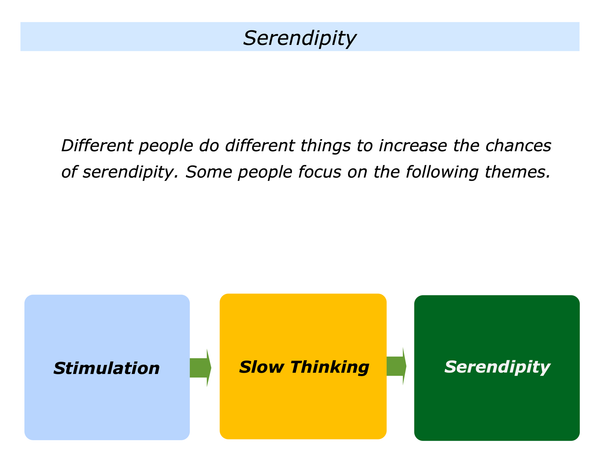
Some people aim to create serendipity but it can remain elusive. There are some things that people can do, however, to increase the chances of creating such moments.
Some people do things they find stimulating. Some is to set aside time for slow thinking or going off the beaten track. Let’s explore these themes.
Stimulation
The first step can be for people to do something they find stimulating. Different people will do different things when exploring this theme. Here are some that people may mention.
Stimulation – The specific things
that I find stimulating are:
To do things that give me positive energy … To focus on what I can control … To be grateful and count my blessings … To encourage people … To be generous … To write positive articles.
To go for a walk … To read inspiring stories … To listen to certain music … To be with my dogs … To sleep … To potter around … To do things that make my heart sing … To find solutions to specific challenges.
To paint … To cook food … To study success … To be with positive people … To listen to the sound of water … To play to my strengths … To work with certain clients … To pass on knowledge to people.
Some people find their true work by absorbing themselves in things they find stimulating. These can lead to serendipity and new pathways. Here is a summary of how one doctor featured on the television programme 24 Hours In A&E explained the path they took.
The Paediatrician’s Story
I have always been good at passing exams because I have a photographic memory. But it wasn’t until my early twenties that I discovered what I felt passionately about.
I took a year off to go travelling and eventually landed in the Greek islands. There I met many refugees and their families. I worked as a volunteer in the refugee camps and found I was good with children.
This prompted me to go back to university and study to become a paediatrician. I now work in the Accident & Emergency Department of a London hospital and love my work.
Some people find that stimulation can lead to experiencing something that sparks their imagination. They may then translate into action and follow a new pathway in life. Let’s explore another approach.
Slow Thinking
Some people find that serendipity happens as a by-product of what Carl Honoré called slow thinking. This can involves slowing down, pottering around or going off the beaten track.
Carl explained that fast thinking often generates the pieces of the jigsaw. Sometimes slow thinking may be needed to make sense of the whole picture.
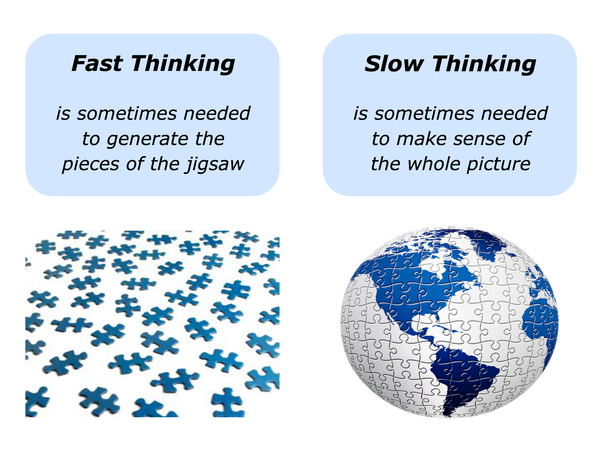
Different people do slow thinking in different ways. Creative people love their work time, for example, but they also love their wandering time. This comes in different forms, but it serves the function of opening their minds.
They may enjoy the physical process of wandering – such as walking, exploring or having new experiences. They may also enjoy other forms of wandering – such as thinking, learning, creating and imagining.
Some people simply enjoy pottering around. They may do this in their garden shed, explore ideas or even surf the internet. One definition of pottering around is:
To move about without hurrying and in a relaxed and pleasant way.
Sometimes a person may do this in a physical way. They may set off from their hotel in a city and discover new things when walking around the streets.
Sometimes a person may simply explore interesting ideas, books or experiences. Sometimes this can lead to them taking a different direction in their career. Let’s look at one example.
The Chief Executive’s Story
Donna was finishing a degree in chemistry and aimed to pursue this as a career. During her final year she visited a friend who invited her to a trade fair where companies where looking to hire graduates.
Accompanying her friend, Donna became interested the IBM stand. The company was demonstrating a new technology that they claimed could simplify people’s lives.
Donna tried the new technology. This led to further discussions, doing some interim work and joining the company. Being dyslexic and a good problem solver, much to her surprise she moved towards sales.
Donna was successful and was offered a role in another company. She became Sales Director and eventually the CEO. She then focused on a different kind of chemistry. This involved coordinating the company’s strengths and people to help it to achieve success.
Serendipity
Serendipity can happen in many situations. As mentioned earlier, it can be helped by doing things you find stimulating or doing some slow thinking. But sometimes it may simply happen by chance.
Looking at my own life, this happened more than thirty years ago when I was running leadership workshops for a large company. One day the CEO mentioned they wanted to do a mentoring programme for people across the business. They had made a start but things were not going to plan.
The CEO casually asked if I knew anything about mentoring. This was something I had done on an informal basis, but not in terms of developing a training programme.
Within half an hour we clarified the goals for doing mentoring workshops for mentors and mentees. This led to me running sessions and eventually writing the book The Art Of Mentoring. This formed the basis for my work for the next thirty years.
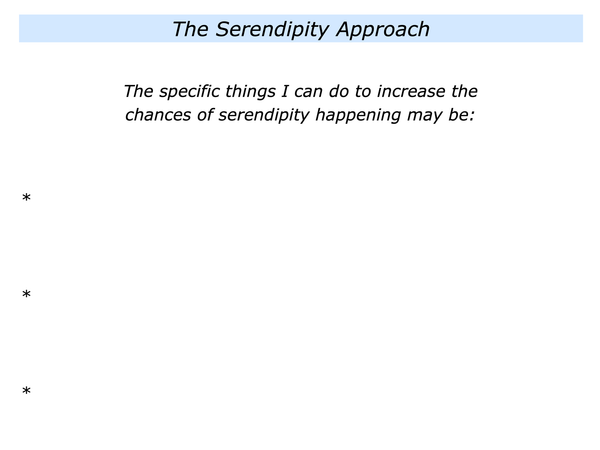
Let’s return to your own life and work. Imagine that you may want to increase the chances of experiencing serendipity. How can you do this in your own way?
If you wish, try tackling the exercise on this theme. This invites you to complete the following sentences.

Leave a Reply